Comparative Study
. 2005 Oct;78(4):862-70.
doi: 10.1189/jlb.1004583. Epub 2005 Aug 4.

Enhanced superoxide release and elevated protein kinase C activity in neutrophils from diabetic patients: association with periodontitis

Affiliations
Comparative Study

Enhanced superoxide release and elevated protein kinase C activity in neutrophils from diabetic patients: association with periodontitis

M Karima et al. J Leukoc Biol. 2005 Oct.

Abstract

Inflammation and oxidative stress are important factors in the pathogenesis of diabetes and contribute to the pathogenesis of diabetic complications. Periodontitis is an inflammatory disease that is characterized by increased oxidative stress, and the risk for periodontitis is increased significantly in diabetic subjects. In this study, we examined the superoxide (O(2)(-))-generating reduced nicotinamide adenine dinucleotide phosphate-oxidase complex and protein kinase C (PKC) activity in neutrophils. Fifty diabetic patients were grouped according to glycemic control and the severity of periodontitis. Neutrophils from diabetic patients with moderate [amount of glycated hemoglobin (HbA(1c)) between 7.0% and 8.0%] or poor (HbA(1c) >8.0%) glycemic control released significantly more O(2)(-) than neutrophils from diabetic patients with good glycemic control (HbA(1c) <7.0%) and neutrophils from nondiabetic, healthy individuals upon stimulation with 4beta-phorbol 12-myristate 13-acetate or N-formyl-Met-Leu-Phe. Depending on glycemic status, neutrophils from these patients also exhibited increased activity of the soluble- and membrane-bound forms of PKC, elevated amounts of diglyceride, and enhanced phosphorylation of p47-phox during cell stimulation. In addition, we report a significant correlation between glycemic control (HbA(1c) levels) and the severity of periodontitis in diabetic patients, suggesting that enhanced oxidative stress and increased inflammation exacerbate both diseases. Thus, hyperglycemia can lead to a novel form of neutrophil priming, where elevated PKC activity results in increased phosphorylation of p47-phox and O(2)(-) release.


Figures
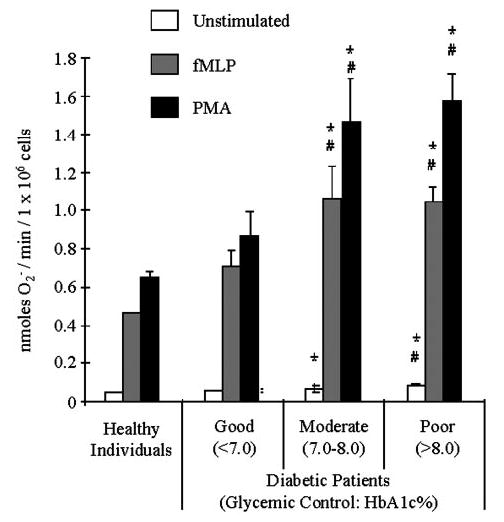
Fig. 1
Fig. 1
Neutrophils from diabetic subjects generate more O2 anion. Diabetic individuals were grouped into three categories based on glycemic control as defined by the American Diabetes Association. Rates of O2 release by neutrophils obtained from healthy individuals and patients with good (HbA1c 3 7.0%), moderate (HbA1c between 7.0% and 8.0%), and poor (HbA1c >8.0%) glycemic control are presented. Cells were stimulated with 1.0 μM fMLP or 300 nM PMA, and O2 release was measured as described in Materials and Methods. Neutrophils from diabetic patients with moderate and poor glycemic control exhibited greater release of O2 than neutrophils from patients with well-controlled diabetes or healthy individuals. (*, P<0.05, compared with healthy; #, P<0.05, compared with well-controlled diabetics.)
Fig. 2
Fig. 2
O2 release by diabetic neutrophils is not insulin-dependent. Cells were stimulated with 1.0 μM fMLP or 300 nM PMA, and O2 release was measured as described in Materials and Methods. No differences in O2 release were observed between patients with type 1 and type 2 DM. These data include patients with good, moderate, and poor glycemic control.
Fig. 3
Fig. 3
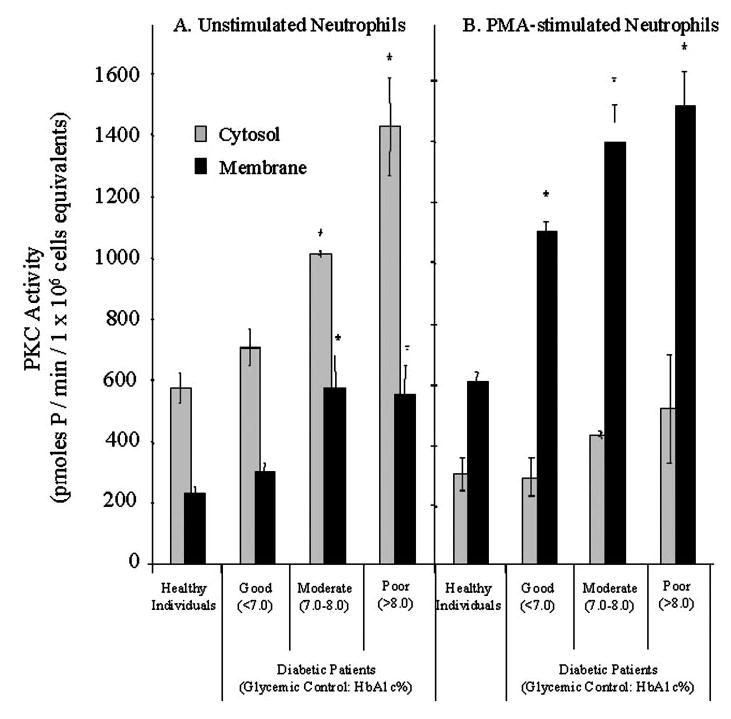
Ca2+-dependent PKC activity is increased in membranes of neutrophils from diabetic patients. Ca2+-dependent PKC activity was measured under optimal conditions in the 100,000 g soluble and membrane fractions of unstimulated (A) and stimulated neutrophils (B), which were stimulated with PMA (300 nM) for 10.0 min. (A) Unstimulated neutrophils from diabetic patients with moderate and poor glycemic control exhibited significantly higher PKC activity than neutrophils from healthy subjects and patients with well-controlled diabetes (#, P<0.05). (B) Redistribution of PKC activity from the soluble to the membrane fraction in PMA-stimulated neutrophils was significantly greater in cells from diabetic patients compared with healthy individuals, independent of glycemic control (*, P<0.05). Procedures for cell fractionation and the assaying Ca2+-dependent PKC activity are described in Materials and Methods.
Fig. 4
Fig. 4
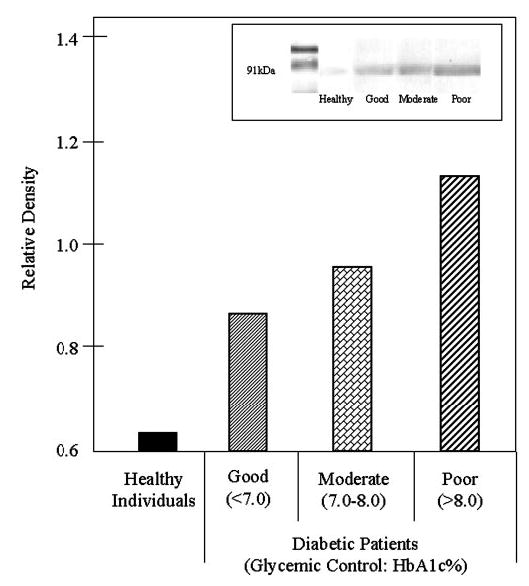
Total neutrophil PKC increases with poor glycemic control. Neutrophils were evaluated by Western blotting using an affinity-purified polyclonal antibody specific for PKC (inset). Band density was quantified by densitometry. The data reveal that PKC total protein is increased in diabetics, and the increase is associated with glycemic control.
Fig. 5
Fig. 5
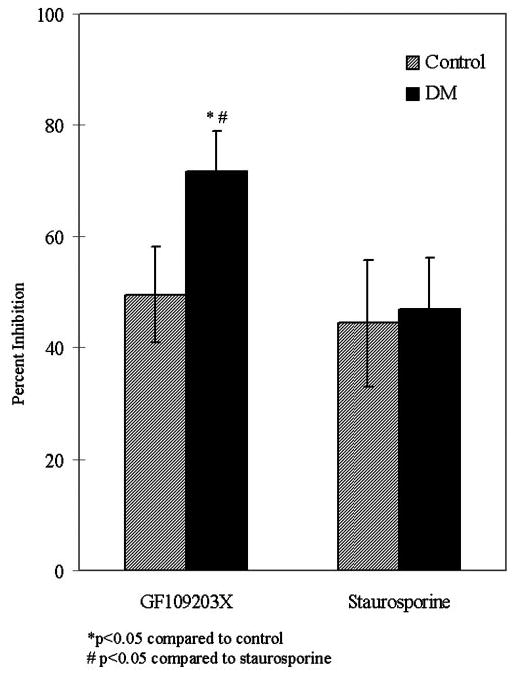
Inhibition of PKC suppresses O2 generation in healthy individuals and diabetic patients. Peripheral blood neutrophils were treated with GF109203X, a selective inhibitor of PKC-α,-β 1, and -β2 at 5 μM for 15 min, or staurosporine, a nonspecific, potent inhibitor of kinases at 0.1 μM for 10 min. O2 generation was then analyzed in response to fMLP (1.0 μM). GF109203X inhibited PKC activation ~50% more in diabetics compared with healthy individuals (*, P<0.05). Staurosporine inhibition was less effective, and there was no difference between patients and healthy control individuals. The effect of GF109203X on diabetic neutrophils was also significantly higher than the staurosporine-treated cells (#, P<0.05).
Fig. 6
Fig. 6
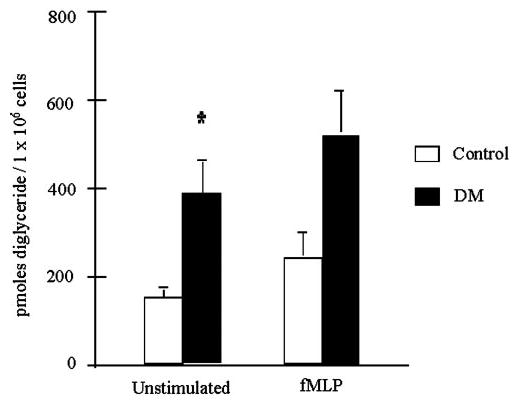
Diglycerides in neutrophils from diabetic patients and healthy, nondiabetic individuals. Diglyceride was measured in neutrophils from healthy individuals and diabetic patients before and after cell stimulation with 1.0 μM fMLP for 5.0 min. Unstimulated neutrophils from diabetic patients contained significantly more diglyceride than unstimulated neutrophils from healthy individuals (P<0.01). The diabetic patients used in these studies included individuals with good, moderate, and poor glycemic control. Diglyceride was measured as described in Materials and Methods.
Fig. 7
Fig. 7
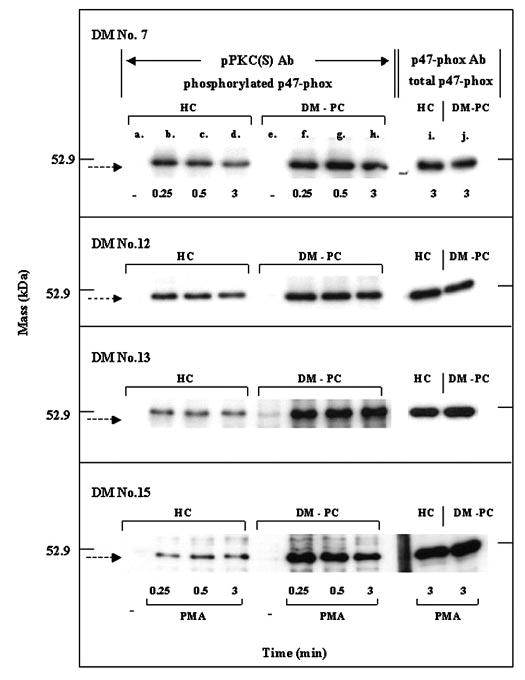
Phosphorylation of p47-phox in normal neutrophils and neutrophils from diabetic patients with poor glycemic control monitored by Western blotting with a pAb. Neutrophils from healthy individuals (HC; lanes a–d) and diabetes patients with poor glycemic control (DM-PC; lanes e–h) were stimulated with 300 nM PMA for the time periods indicated, and phosphorylation of p47-phox was measured by Western blotting with the pPKC (S) Ab. Neutrophils from the patients and healthy individuals were isolated and stimulated simultaneously. Lanes i and j show the total amount of p47-phox in these subjects monitored with an antibody that recognizes the phosphorylated and nonphosphorylated forms of this protein. Data from four different patients are presented. Conditions for cell stimulation and Western blotting are provided in Materials and Methods.
Fig. 8
Fig. 8
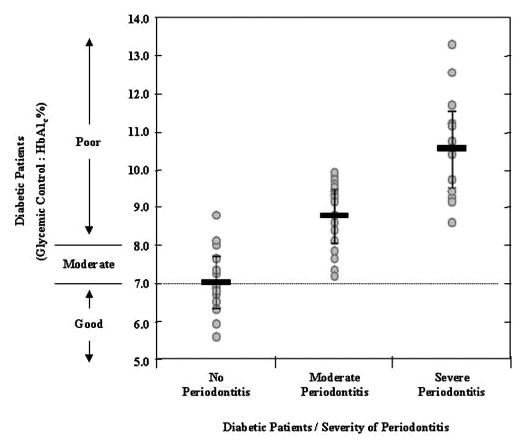
The severity of periodontitis is increased with poor glycemic control on diabetes. The mean level of HbA1c increases significantly as the severity of periodontitis increases (r = 0.71, P<0.001). The broken line indicates the threshold for “strict glycemic control” as the “treatment goal” recommended by American Diabetes Association. Diabetics with severe periodontitis have significantly higher HbA1c percent levels compared with diabetics with no periodontal disease (DM-NP; *, P<0.001) and those with moderate periodontitis (#, P<0.005). The severity of periodontitis was assessed by measuring “pocket depth” on two nonadjacent teeth as described in Materials and Methods. Chronic periodontitis alone did not lead to increased O2 production (data not shown). Data presented here were adjusted for the duration of diabetes.

References

    1. Zimmet P, Alberti KG, Shaw J. Global and societal implications of the diabetes epidemic. Nature. 2001;414:782–787. - PubMed
    1. Gillum RF, Mussolino ME, Madans JH. Diabetes mellitus, coronary heart disease incidence, and death from all causes in African American and European American women: The NHANES I epidemiologic follow-up study. J Clin Epidemiol. 2000;53:511–518. - PubMed
    1. Robinson JM, Badwey JA. The NADPH oxidase complex of phagocytic leukocytes: a biochemical and cytochemical view. Histochem Cell Biol. 1995;103:163–180. - PubMed
    1. Allen LA, DeLeo FR, Gallois A, Toyoshima S, Suzuki K, Nauseef WM. Transient association of the nicotinamide adenine dinucleotide phosphate oxidase subunits p47phox and p67phox with phagosomes in neutrophils from patients with X-linked chronic granulomatous disease. Blood. 1999;93:3521–3530. - PubMed
    1. Groemping Y, Lapouge K, Smerdon SJ, Rittinger K. Molecular basis of phosphorylation-induced activation of the NADPH oxidase. Cell. 2003;113:343–355. - PubMed

Publication types