


Sensitivity of PCR targeting the IS2404 insertion sequence of Mycobacterium ulcerans in an Assay using punch biopsy specimens for diagnosis of Buruli ulcer
- PMID: 16081892
- PMCID: PMC1233911
- DOI: 10.1128/JCM.43.8.3650-3656.2005
Sensitivity of PCR targeting the IS2404 insertion sequence of Mycobacterium ulcerans in an Assay using punch biopsy specimens for diagnosis of Buruli ulcer
Abstract
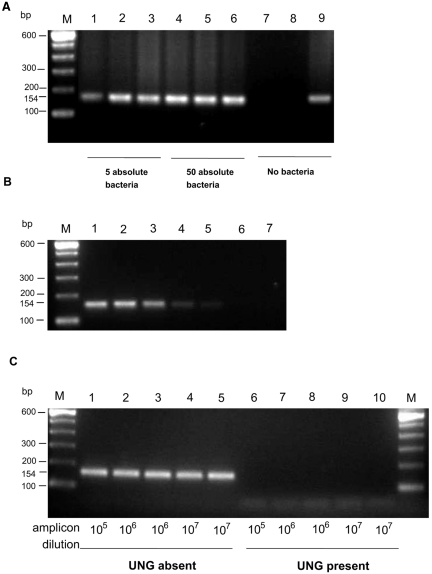
Punch biopsy specimens from Mycobacterium ulcerans disease lesions were used to compare the sensitivities and specificities of direct smear, culture, PCR, and histopathology in making a diagnosis of M. ulcerans disease in a field setting. PCR for the insertion element IS2404 was modified to include uracil-N-glycosylase and deoxyuridine triphosphate instead of deoxythymidine triphosphate to reduce the risk of cross contamination. The "gold standard" for confirmation of clinically diagnosed Buruli ulcer was a definite histological diagnosis, a positive culture for M. ulcerans, or a smear positive for acid-fast bacilli (AFB), together with a possible histological diagnosis. For 70 clinically diagnosed cases of M. ulcerans disease, the modified PCR was 98% sensitive and gave a rapid result. The sensitivities of microscopy, culture, and histology were 42%, 49%, and 82%, respectively. The use of a 4-mm punch biopsy specimen was preferred to a 6-mm punch biopsy specimen since the wound was less likely to bleed and to need stitching. Given adequate technical expertise and the use of controls, the PCR was viable in a teaching hospital setting in Ghana; and in routine practice, we would recommend the use of Ziehl-Neelsen staining of biopsy specimens to detect AFB, followed by PCR, in AFB-negative cases only, in order to minimize costs. Histology and culture remain important as quality control tests, particularly in studies of treatment efficacy.
Figures
References
-
- Arora, S. K., B. Kumar, and S. Sehgal. 2000. Development of a polymerase chain reaction dot-blotting system for detecting cutaneous tuberculosis. Br. J. Dermatol. 142:72-76. - PubMed
-
- Asiedu, K., R. Scherpbier, and M. Raviglione. 2000. Buruli ulcer: Mycobacterium ulcerans infection. World Health Organization, Geneva, Switzerland. [Online.] http://www.who.int/gtb-buruli/publications/index.html.
-
- Etuaful, S., B. Carbonnelle, J. Grosset, S. Lucas, C. Horsefield, R. Phillips, M. Evans, D. Ofori-Adjei, E. Klustse, J. Owusu-Boateng, G. K. Amedofu, P. Awuah, E. Ampadu, G. Amofah, K. Asiedu, and M. Wansbrough-Jones. 2003. Bactericidal activity of rifampicin and streptomycin treatment for early human M. ulcerans lesions, p. 10. In Report of the 6th WHO Advisory Group Meeting on Buruli ulcer meeting. [Online.] http://www.who.int/gtb-buruli/activities/meetings.htm.
-
- Evans, M. R., R. Phillips, S. N. Etuaful, G. Amofah, J. Adomako, O. Adjei, J. Dennis-Antwi, S. B. Lucas, and M. H. Wansbrough-Jones. 2003. An outreach education and treatment project in Ghana for the early stage of Mycobacterium ulcerans disease. Trans. R. Soc. Trop. Med. Hyg. 97:159-160. - PubMed
Publication types
MeSH terms
Substances
Grants and funding
LinkOut - more resources
Full Text Sources
Medical
