


Identification of medically important molds by an oligonucleotide array
- PMID: 16081907
- PMCID: PMC1233923
- DOI: 10.1128/JCM.43.8.3760-3768.2005
Identification of medically important molds by an oligonucleotide array
Abstract
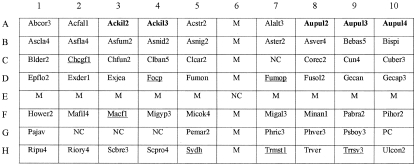
Infections caused by fungi have increased in recent years. Accurate and rapid identification of fungal pathogens is important for appropriate treatment with antifungal agents. On the basis of the internal transcribed spacer 1 (ITS 1) and ITS 2 sequences of the rRNA genes, an oligonucleotide array was developed to identify 64 species (32 genera) of clinically important filamentous (or dimorphic) fungi. These 64 species included fungi causing superficial, cutaneous, subcutaneous, and invasive infections. The method consisted of PCR amplification of the ITS regions using a pair of universal primers, followed by hybridization of the digoxigenin-labeled PCR products to a panel of species- or group-specific oligonucleotides immobilized on a nylon membrane. Of 397 fungal strains (290 target and 107 nontarget strains) tested, the sensitivity and specificity of the array was 98.3% (285/290) and 98.1% (105/107), respectively. Misidentified strains were usually those belonging to the same genus of the target species or having partial homology with oligonucleotide probes on the membrane. The whole procedure can be finished within 24 h starting from isolated colonies; reproductive structures, which are essential for the conventional identification methods, are not needed. In conclusion, the present array is a powerful tool for identification of clinically important filamentous fungi and may have the potential to be continually extended by adding further oligonucleotides to the array without significantly increasing the cost or complexity.
Figures
References
-
- Adamczyk, J., M. Hesselsoe, N. Iversen, M. Horn, A. Lehner, P. H. Nielsen, M. Schloter, P. Roslev, and M. Wagner. 2003. The isotope array, a new tool that employs substrate-mediated labeling of rRNA for determination of microbial community structure and function. Appl. Environ. Microbiol. 69:6875-6887. - PMC - PubMed
-
- Baddley, J. W., T. P. Stroud, D. Salzman, and P. G. Pappas. 2001. Invasive mold infections in allogeneic bone marrow transplant recipients. Clin. Infect. Dis. 32:1319-1324. - PubMed
-
- Barnes, R. A., D. W. Denning, E. G. V. Evans, R. J. Hay, C. C. Kibbler, A. G. Prentice, M. D. Richardson, M. M. Roberts, T. R. Rogers, D. C. Speller, D. W. Warnock, and R. E. Warren. 1996. Fungal infections: a survey of laboratory services for diagnosis and treatment. Commun. Dis. Rep. Rev. 6:R69-R75. - PubMed
-
- Brown, T. J., and R. M. Anthony. 2000. The addition of low numbers of 3′ thymine bases can be used to improve the hybridization signal of oligonucleotides for use within arrays on nylon supports. J. Microbiol. Methods 42:203-207. - PubMed
Publication types
MeSH terms
Substances
LinkOut - more resources
Full Text Sources
Other Literature Sources
Medical
