


Comment
doi: 10.1038/nbt0805-942.
Discovering DNA regulatory elements with bacteria
- PMID: 16082362
- PMCID: PMC2720157
- DOI: 10.1038/nbt0805-942
Item in Clipboard
Comment
Discovering DNA regulatory elements with bacteria
Nat Biotechnol.
2005 Aug.
No abstract available
Figures
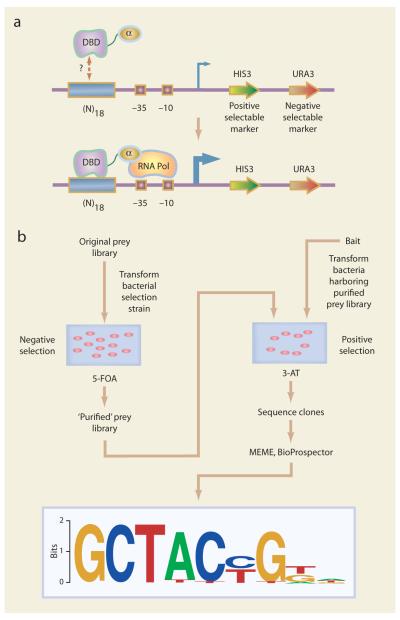
Schematic diagram of the bacterial one-hybrid selection. (A) A library of randomized 18 bp oligonucleotides are cloned upstream of the HIS3 (positive) and URA3 (negative) selectable markers, in a bacterial strain lacking the bacterial HIS3 and URA3 homologs (hisB and pyrF, respectively). A plasmid containing the DNA-binding domain (DBD) of a query transcription factor fused to the alpha subunit of RNA polymerase (the “bait”) is then transformed into bacteria harboring the prey library. If the query DNA-binding domain interacts with a prey DNA sequence, then RNA polymerase is recruited, resulting in the expression of the HIS3 and URA3 selectable marker genes. (Adapted from Meng et al.) (B) The original prey library of candidate DNA binding sites undergoes a round of negative selection on plates containing 5-FOA, in order to reduce the proportion of self-activating sequences. The resulting “purified” prey library is then transformed with the bait plasmid, and the bacteria then undergo positive selection at a range of stringencies by growing the cells on a series of plates spanning a range of 3-AT concentrations. Prey from individual colonies are then isolated and sequenced. The prey sequences are then examined with motif finding tools (MEME, BioProspector) in order to identify the DNA binding site motif of the query transcription factor.
Comment on
-
Design of a genome-wide siRNA library using an artificial neural network.Nat Biotechnol. 2005 Aug;23(8):995-1001. doi: 10.1038/nbt1118. Epub 2005 Jul 17. Nat Biotechnol. 2005. PMID: 16025102
References
-
- Dove SL, Joung JK, Hochschild A. Activation of prokaryotic transcription through arbitrary protein-protein contacts. Nature. 1997;386:627–630. - PubMed
-
- Wilson TE, Fahrner TJ, Johnston M, Milbrandt J. Identification of the DNA binding site for NGFI-B by genetic selection in yeast. Science. 1991;252:1296–1300. - PubMed
-
- Lieb JD, Liu X, Botstein D, Brown PO. Promoter-specific binding of Rap1 revealed by genome-wide maps of protein-DNA association. Nat. Genet. 2001;28:327–334. - PubMed
Publication types
MeSH terms
Substances
Grants and funding
LinkOut - more resources
Full Text Sources
