


Polymorphisms in cinnamoyl CoA reductase (CCR) are associated with variation in microfibril angle in Eucalyptus spp
- PMID: 16085705
- PMCID: PMC1456829
- DOI: 10.1534/genetics.105.042028
Polymorphisms in cinnamoyl CoA reductase (CCR) are associated with variation in microfibril angle in Eucalyptus spp
Abstract
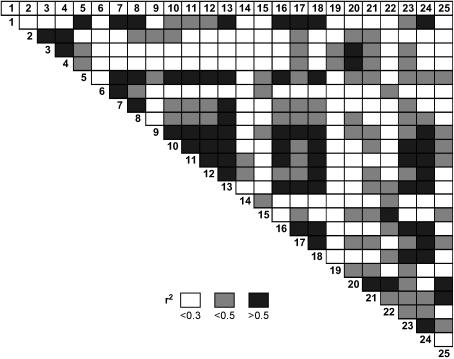
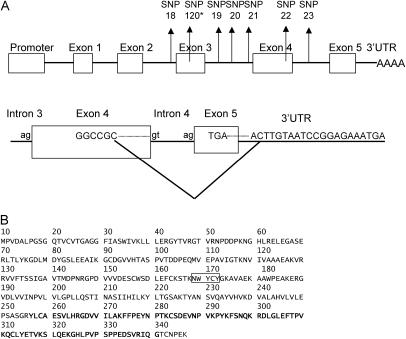
Linkage disequilibrium (LD) mapping using natural populations results in higher resolution of marker-trait associations compared to family-based quantitative trait locus (QTL) studies. Depending on the extent of LD, it is possible to identify alleles within candidate genes associated with a trait. Analysis of a natural mutant in Arabidopsis has shown that mutations in cinnamoyl CoA reductase (CCR), a key lignin gene, affect physical properties of the secondary cell wall such as stiffness and strength. Using this gene, we tested whether LD mapping could identify alleles associated with microfibril angle (MFA), a wood quality trait affecting stiffness and strength of wood. We identified 25 common single-nucleotide polymorphism (SNP) markers in the CCR gene in Eucalyptus nitens. Using single-marker and haplotype analyses in 290 trees from a E. nitens natural population, two haplotypes significantly associated with MFA were found. These results were confirmed in two full-sib families of E. nitens and Eucalyptus globulus. In an effort to understand the functional significance of the SNP markers, we sequenced the cDNA clones and identified an alternatively spliced variant from the significant haplotype region. This study demonstrates that LD mapping can be used to identify alleles associated with wood quality traits in natural populations of trees.
Figures
References
-
- Buckler, E. S., and J. M. Thornsberry, 2002. Plant molecular diversity and applications to genomics. Curr. Opin. Plant Biol. 5: 107–111. - PubMed
Publication types
MeSH terms
Substances
LinkOut - more resources
Full Text Sources
Molecular Biology Databases
Research Materials
Miscellaneous
