. 2005 Aug 16;102(33):11870-5.
doi: 10.1073/pnas.0502488102. Epub 2005 Aug 5.

Inactivation of phosphorylated endothelial nitric oxide synthase (Ser-1177) by O-GlcNAc in diabetes-associated erectile dysfunction

Affiliations

Inactivation of phosphorylated endothelial nitric oxide synthase (Ser-1177) by O-GlcNAc in diabetes-associated erectile dysfunction

Biljana Musicki et al. Proc Natl Acad Sci U S A. .

Abstract

Impaired endothelial nitric oxide synthase (eNOS) function is associated with erectile dysfunction in diabetes mellitus, but the exact molecular basis for the eNOS defect in the diabetic penis remains unclear. We investigated whether hyperglycemia increases O-GlcNAc modification of eNOS in the penis, preventing phosphorylation at the primary positive regulatory site on the enzyme and hampering mechanisms of the erectile response. Type I diabetes mellitus was induced in male rats by alloxan (140 mg/kg, i.p.). After 5 wk, the diabetic rat penis exhibited increased O-GlcNAc modification of eNOS and decreased eNOS phosphorylation at Ser-1177 at baseline compared with the control rat penis; eNOS phosphorylation at Thr-495, Ser-615, and Ser-633 was not affected. In addition, eNOS phosphorylation at Ser-1177 was impaired in the diabetic rat penis in response to penile blood flow (shear stress) elicited by electrical stimulation of the cavernous nerve (ES) and to recombinant human VEGF165. Phosphorylation of Akt, a mediator of shear stress-induced eNOS phosphorylation at Ser-1177, was decreased in the diabetic penis at baseline, but it was restored by ES. Erectile response to shear stress elicited by ES and to VEGF was decreased in diabetic compared with control rats. This work demonstrates that eNOS inactivation occurs in the diabetic penis by a glycosylation mechanism specifically at Ser-1177, by which the enzyme is rendered incapable of activation by fluid shear stress stimuli and VEGF signaling. In vivo penile erection paradigm supports the physiologic relevance of O-GlcNAc modification in vascular disorders associated with diabetes.


Figures
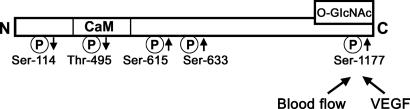
Fig. 1.
Fig. 1.
A model of eNOS phosphorylation sites, a proposed site of O-GlcNAc, and the site of action of blood flow-induced shear stress and VEGF on eNOS. Arrows indicate increase or decrease of the activity of the enzyme upon phosphorylation.
Fig. 2.
Fig. 2.
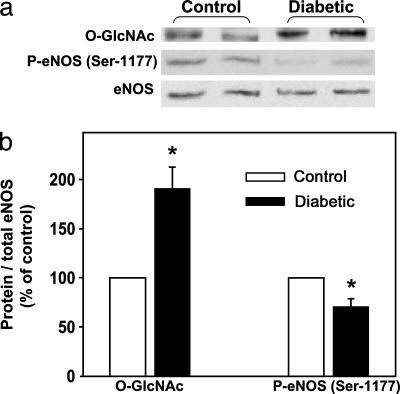
O-GlcNAc modification of eNOS is increased, and P-eNOS (Ser-1177) is decreased in the diabetic rat penis. Flaccid, nonerect penes (at baseline) were excised 5 wk after the induction of diabetes by alloxan (140 mg/kg). O-GlcNAc and P-eNOS were examined in partially purified penile homogenates by Western blotting. (a) Representative Western immunoblot of O-GlcNAc, P-eNOS (Ser-1177), and total eNOS in penes of control and diabetic rats at baseline. (b) Quantitative densitometry of O-GlcNAc and P-eNOS (Ser-1177) in penes of control and diabetic rats at baseline. Results are expressed as the ratio of P-eNOS (Ser-1177) to total eNOS and O-GlcNAc to total eNOS. Values are normalized to controls. n = 6; *, P < 0.05 compared with controls.
Fig. 3.
Fig. 3.
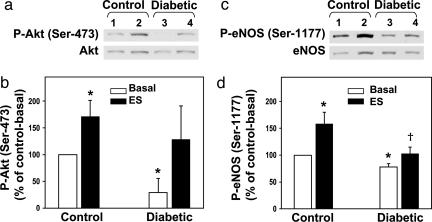
eNOS (Ser-1177), but not Akt (Ser-473), phosphorylation is impaired in the diabetic penis in response to shear stress elicited by ES. (a and c) Representative Western immunoblots. (b and d) A quantitative densitometry of P-Akt (Ser-473) and P-eNOS (Ser-1177), respectively, in penes of control and diabetic rats at baseline (lanes 1 and 3, respectively) and in penes of control and diabetic rats after ES (lanes 2 and 4, respectively). Results are expressed as the ratio of P-Akt to total Akt and P-eNOS to total eNOS. Values are normalized to controls; n = 5-7; *, P < 0.05 vs. control-basal; †, P < 0.05 vs. control-ES.
Fig. 4.
Fig. 4.
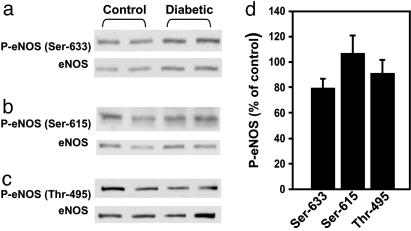
Phosphorylation of eNOS at Ser-633, Ser-615, and Thr-495 in penes is not affected by diabetes. (a-c) Representative Western immunoblots of eNOS phosphorylation sites and total eNOS. (d) A quantitative densitometry of eNOS phosphorylated at Ser-633, Ser-615, and Thr-495 in penes of control and diabetic rats at baseline. Results are expressed as the ratio of P-eNOS to total eNOS. Values are normalized to controls; n = 4-6.
Fig. 5.
Fig. 5.
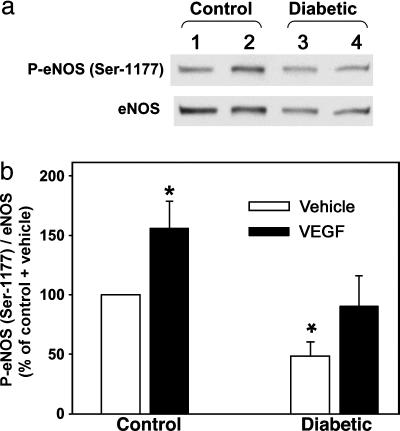
eNOS (Ser-1177) phosphorylation by VEGF is impaired in the diabetic penis. rhVEGF165 (0.5 μg) or vehicle was injected into the corpus cavernosum 25 min before penes collection at baseline. (a) Representative Western immunoblot of P-eNOS (Ser-1177) and total eNOS. (b) Quantitative densitometry of P-eNOS (Ser-1177) in penes of control and diabetic rats treated with vehicle (lanes 1 and 3, respectively) and in penes of control and diabetic rats treated with VEGF (lanes 2 and 4, respectively). Results are expressed as the ratio of P-eNOS (Ser-1177) to total eNOS. Values are normalized to controls; n = 6-7; *, P < 0.05 vs. control-vehicle.
Fig. 6.
Fig. 6.
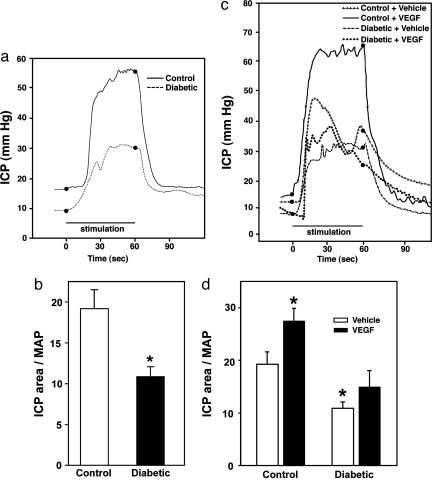
Erectile response to shear stress and VEGF is impaired in diabetic rats. (a) Representative ICP responses to 6 V ES. (b) Quantitative analysis of the erectile response to shear stress elicited by ES (6 V, 1 min) in control and diabetic rats. (c) Representative ICP responses to VEGF during 3 V ES. (d) Quantitative analysis of the erectile response to VEGF during submaximal ES (3 V, 1 min) in control and diabetic rats. The stimulus interval is indicated by a solid bar. ICP area, expressed per mean arterial pressure, is defined as the area under the curve, which corresponds to the duration of ES (full erectile status). n = 6; *, P < 0.05 compared with controls.

References

    1. Hurt, K. J., Musicki, B., Palese, M. A., Crone, J. K., Becker, R. E., Moriarity, J. L., Snyder, S. H. & Burnett, A. L. (2002) Proc. Natl. Acad. Sci. USA 99, 4061-4066. - PMC - PubMed
    1. Musicki, B., Palese, M. A., Crone, J. K. & Burnett, A. L. (2004) Biol. Reprod. 70, 282-289. - PubMed
    1. Harris, M. B., Ju, H., Venema, V. J., Liang, H., Zou. R., Michell, B. J., Chen, Z. P., Kemp, B. E. & Venema, R. C. (2001) J. Biol. Chem. 276, 16587-16591. - PubMed
    1. Michell, B. J., Chen, Z., Tiganis, T., Stapleton, D., Katsis, F., Power, D. A., Sim, A. T. & Kemp, B. E. (2001) J. Biol. Chem. 276, 17625-17628. - PubMed
    1. Fleming, I., Fisslthaler, B., Dimmeler, S., Kemp, B. E. & Busse, R. (2001) Circ. Res. 88, E68-E75. - PubMed

Publication types

MeSH terms