


Coronary microvascular dysfunction in male patients with Anderson-Fabry disease and the effect of treatment with alpha galactosidase A
- PMID: 16085718
- PMCID: PMC1860797
- DOI: 10.1136/hrt.2004.054015
Coronary microvascular dysfunction in male patients with Anderson-Fabry disease and the effect of treatment with alpha galactosidase A
Abstract
Objective: To measure coronary flow reserve (CFR), an index of microvascular function, in Anderson-Fabry disease (AFD) at baseline and after enzyme replacement therapy (ERT).
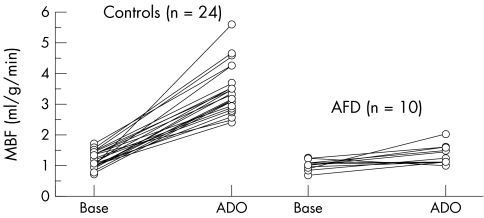
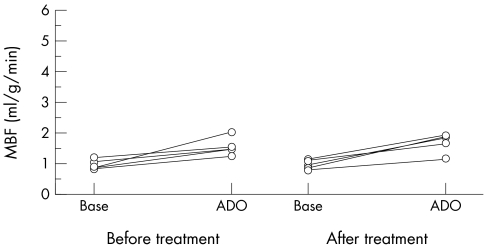
Methods and results: Mean (SD) myocardial blood flow (MBF) at rest and during hyperaemia (adenosine 140 microg/kg/min) was measured in 10 male, non-smoking patients (53.8 (10.9) years, cholesterol 5.5 (1.3) mmol/l) and in 24 age matched male, non-smoking controls (52.0 (7.6) years, cholesterol 4.5 (0.6) mmol/l) by positron emission tomography (PET). Resting and hyperaemic MBF and CFR (hyperaemic/resting MBF) were reduced in patients compared with controls (0.99 (0.17) v 1.17 (0.25) ml/g/min, p < 0.05; 1.37 (0.32) v 3.44 (0.78) ml/g/min, p < 0.0001; and 1.41 (0.39) v 3.03 (0.85), p < 0.0001, respectively). This coronary microvascular dysfunction was independent of cholesterol concentrations. PET was repeated in five patients after 10.1 (2.3) months of ERT; resting and hyperaemic MBF and CFR were unchanged after ERT (0.99 (0.16) v 0.99 (0.16) ml/g/min; 1.56 (0.29) v 1.71 (0.3) ml/g/min; and 1.6 (0.37) v 1.74 (0.28), respectively; all not significant).
Conclusions: The results of the present study show that patients with AFD have very abnormal coronary microvascular function. These preliminary data suggest that ERT has no effect on coronary microvascular dysfunction. Further work is necessary to determine whether treatment at an earlier stage in the course of the disease may improve coronary microvascular function in patients with AFD.
References
-
- Desnick R J, Ioannou Y A, Eng C M. a‐Galactosidase A deficiency: Fabry disease. In: Scriver CR, Beaudet AL, Sly WS, et al, eds. The metabolic and molecular bases of inherited disease. 8th ed. New York: McGraw‐Hill, 20013733–3774.
-
- Moon J C, Sachdev B, Elkington A G.et al Gadolinium enhanced cardiovascular magnetic resonance in Anderson‐Fabry disease: evidence for a disease specific abnormality of the myocardial interstitium. Eur Heart J 2003242151–2155. - PubMed
-
- Sachdev B, Takenaka T, Teraguchi H.et al Prevalence of Anderson‐Fabry disease in male patients with late onset hypertrophic cardiomyopathy. Circulation 20021051407–1411. - PubMed
-
- Maron B J, Gottdiener J S, Epstein S E. Patterns and significance of distribution of left ventricular hypertrophy in hypertrophic cardiomyopathy: a wide angle, two dimensional echocardiographic study of 125 patients. Am J Cardiol 198148418–428. - PubMed
Publication types
MeSH terms
Substances
Grants and funding
LinkOut - more resources
Full Text Sources
Medical
