. 2005 Aug;71(8):4241-7.
doi: 10.1128/AEM.71.8.4241-4247.2005.

Role for HtrA in stress induction and virulence potential in Listeria monocytogenes

Affiliations

Role for HtrA in stress induction and virulence potential in Listeria monocytogenes

Helena M Stack et al. Appl Environ Microbiol. 2005 Aug.

Abstract

In silico analysis of the Listeria monocytogenes genome revealed lmo0292, a gene predicted to encode a HtrA-like serine protease. A stable insertion mutant was constructed, revealing a requirement for htrA in the listerial response to heat, acid, and penicillin stress. Transcriptional analysis revealed that htrA is not induced in response to heat shock but is induced in response to low pH and penicillin G stress. Furthermore, htrA expression was shown to be dependent upon the LisRK two-component sensor-kinase, a system known to respond to changes in integrity of the cell envelope. In addition, we demonstrated that a second in-frame start codon, upstream of that previously annotated for L. monocytogenes htrA, incorporating a putative signal sequence appears to influence virulence potential. Finally, a significant virulence defect was observed for the htrA mutant, indicating that this gene is required for full virulence in mice. Our findings suggest that L. monocytogenes lmo0292 encodes an HtrA-like serine protease that is not part of the classical heat shock response but is involved in stress responses and virulence.


Figures
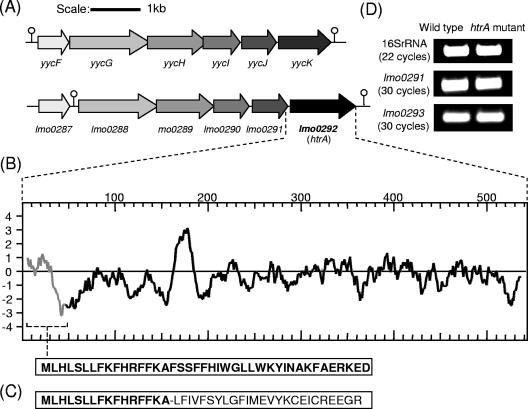
FIG. 1.
FIG. 1.
(A) Genomic organization of the yyc operon in B. subtilis and the corresponding region of the L. monocytogenes EGDe genome. (B) Kyte and Doolittle hydrophobicity plots of HtrA in L. monocytogenes EGDe (gray line indicates putative leader peptide). (C) The frameshift mutation in the potential signal sequence of HtrA is represented by a dash. (D) Transcriptional analysis of lmo0291 and lmo0293. Total RNA was isolated from exponential-phase cultures of EGDe and the htrA mutant grown in BHI at 37°C. RNA was converted to cDNA, and PCRs were performed with lmo0291 and lmo0293 specific primers.
FIG. 2.
FIG. 2.
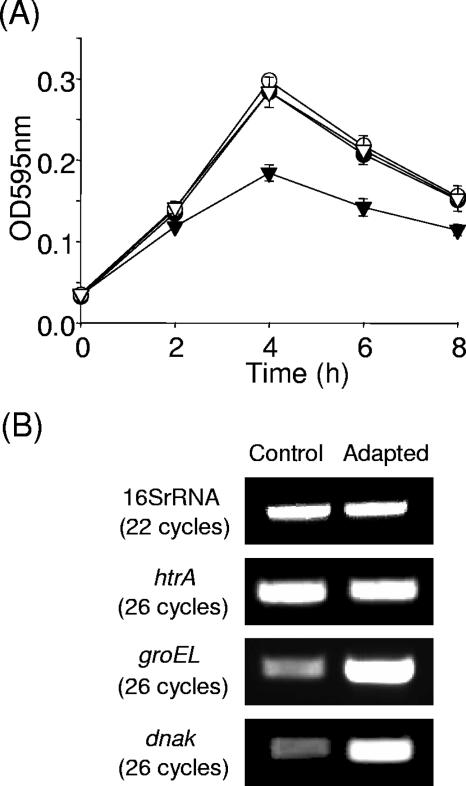
(A) Growth of wild-type EGDe (•), revertant (○), htrA mutant (▾), and HtrASS* (▿) under sublethal heat conditions (44°C). Error bars represent standard deviations of triplicate experiments. (B) Transcriptional analysis of htrA by RT-PCR. Total RNA was isolated from exponential-phase cultures of EGDe grown in BHI at 37°C (Control) and exposed to 45°C for 30 min (Adapted). RNA was converted to cDNA and PCRs were performed with htrA, groEL, and dnaK specific primers.
FIG. 3.
FIG. 3.
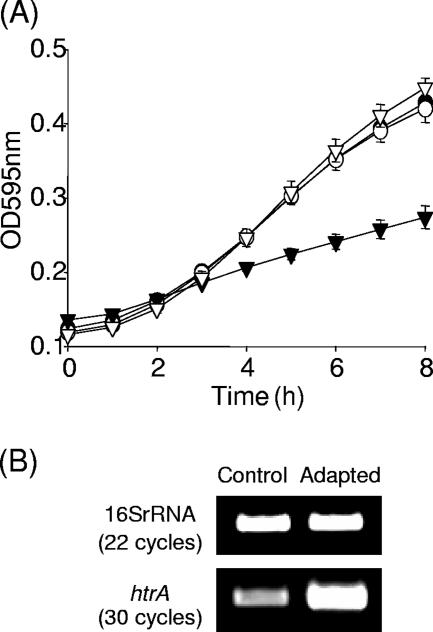
(A) Growth of wild-type EGDe (•), revertant (○), htrA mutant (▾), and HtrASS* (▿) under sublethal acid conditions (pH 5, HCl). Error bars represent standard deviations of triplicate experiments. (B) Transcriptional analysis of htrA by RT-PCR. Total RNA was isolated from exponential-phase cultures of EGDe grown in pH 7 BHI (Control) and exposed to pH 5 for 30 min (Adapted). RNA was converted to cDNA, and PCRs were performed with htrA specific primers.
FIG. 4.
FIG. 4.
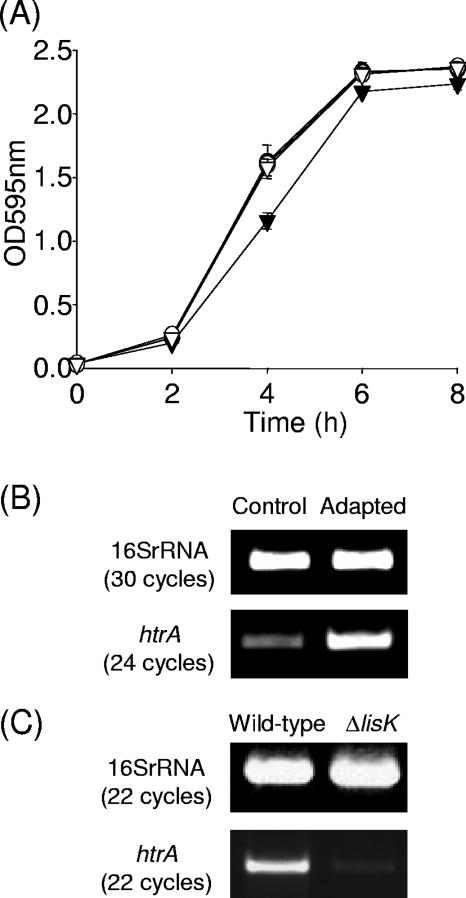
(A) Growth of wild-type EGDe (•), revertant (○), htrA mutant (▾), and HtrASS* (▿) under sublethal penicillin G conditions (87.5 ng/ml). Error bars represent standard deviations of triplicate experiments. (B and C) Transcriptional analysis of htrA by RT-PCR. (B) Total RNA was isolated from exponential-phase cultures of EGDe growing in BHI (Control) and exposed to penicillin G at 87.5 ng/ml for 30 min (Adapted). (C) Total RNA was extracted from stationary-phase cultures of LO28 wild-type and ΔlisK strains. RNA was converted to cDNA, and PCRs were performed with htrA specific primers.
FIG. 5.
FIG. 5.
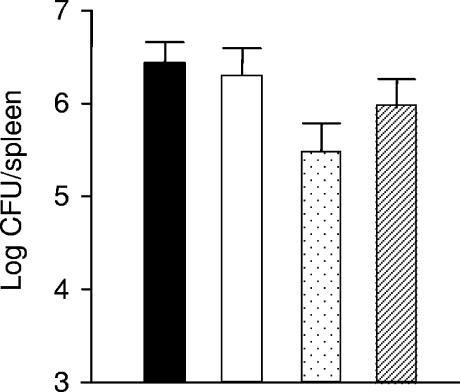
Levels of EGDe (black bar), revertant (white bar), htrA mutant (dotted bar), and HtrASS* (hatched bar) in the spleens of BALB/c mice 3 days after intraperitoneal infection. Error bars represent the standard deviations of four experiments.

References

    1. Antelmann, H., E. Darmon, D. Noone, J.-W. Veening, H. Westers, S. Bron, O. P. Kuipers, K. M. Devine, M. Hecker, and J. M. van Diji. 2003. The extracellular proteome of Bacillus subtilis under secretion conditions. Mol. Micrbiol. 49:143-156. - PubMed
    1. Begley, M., C. Hill, and C. G. M. Gahan. 2003. Identification and disruption of btlA, a locus involved in bile tolerance and general stress resistance in Listeria monocytogenes. FEMS Microbiol. Lett. 218:31-38. - PubMed
    1. Cortes, G., B. de Astorza, V. J. Benedi, and S. Alberti. 2002. Role of the htrA gene in Klebsiella pneumoniae virulence. Infect. Immun. 70:4772-4776. - PMC - PubMed
    1. Cotter, P. D., C. G. M. Gahan, and C. Hill. 1999. Identification and disruption of lisRK, a genetic locus encoding a two-component signal transduction system involved in stress tolerance and virulence in Listeria monocytogenes. J. Bacteriol. 181:6840-6843. - PMC - PubMed
    1. Cotter, P. D., C. M. Guinane, and C. Hill. 2002. The LisRK signal transduction system determines the sensitivity of Listeria monocytogenes to nisin and cephalosporins. Antimicrob. Agents Chemother. 46:2784-2790. - PMC - PubMed

Publication types

MeSH terms

LinkOut - more resources