


Evolution of selenium utilization traits
- PMID: 16086848
- PMCID: PMC1273633
- DOI: 10.1186/gb-2005-6-8-r66
Evolution of selenium utilization traits
Abstract
Background: The essential trace element selenium is used in a wide variety of biological processes. Selenocysteine (Sec), the 21st amino acid, is co-translationally incorporated into a restricted set of proteins. It is encoded by an UGA codon with the help of tRNASec (SelC), Sec-specific elongation factor (SelB) and a cis-acting mRNA structure (SECIS element). In addition, Sec synthase (SelA) and selenophosphate synthetase (SelD) are involved in the biosynthesis of Sec on the tRNASec. Selenium is also found in the form of 2-selenouridine, a modified base present in the wobble position of certain tRNAs, whose synthesis is catalyzed by YbbB using selenophosphate as a precursor.
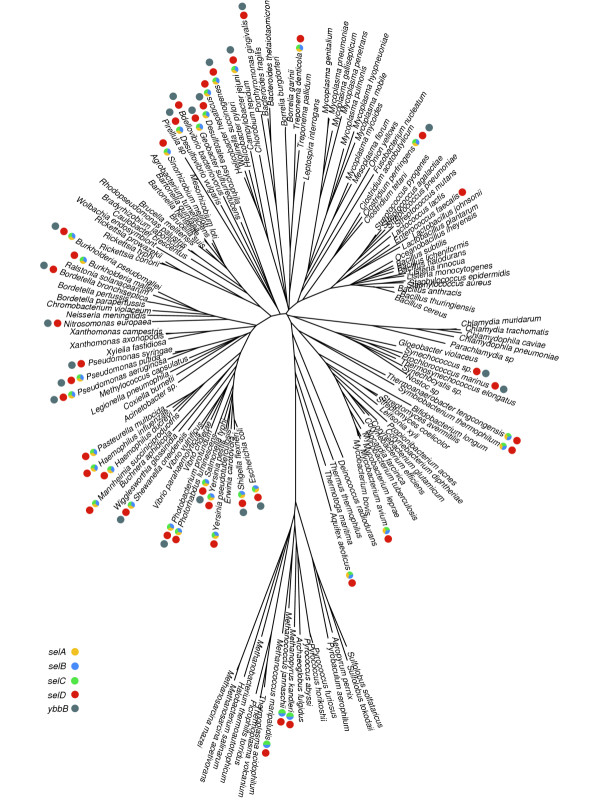
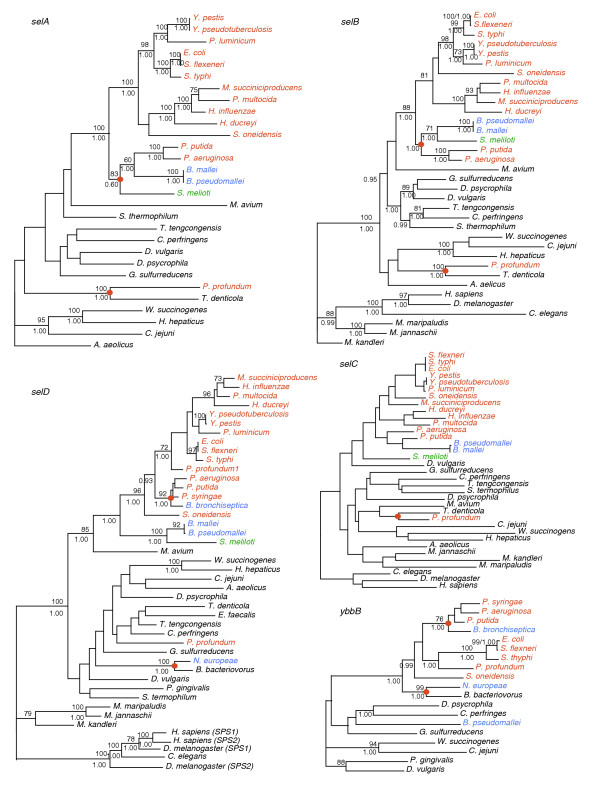
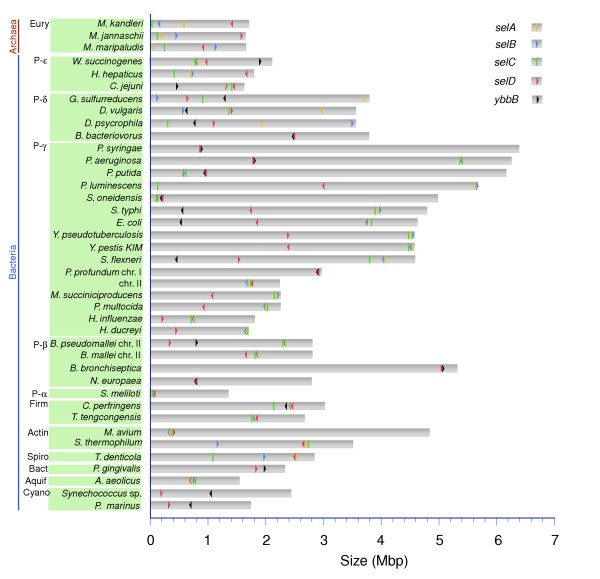
Results: We analyzed completely sequenced genomes for occurrence of the selA, B, C, D and ybbB genes. We found that selB and selC are gene signatures for the Sec-decoding trait. However, selD is also present in organisms that do not utilize Sec, and shows association with either selA, B, C and/or ybbB. Thus, selD defines the overall selenium utilization. A global species map of Sec-decoding and 2-selenouridine synthesis traits is provided based on the presence/absence pattern of selenium-utilization genes. The phylogenies of these genes were inferred and compared to organismal phylogenies, which identified horizontal gene transfer (HGT) events involving both traits.
Conclusion: These results provide evidence for the ancient origin of these traits, their independent maintenance, and a highly dynamic evolutionary process that can be explained as the result of speciation, differential gene loss and HGT. The latter demonstrated that the loss of these traits is not irreversible as previously thought.
Figures
References
-
- Lee SR, Bar-Noy S, Kwon J, Levine RL, Stadtman TC, Rhee SG. Mammalian thioredoxin reductase: oxidation of the C-terminal cysteine/selenocysteine active site forms a thioselenide, and replacement of selenium with sulfur markedly reduces catalytic activity. Proc Natl Acad Sci USA. 2000;97:2521–2526. doi: 10.1073/pnas.050579797. - DOI - PMC - PubMed
Publication types
MeSH terms
Substances
Grants and funding
LinkOut - more resources
Full Text Sources
Molecular Biology Databases
