


Enhanced schooling performance in lateralized fishes
- PMID: 16087422
- PMCID: PMC1559851
- DOI: 10.1098/rspb.2005.3145
Enhanced schooling performance in lateralized fishes
Abstract
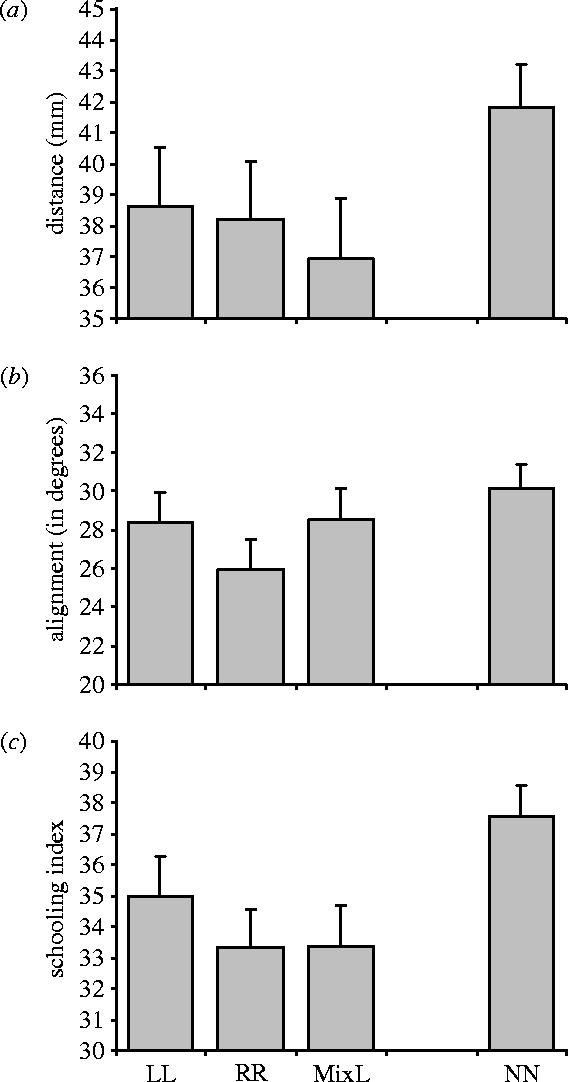
The occurrence of functional left-right cerebral asymmetries has been documented in a wide range of animals, suggesting that the lateralization of cognitive functions enjoys some kind of selective advantage over the bilateral control of the same functions. Here, we compared schooling performance of fishes with high or low degree of lateralization, which were obtained through selective breeding. Schools of lateralized fishes moving in a novel environment showed significantly more cohesion and coordination than schools of non-lateralized (NL) fishes. Pairs of fishes lateralized in opposite directions were as efficient as pairs of same laterality, suggesting that the performance of lateralized fishes derives from a computational advantage rather than being the consequence of a behavioural similarity among schoolmates. In schools composed of both lateralized and NL fishes, the latter were more often at the periphery of the school while lateralized fishes occupied the core, a position normally safer and energetically less expensive.
Figures
References
-
- Ades C, Ramires E.N. Asymmetry of leg use during prey handling in the spider Scytodes globula (Scytodidae) J. Insect Behav. 2002;15:563–570.
-
- Andrew R.J. The earliest origin and subsequent evolution of lateralization. In: Rogers L.J, Andrew R.J, editors. Comparative vertebrate lateralization. Cambridge University Press; Cambridge: 2002. pp. 70–93.
-
- Andrew R.J, Mench J, Rainey C. Right–left asymmetry of response to visual stimuli in the domestic chick. In: Ingle D.J, Goodale M.A, Mansfield R.J.W, editors. Advances in the analysis of visual behavior. MIT Press; Cambridge: 1982. pp. 197–209.
-
- Benoit-Bird K.J, Au W.W.L. Prey dynamics affect foraging by a pelagic predator (Stenella longirostris) over a range of spatial and temporal scales. Behav. Ecol. Sociobiol. 2003;53:364–373.
-
- Bisazza A, Facchin L, Vallortigara G. Heritability of lateralization in fish: concordance of right–left asymmetry of detour responses between parents and offspring. Neuropsychologia. 2000;38:907–912. - PubMed
Publication types
MeSH terms
LinkOut - more resources
Full Text Sources
