Genomewide identification of Sko1 target promoters reveals a regulatory network that operates in response to osmotic stress in Saccharomyces cerevisiae
- PMID: 16087739
- PMCID: PMC1214534
- DOI: 10.1128/EC.4.8.1343-1352.2005
Genomewide identification of Sko1 target promoters reveals a regulatory network that operates in response to osmotic stress in Saccharomyces cerevisiae
Abstract
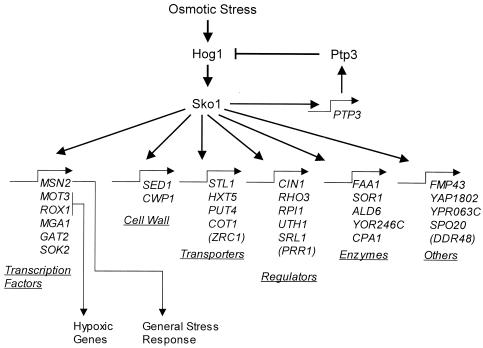
In Saccharomyces cerevisiae, the ATF/CREB transcription factor Sko1 (Acr1) regulates the expression of genes induced by osmotic stress under the control of the high osmolarity glycerol (HOG) mitogen-activated protein kinase pathway. By combining chromatin immunoprecipitation and microarrays containing essentially all intergenic regions, we estimate that yeast cells contain approximately 40 Sko1 target promoters in vivo; 20 Sko1 target promoters were validated by direct analysis of individual loci. The ATF/CREB consensus sequence is not statistically overrepresented in confirmed Sko1 target promoters, although some sites are evolutionarily conserved among related yeast species, suggesting that they are functionally important in vivo. These observations suggest that Sko1 association in vivo is affected by factors beyond the protein-DNA interaction defined in vitro. Sko1 binds a number of promoters for genes directly involved in defense functions that relieve osmotic stress. In addition, Sko1 binds to the promoters of genes encoding transcription factors, including Msn2, Mot3, Rox1, Mga1, and Gat2. Stress-induced expression of MSN2, MOT3, and MGA1 is diminished in sko1 mutant cells, while transcriptional regulation of ROX1 seems to be unaffected. Lastly, Sko1 targets PTP3, which encodes a phosphatase that negatively regulates Hog1 kinase activity, and Sko1 is required for osmotic induction of PTP3 expression. Taken together our results suggest that Sko1 operates a transcriptional network upon osmotic stress, which involves other specific transcription factors and a phosphatase that regulates the key component of the signal transduction pathway.
Figures


References
-
- Alepuz, M. P., A. Jovanovic, V. Reiser, and G. Ammerer. 2001. Stress-induced MAP kinase Hog1 is part of transcription activation complexes. Mol. Cell 7:767-777. - PubMed
-
- Bilsland, E., C. Molin, S. Swaminathan, A. Ramne, and P. Sunnerhagen. 2004. Rck1 and Rck2 MAPKAP kinases and the HOG pathway are required for oxidative stress resistance. Mol. Microbiol. 53:1743-1756. - PubMed
-
- Cawley, S., S. Bekiranov, H. H. Ng, P. Kapranov, E. A. Sekinger, D. Kampa, A. Piccolboni, V. Smentchenko, J. Cheng, A. J. Williams, R. Wheeler, B. Wong, J. Drenkow, M. Yamanaka, S. Patel, S. Brubaker, H. Tammana, G. Helt, K. Struhl, and T. R. Gingeras. 2004. Unbiased mapping of transcription factor binding sites along human chromosomes 21 and 22 points to widespread regulation of non-coding RNAs. Cell 116:499-509. - PubMed
-
- Cliften, P., P. Sudarsanam, A. Desikan, L. Fulton, B. Fulton, J. Majors, R. Waterston, B. A. Cohen, and M. Johnston. 2003. Finding functional features in Saccharomyces genomes by phylogenetic footprinting. Science 301:71-76. - PubMed
Publication types
MeSH terms
Substances
Grants and funding
LinkOut - more resources
Full Text Sources
Molecular Biology Databases
Miscellaneous