The pkaB gene encoding the secondary protein kinase A catalytic subunit has a synthetic lethal interaction with pkaA and plays overlapping and opposite roles in Aspergillus nidulans
- PMID: 16087751
- PMCID: PMC1214532
- DOI: 10.1128/EC.4.8.1465-1476.2005
The pkaB gene encoding the secondary protein kinase A catalytic subunit has a synthetic lethal interaction with pkaA and plays overlapping and opposite roles in Aspergillus nidulans
Abstract
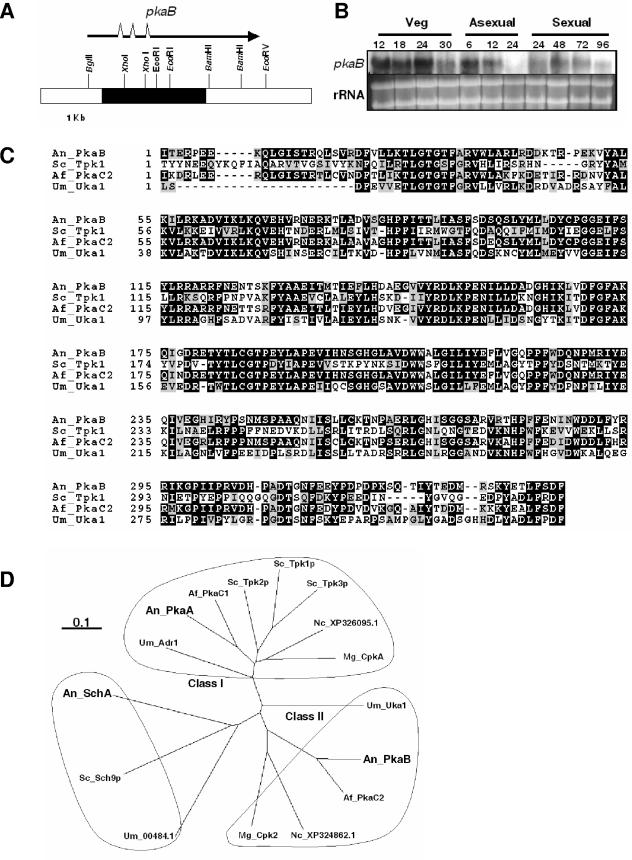
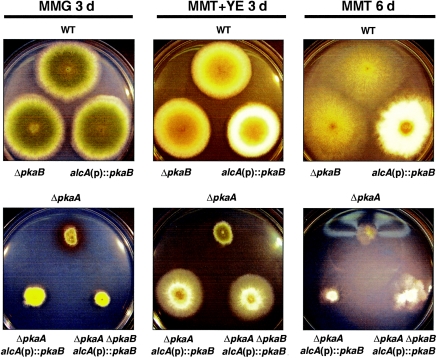
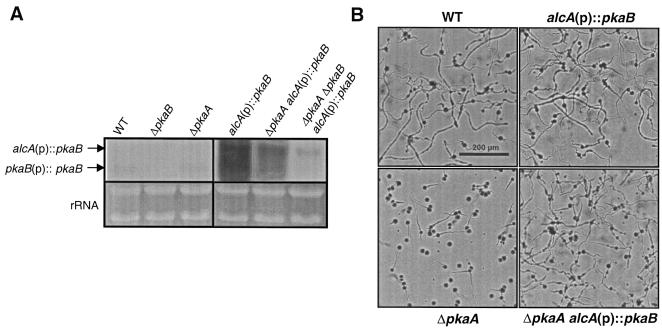
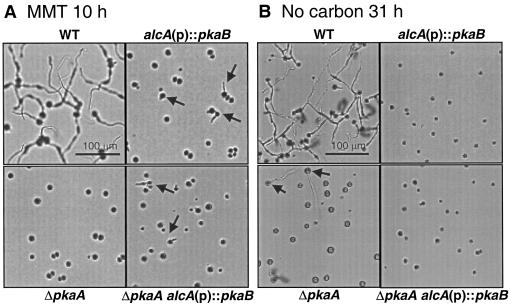
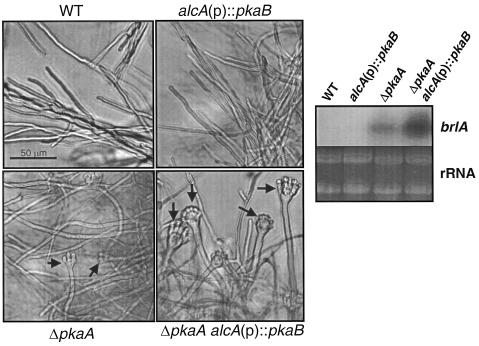
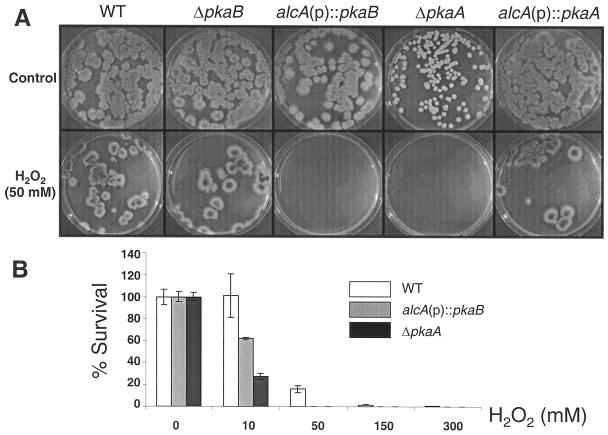
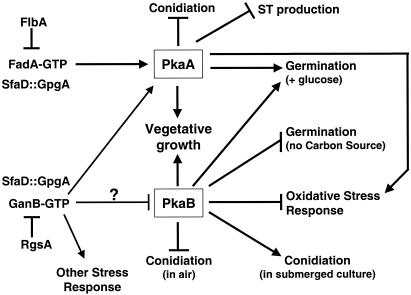
Filamentous fungal genomes contain two distantly related cyclic AMP-dependent protein kinase A catalytic subunits (PKAs), but only one PKA is found to play a principal role. In Aspergillus nidulans, PkaA is the primary PKA that positively functions in vegetative growth and spore germination but negatively controls asexual sporulation and production of the mycotoxin sterigmatocystin. In this report, we present the identification and characterization of pkaB, encoding the secondary PKA in A. nidulans. Although deletion of pkaB alone does not cause any apparent phenotypic changes, the absence of both pkaB and pkaA is lethal, indicating that PkaB and PkaA are essential for viability of A. nidulans. Overexpression of pkaB enhances hyphal proliferation and rescues the growth defects caused by DeltapkaA, indicating that PkaB plays a role in vegetative growth signaling. However, unlike DeltapkaA, deletion of pkaB does not suppress the fluffy-autolytic phenotype resulting from DeltaflbA. While upregulation of pkaB rescues the defects of spore germination resulting from DeltapkaA in the presence of glucose, overexpression of pkaB delays spore germination. Furthermore, upregulation of pkaB completely abolishes spore germination on medium lacking a carbon source. In addition, upregulation of pkaB enhances the level of submerged sporulation caused by DeltapkaA and reduces hyphal tolerance to oxidative stress. In conclusion, PkaB is the secondary PKA that has a synthetic lethal interaction with PkaA, and it plays an overlapping role in vegetative growth and spore germination in the presence of glucose but an opposite role in regulating asexual sporulation, germination in the absence of a carbon source, and oxidative stress responses in A. nidulans.
Figures
References
-
- Adams, T. H., M. T. Boylan, and W. E. Timberlake. 1988. brlA is necessary and sufficient to direct conidiophore development in Aspergillus nidulans. Cell 54:353-362. - PubMed
-
- Bockmühl, D. P., S. Krishnamurthy, M. Geards, A. Sonneborn, and J. F. Ernst. 2001. Distinct and redundant roles of the two protein kinase A isoforms Tpk1P and Tpk2P in morphogenesis and growth of Candida albicans. Mol. Microbiol. 42:1243-1257. - PubMed
Publication types
MeSH terms
Substances
LinkOut - more resources
Full Text Sources