


Effects of captopril on the renin angiotensin system, oxidative stress, and endothelin in normal and hypertensive rats
- PMID: 16087785
- PMCID: PMC1414647
- DOI: 10.1161/01.HYP.0000174602.59935.d5
Effects of captopril on the renin angiotensin system, oxidative stress, and endothelin in normal and hypertensive rats
Abstract
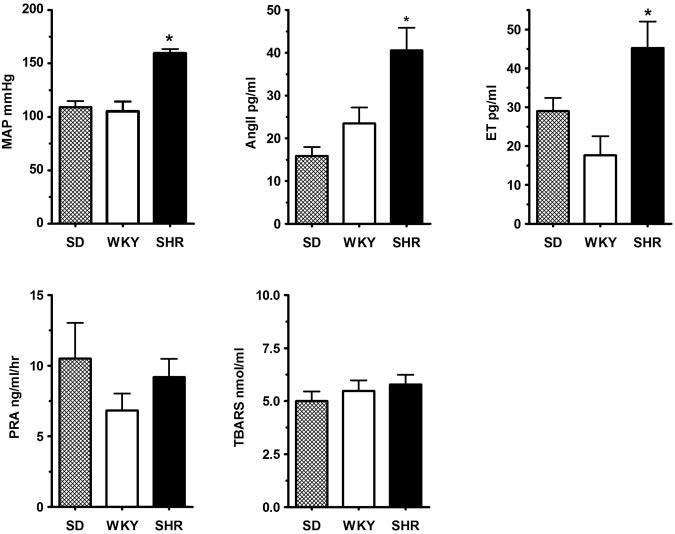
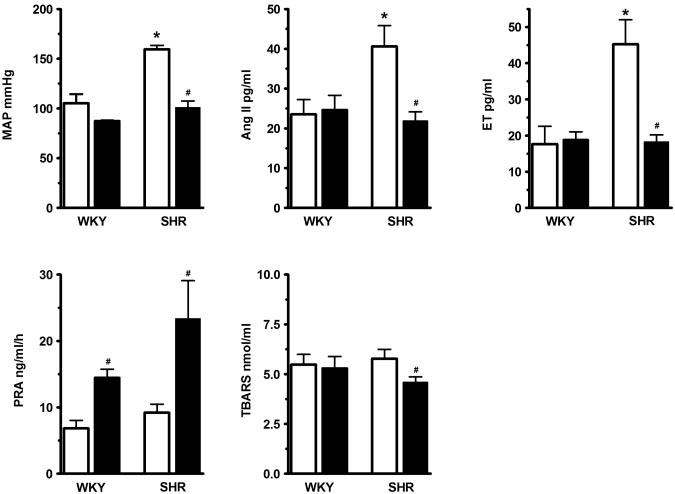
There is substantial evidence suggesting that angiotensin II plays an important role in elevating blood pressure of spontaneously hypertensive rats, despite normal plasma renin activity, and that converting enzyme inhibitors (captopril) can effectively normalize blood pressure in the spontaneously hypertensive rats. One mechanism by which angiotensin II induces hypertension is via oxidative stress and endothelin, as seen in subpressor angiotensin II-induced hypertension. In fact, it has been shown that antioxidants lower mean arterial pressure in spontaneously hypertensive rats. However, the relationship between angiotensin II, oxidative stress, and endothelin in the spontaneously hypertensive rats is still relatively undefined. This study examines the relationship between mean arterial pressure, plasma renin activity, angiotensin II, oxidative stress, and endothelin in spontaneously hypertensive rats compared with normotensive Wistar Kyoto rats, and the effects of captopril on this association. Untreated spontaneously hypertensive rats had increased plasma angiotensin II levels despite normal plasma renin activity, oxidative stress, and endothelin. Captopril treatment in spontaneously hypertensive rats lowered mean arterial pressure, angiotensin II, oxidative stress, and endothelin, and increased plasma renin activity. In contrast, captopril increased plasma renin activity (suggesting effective captopril treatment) but did not significantly alter mean arterial pressure, angiotensin II, oxidative stress, or endothelin of Wistar Kyoto rats. These results suggest that in spontaneously hypertensive rats, angiotensin II is a primary instigator of hypertension, and that captopril selectively lowers angiotensin II, oxidant stress, and endothelin, which in turn may contribute to the blood pressure-lowering efficacy of captopril in spontaneously hypertensive rats.
Figures
References
-
- Wood JM. Current Advances in ACE Inhibition 2. Churchill Livingstone; London: 1991.
-
- Antonaccio MJ, High JP, Rubin B, Schaeffer T. Contribution of the kidneys but not adrenal glands to the acute antihypertensive effects of captopril in spontaneously hypertensive rats. Clin Sci (Lond) 1979;57:127s–130s. - PubMed
-
- Harrap SB, Nicolaci JA, Doyle AE. Persistent effects on blood pressure and renal haemodynamics following chronic angiotensin converting enzyme inhibition with perindopril. Clin Exp Pharmacol Physiol. 1986;13:753–765. - PubMed
-
- Bunkenburg B, Schnell C, Baum HP, Cumin F, Wood JM. Prolonged angiotensin II antagonism in spontaneously hypertensive rats. Hemodynamic and biochemical consequences. Hypertension. 1991;18:278–288. - PubMed
-
- Gillies LK, Lu M, Wang H, Lee RM. AT1 receptor antagonist treatment caused persistent arterial functional changes in young spontaneously hypertensive rats. Hypertension. 1997;30:1471–1478. - PubMed
Publication types
MeSH terms
Substances
Grants and funding
LinkOut - more resources
Full Text Sources
Medical
