. 2005:25:129-34.

Effects of recombinant hematopoietins on blood-loss anemia in mice

Affiliations

Effects of recombinant hematopoietins on blood-loss anemia in mice

Kevin B Jones et al. Iowa Orthop J. 2005.

Abstract

Use of recombinant human erythropoietin (rhEPO) for treatment of pre-operative anemia in anticipation of orthopaedic surgical blood loss has become a routine practice. Use of rhEPO to help manage unanticipated blood loss from elective surgery or major orthopaedic trauma is limited by the rate and volume of erythropoiesis that is achievable with exogenously administered rhEPO. The rate and volume of erythropoiesis may be limited by the available population of cells responsive to EPO. Cytokines known to affect these early hematopoietic progenitors may potentiate the effects of rhEPO. In this study, mice were rendered anemic by loss of approximately one-third of their total blood volume. A control group received only iron supplementation. Mice in three experimental groups received three injections of rhEPO. Two of these groups also received either recombinant murine stem cell factor (rmSCF) or recombinant murine interleukin-3 (rmIL-3). Both were before and in conjunction with rhEPO. Animals were sacrificed for peripheral blood testing at baseline, after initiation of rmSCF and rmIL-3 prior to rhEPO administration, and at three time points after dosing of rhEPO. Additionally, the bone marrow was harvested and cultured to determine the concentration of erythroid progenitors after treatment with rmIL-3 or rmSCF, and after further treatment with rhEPO. Hematocrits were significantly higher in the first measurement point after administration of rhEPO in the groups receiving additional cytokines. The control and rhEPO-only groups were not different at this early time point. The maximal rate of erythropoiesis was also elevated in the groups receiving additional cytokines. The bone marrow of mice receiving SCF had a dramatically increased number of erythroid progenitors compared to all other groups. The population of EPO-responsive cells, dependent on cytokines not controlled by hypoxia, is a major rate-limiting and volume-limiting factor in the response to rhEPO during recovery from blood-loss anemia. Administration of earlier-acting cytokines has the potential to increase the rate and volume of exogenously stimulated erythropoiesis.


Figures

Figure 1
Figure 1
This schematic illustrates the effects of three hematopoietins on proliferation and differentiation in the myeloid lineage and its erythroid arm. The myeloid lineage initially includes cells with the ability to form colonies of precursors to granulocytes, erythrocytes, megakaryocytes and monocytes/macrophages (CFU-GEMM). The earliest cell to express the erythropoietin receptor and respond to stimulation with erythropoietin is the burst-forming unit-erythrocyte (BFU-E); it is also the earliest dedicated erythroid progenitor, ultimately proliferating/differentiating into a burst-like array of colony-forming units-erythrocytes (CFU-Es). These CFU-Es continue to respond to erythropoietin as they form a colony of erythroblasts, which lose the ability to proliferate and begin to terminally differentiate and build hemoglobin stores prior to release into the peripheral blood circulation and degradation of the nucleus.
Figure 2
Figure 2. Hematocrit Recovery after Blood Loss Anemia
This chart demonstrates the change in hematocrit over time for different cytokine treatment regimens for blood-loss anemia. The groups receiving recombinant murine stem cell factor (rmSCF) or recombinant murine interleukin-3 (rmIL-3) in addition to recombinant human erythropoietin (rhEPO) demonstrate higher and earlier peaks in hematocrit. Recombinant human erythropoietin (rhEPO) alone is not significantly different than the control at day nine. The asterisks denote statistically significant differences from all other groups at the same time point (p>0.05). NS denotes no significant difference. Error bars represent standard deviations from the mean.
Figure 3
Figure 3. Rate of Erythrocyte Production after Blood Loss Anemia
This chart demonstrates the change in reticulocyte production index over time for different cytokine treatment regimens for blood-loss anemia. The reticulocyte production index is a corrected (for hematocrit) percentage of reticulocytes, or recently released, immature red blood cells, among total erythrocytes in the peripheral blood. The index is a measure of the number of red blood cells that have completed the bone marrow stages of erythropoeisis in approximately the last 24 hours, and therefore a measure of the rate of red blood cell production. The groups receiving recombinant murine stem cell factor (rmSCF) or recombinant murine interleukin-3 (rmIL-3) in addition to recombinant human erythropoietin (rhEPO) demonstrate a higher peak rate of erythropoiesis. These groups drop to subnormal rates of red cell production when exogenous cytokines are no longer circulating, as the endogenous secretion of EPO is suppressed by the lack of hypoxia resulting from the supranormal hematocrit. Asterisks denote statistically significant dif ferences from control groups (p<0.05). Error bars represent standard deviations from the mean.
Figure 4
Figure 4. Prevalence of Erythroid Progenitors on Day 6 of Blood Loss Anemia
This chart illustrates the concentration of dedicated, early erythrocyte progenitors cultured from the bone marrow of mice after four days of injections with recombinant murine stem cell factor (rmSCF), recombinant murine interleukin-3 (rmIL-3), or vehicle alone. These cells are the earliest cells that will respond to stimulation by erythropoietin. The strength of this population of cells appears to be a major rate-limiting factor in the effectiveness of erythropoietin administration.
Figure 5
Figure 5. Prevalence of Erythroid Progenitors on Day 9 of Blood Loss Anemia
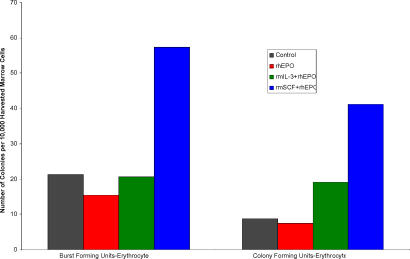
This chart illustrates the concentration of dedicated, early erythrocyte progenitors cultured from the bone marrow of mice after treatment with vehicle alone, recombinant human erythropoietin (rhEPO) alone, or rhEPO with recombinant murine stem cell factor (rmSCF), or with recombinant murine interleukin-3 (rmIL-3). The rhEPO-only group appears to have a lower-than-normal presence of these cells, suggesting that the combination of exogenous and high endogenous levels of EPO, without prior priming to build up the early progenitor population, has depleted it, explaining the lag in red blood cell production in this group.

References

    1. Dodd RY. Current safety of the blood supply in the United States. Int J Hematol. 2004;80(4):301–305. - PubMed
    1. Bierbaum BE, Callaghan JJ, Galante JO, Rubash HE, Tooms RE, Welch RB. An analysis of blood management in patients having a total hip or knee arthroplasty. J Bone Joint Surg. (Am) 1999;81(1):2–10. - PubMed
    1. Blumberg N. Allogeneic transfusion and infection: economic and clinical implications. Semin Hematol. 1997;34(3 Suppl 2):34–40. - PubMed
    1. Borghi B, Casati A. Incidence and risk factors for allogenic blood transfusion during major joint replacement using an integrated autotransfusion regimen. Eur J Anaesthesiol. 2000;17(7):411–417. The Rizzoli Study Group on Orthopaedic Anaesthesia. - PubMed
    1. Innerhofer P, Walleczek C, Luz G, Hobisch-Hagen P, Benzer A, Stockl B, Hessenberger G, Nussbaumer W, Schobersberger W. Transfusion of buffy coat-depleted blood components and risk of postoperative infection in orthopedic patients. Transfusion. 1999;39(6):625–632. - PubMed

LinkOut - more resources