Decreased insulin-stimulated ATP synthesis and phosphate transport in muscle of insulin-resistant offspring of type 2 diabetic parents
- PMID: 16089501
- PMCID: PMC1184227
- DOI: 10.1371/journal.pmed.0020233
Decreased insulin-stimulated ATP synthesis and phosphate transport in muscle of insulin-resistant offspring of type 2 diabetic parents
Abstract
Background: Insulin resistance is the best predictor for the development of type 2 diabetes. Recent studies have shown that young, lean, insulin-resistant (IR) offspring of parents with type 2 diabetes have reduced basal rates of muscle mitochondrial phosphorylation activity associated with increased intramyocellular lipid (IMCL) content, which in turn blocks insulin signaling and insulin action in muscle. In order to further characterize mitochondrial activity in these individuals, we examined insulin-stimulated rates of adenosine triphosphate (ATP) synthesis and phosphate transport in skeletal muscle in a similar cohort of participants.
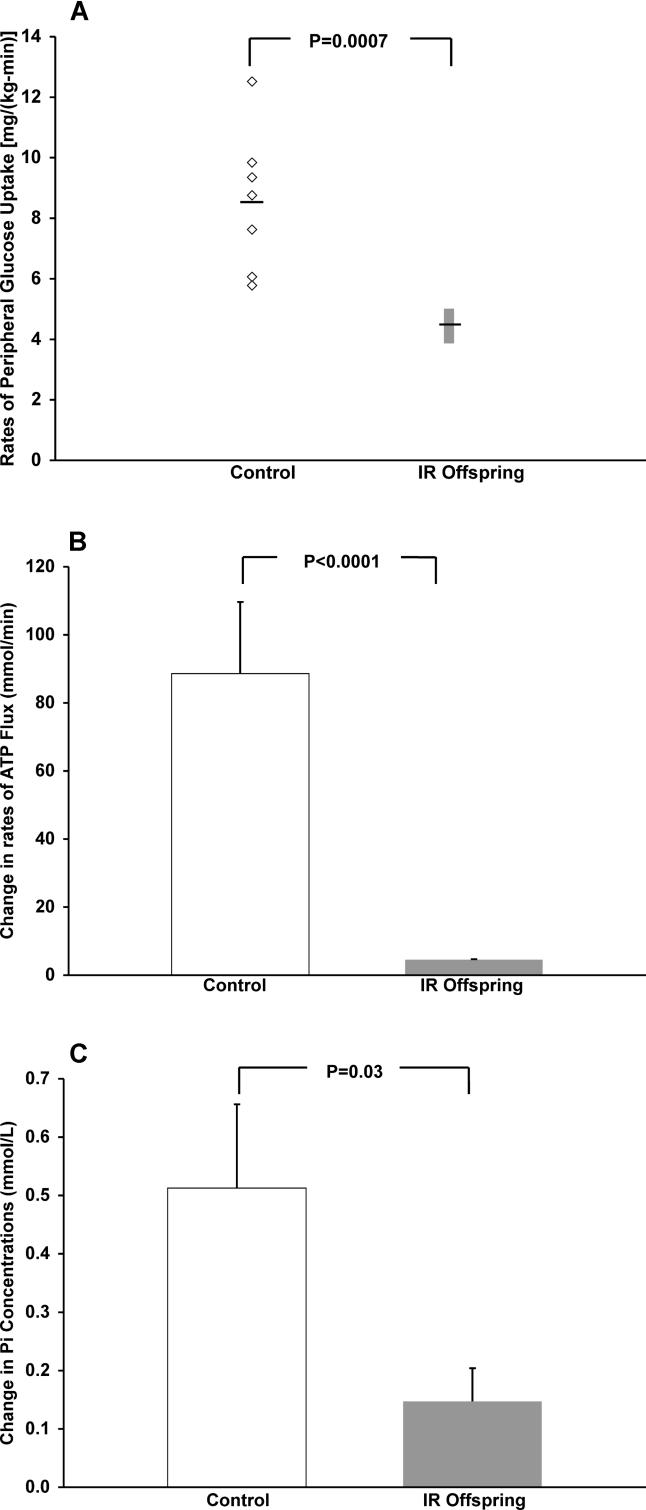
Methods and findings: Rates of insulin-stimulated muscle mitochondrial ATP synthase flux and insulin-stimulated increases in concentrations of intramyocellular inorganic phosphate (Pi) were assessed by 31P magnetic resonance spectroscopy (MRS) in healthy, lean, IR offspring of parents with type 2 diabetes and healthy, lean control participants with normal insulin sensitivity. IMCL content in the soleus muscle of all participants was assessed by 1H MRS. During a hyperinsulinemic-euglycemic clamp, rates of insulin-stimulated glucose uptake were decreased by approximately 50% in the IR offspring compared to the control participants (p = 0.007 versus controls) and were associated with an approximately 2-fold increase in IMCL content (p < 0.006 versus controls). In the control participants rates of ATP synthesis increased by approximately 90% during the hyperinsulinemic-euglycemic clamp. In contrast, insulin-stimulated rates of muscle mitochondrial ATP synthesis increased by only 5% in the IR offspring (p = 0.001 versus controls) and was associated with a severe reduction of insulin-stimulated increases in the intramyocellular Pi concentrations (IR offspring: 4.7% +/- 1.9% versus controls: 19.3% +/- 5.7%; p = 0.03). Insulin-induced increases in intramyocellular Pi concentrations correlated well with insulin-stimulated increases in rates of ATP synthesis (r = 0.67; p = 0.008).
Conclusions: These data demonstrate that insulin-stimulated rates of mitochondrial ATP synthesis are reduced in IR offspring of parents with type 2 diabetes. Furthermore, these IR offspring also have impaired insulin-stimulated phosphate transport in muscle, which may contribute to their defects in insulin-stimulated rates of mitochondrial ATP synthesis.
Conflict of interest statement
Figures
Comment in
-
Insulin resistance in the offspring of parents with type 2 diabetes.PLoS Med. 2005 Sep;2(9):e289. doi: 10.1371/journal.pmed.0020289. Epub 2005 Sep 27. PLoS Med. 2005. PMID: 16173834 Free PMC article.
References
-
- Zimmet P, Alberti KG, Shaw J. Global and societal implications of the diabetes epidemic. Nature. 2001;414:782–787. - PubMed
-
- Wild S, Roglic G, Green A, Sicree R, King H. Global prevalence of diabetes: Estimates for the year 2000 and projections for 2030. Diabetes Care. 2004;27:1047–1053. - PubMed
-
- Lillioja S, Mott DM, Howard BV, Bennett PH, Yki-Jarvinen H. Impaired glucose tolerance as a disorder of insulin action. Longitudinal and cross-sectional studies in Pima Indians. N Engl J Med. 1988;318:1217–1225. - PubMed
-
- Lillioja S, Mott DM, Spraul M, Ferraro R, Foley JE. Insulin resistance and insulin secretory dysfunction as precursors of non-insulin-dependent diabetes mellitus. Prospective studies of Pima Indians. N Engl J Med. 1993;329:1988–1992. - PubMed
-
- Warram JH, Martin BC, Krolewski AS, Soeldner JS, Kahn CR. Slow glucose removal rate and hyperinsulinemia precede the development of type II diabetes in the offspring of diabetic parents. Ann Intern Med. 1990;113:909–915. - PubMed
Publication types
MeSH terms
Substances
Grants and funding
LinkOut - more resources
Full Text Sources
Medical
Research Materials
Miscellaneous