


The metabolic basis of whole-organism RNA and phosphorus content
- PMID: 16091465
- PMCID: PMC1187991
- DOI: 10.1073/pnas.0504756102
The metabolic basis of whole-organism RNA and phosphorus content
Abstract
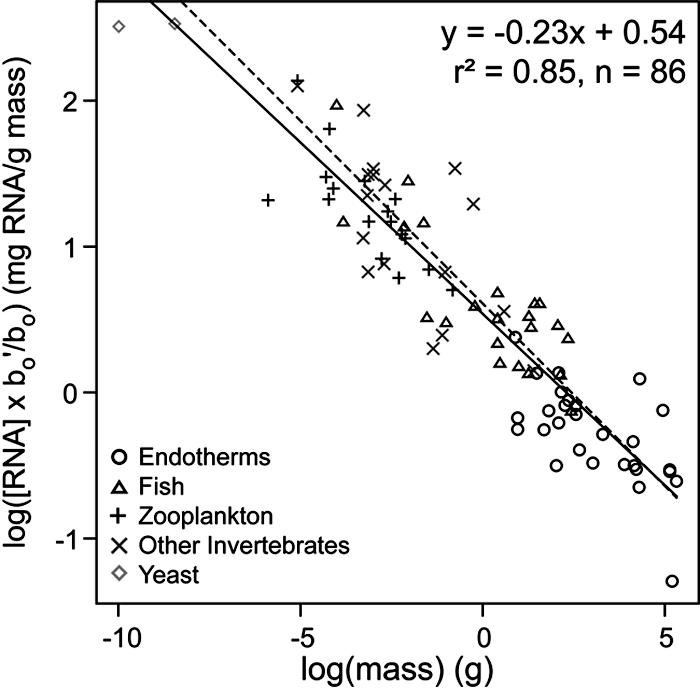
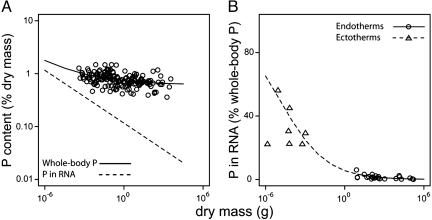
Understanding the storage, flux, and turnover of nutrients in organisms is important for quantifying contributions of biota to biogeochemical cycles. Here we present a model that predicts the storage of phosphorus-rich RNA and whole-body phosphorus content in eukaryotes based on the mass- and temperature-dependence of ATP production in mitochondria. Data from a broad assortment of eukaryotes support the model's two main predictions. First, whole-body RNA concentration is proportional to mitochondrial density and consequently scales with body mass to the -1/4 power. Second, whole-body phosphorus content declines with increasing body mass in eukaryotic unicells but approaches a relatively constant value in large multicellular animals because the fraction of phosphorus in RNA decreases relative to the fraction in other pools. Extension of the model shows that differences in the flux of RNA-associated phosphorus are due to the size dependencies of metabolic rate and RNA concentration. Thus, the model explicitly links two biological currencies at the individual level: energy in the form of ATP and materials in the form of phosphorus, both of which are critical to the functioning of ecosystems. The model provides a framework for linking attributes of individuals to the storage and flux of phosphorus in ecosystems.
Figures
References
-
- Sterner, R. W. & Elser, J. J. (2002) Ecological Stoichiometry: The Biology of Elements from Molecules to the Biosphere (Princeton Univ. Press, Princeton).
-
- Schlesinger, W. H. (1991) Biogeochemistry: An Analysis of Global Change (Academic, San Diego).
-
- Redfield, A. C. (1958) Am. Sci. 46, 205-221.
-
- Elser, J. J., Fagan, W. F., Denno, R. F., Dobberfuhl, D. R., Folarin, A., Huberty, A., Interlandi, S., Kilham, S. S., McCauley, E., Schulz, K. L., et al. (2000) Nature 408, 578-580. - PubMed
-
- Geider, R. J. & La Roche, J. (2002) Eur. J. Phycol. 37, 1-17.
Publication types
MeSH terms
Substances
LinkOut - more resources
Full Text Sources
Other Literature Sources
