Evaluation of the pathologic characteristics of excitotoxic spinal cord injury with MR imaging
- PMID: 16091503
- PMCID: PMC7975169
Evaluation of the pathologic characteristics of excitotoxic spinal cord injury with MR imaging
Abstract
Background and purpose: Although high-resolution MR imaging is a valuable diagnostic tool, in vivo MR imaging has not yet been compared with in vitro MR imaging and histologic techniques following experimental spinal cord injury (SCI). The goal of the present study was to evaluate the feasibility of using in vivo MR imaging, in vitro MR imaging, and histologic techniques to study pathologic changes associated with excitotoxic SCI at a single time point. These results are important for future research using in vivo MR imaging to study the temporal profile of pathologic changes following SCI.
Methods: Rats received intraspinal injections of quisqualic acid at the T12-L2 spinal level. In vivo T1- and T2-weighted and dynamic contrast-enhanced MR images were collected 17-24 days postinjury. Once completed, spinal cords were removed and in vitro MR microscopy and histologic assessment were performed. MR images were collected using 4.7-T (in vivo) and 14.1-T magnets (in vitro).
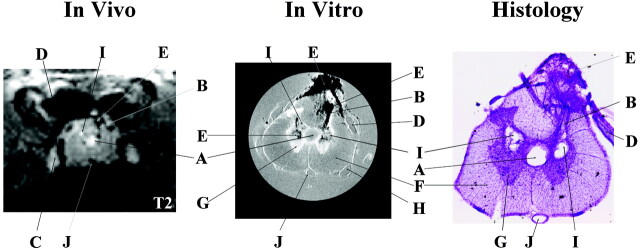
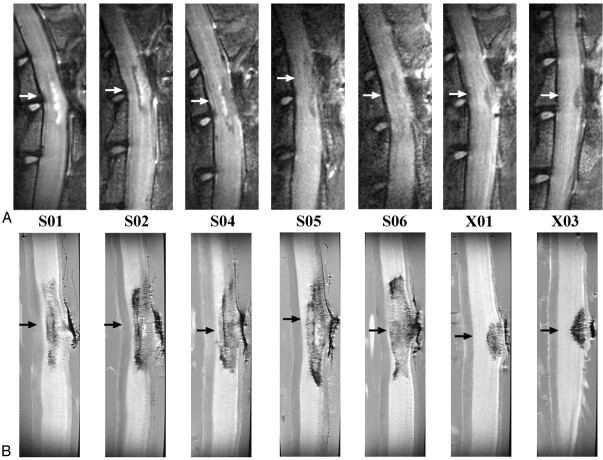
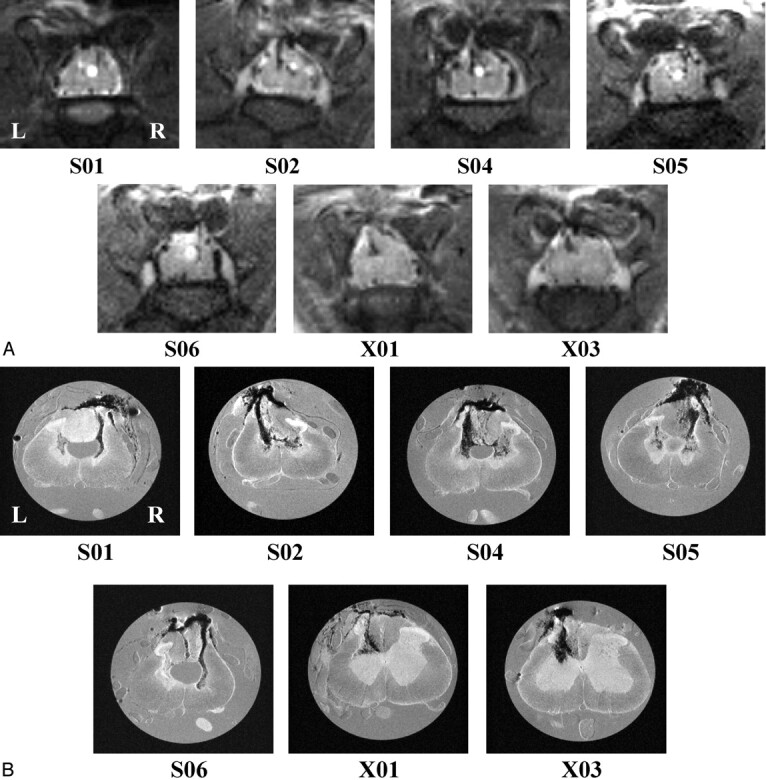
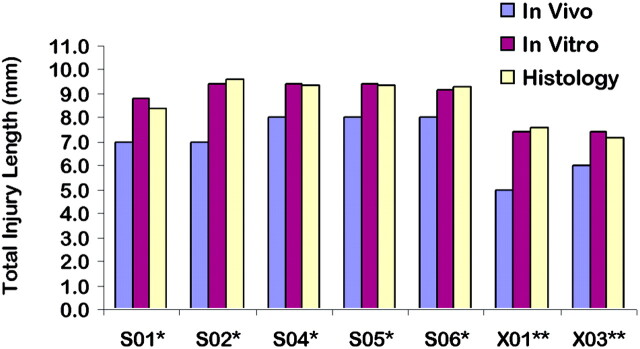
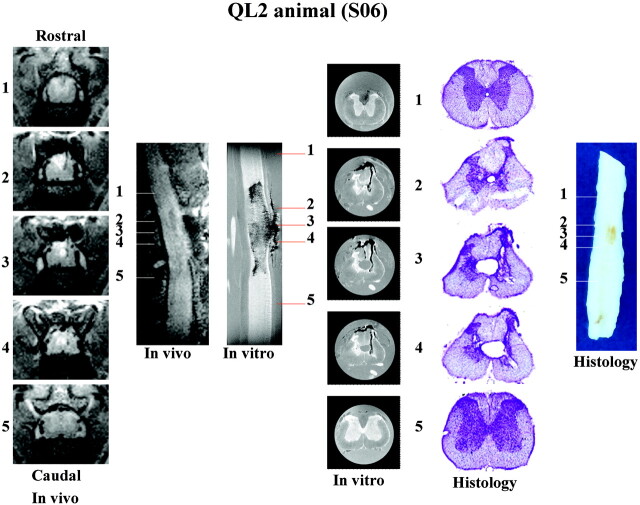
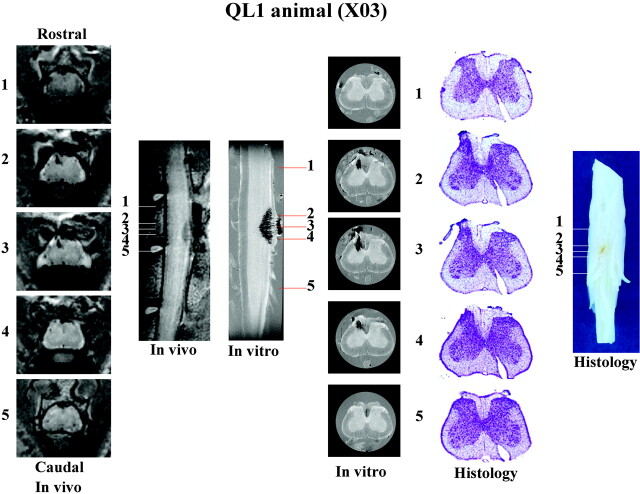
Results: Pathologic changes--including hemorrhage, neuronal loss, cavities, and central canal expansion--were visible in T2-weighted in vivo MR images. Evaluation of the blood-spinal cord barrier after injury with contrast agent enhancement showed no disruption at the time points evaluated. In vitro MR images and histologic evaluation confirmed pathologic details observed in vivo.
Conclusion: Results show that high-resolution in vivo MR imaging has the potential to be used in studying the progression of pathologic changes at multiple time points following SCI. This strategy may provide a way of studying structure-function relationships between therapeutic interventions and different pathologic characteristics of the injured spinal cord.
Figures
Comment in
-
MRI and the evaluation of the blood-spinal cord barrier following injury.AJNR Am J Neuroradiol. 2005 Aug;26(7):1609-10. AJNR Am J Neuroradiol. 2005. PMID: 16091501 Free PMC article. No abstract available.
References
-
- Yezierski RP. Pathophysiology and animal models of spinal cord injury pain. In: Yezierski RP, Burchiel K, eds. Spinal cord injury pain: assessment, mechanisms, management. Seattle: IASP Press;2002. :117–136
-
- Yezierski RP, Santana M, Park SH, Madsen PW. Neuronal degeneration and spinal cavitation following intraspinal injections of quisqualic acid. J Neurotrauma 1993;10:445–456 - PubMed
-
- Yezierski RP, Liu S, Ruenes GL, et al. Excitotoxic spinal cord injury: behavioral and morphological characteristics of a central pain model. Pain 1998;75:141–155 - PubMed
-
- Falconer JC, Narayana PA, Bhattacharjee MB, Liu SJ. Quantitative MRI of spinal cord injury in a rat model. Magn Reson Med 1994;32:484–491 - PubMed
-
- Ohta K, Fujimura Y, Watanabe M, Yato Y. Experimental study on MRI evaluation of the course of cervical spinal cord injury. Spinal Cord 1999;37:580–584 - PubMed
Publication types
MeSH terms
Substances
Grants and funding
LinkOut - more resources
Full Text Sources
Medical