Clinical Trial
. 2005 Aug 10;6(1):92.
doi: 10.1186/1465-9921-6-92.

Health-related quality of life in patients with pulmonary arterial hypertension

Affiliations
Clinical Trial

Health-related quality of life in patients with pulmonary arterial hypertension

Darren B Taichman et al. Respir Res. .

Abstract

Background: Improved outcomes with expanding treatment options for patients with pulmonary arterial hypertension present the opportunity to consider additional end-points in approaching therapy, including factors that influence health-related quality of life. However, comparatively little is known about health-related quality of life and its determinants in patients with pulmonary arterial hypertension.

Methods: Health-related quality of life was evaluated in a cross sectional study of 155 outpatients with pulmonary arterial hypertension using generic and respiratory-disease specific measurement tools. Most patients had either World Health Organization functional Class II or III symptoms. Demographic, hemodynamic and treatment variables were assessed for association with health-related quality of life scores.

Results: Patients with pulmonary arterial hypertension suffered severe impairments in both physical and emotional domains of health-related quality of life. Patients with idiopathic ("primary") pulmonary arterial hypertension had the best, and those with systemic sclerosis the worst health-related quality of life. Greater six-minute walk distance correlated with better health-related quality of life scores, as did functional Class II versus Class III symptoms. Hemodynamic measurements, however, did not correlate with health-related quality of life scores. No differences in health-related quality of life were found between patients who were being treated with calcium channel antagonists, bosentan or continuously infused epoprostenol at the time of quality of life assessment.

Conclusion: Health-related quality of life is severely impaired in patients with pulmonary arterial hypertension and is associated with measures of functional status. Specific associations with impaired health-related quality of life suggest potential areas for targeted intervention.


Figures
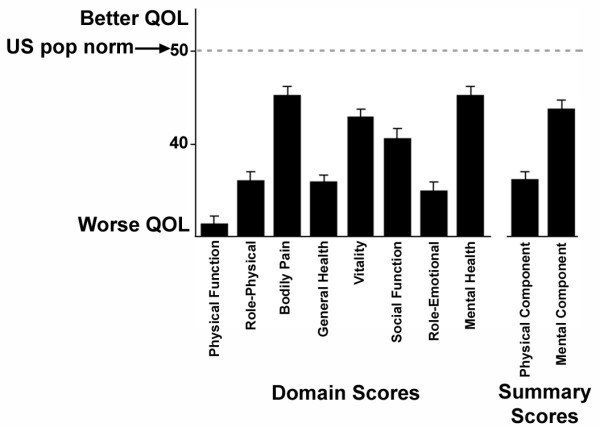
Figure 1
Figure 1
Health-Related Quality of Life Scores for Patients with Pulmonary Arterial Hypertension. Shown are mean (±SE) scores on each domain and summary component score of the SF36. Numerically higher scores indicate better health-related quality of life. All domain and summary scores are significantly lower than the US population normal score of 50 (p < 0.001 for each).
Figure 2
Figure 2
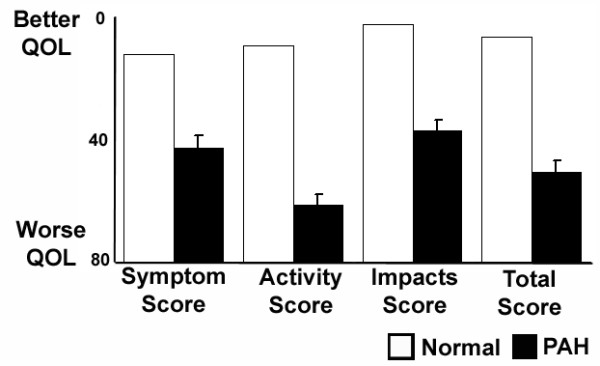
Respiratory-Disease Specific Health-Related Quality of Life Scores in Patients with Pulmonary Arterial Hypertension. Mean (±SE) scores on the Saint George's Respiratory Questionnaire for patients with pulmonary arterial hypertension are compared with the normal population. Numerically lower scores indicate better health-related quality of life. P < 0.0001 for the comparison between normal scores and PAH patients for each.
Figure 3
Figure 3
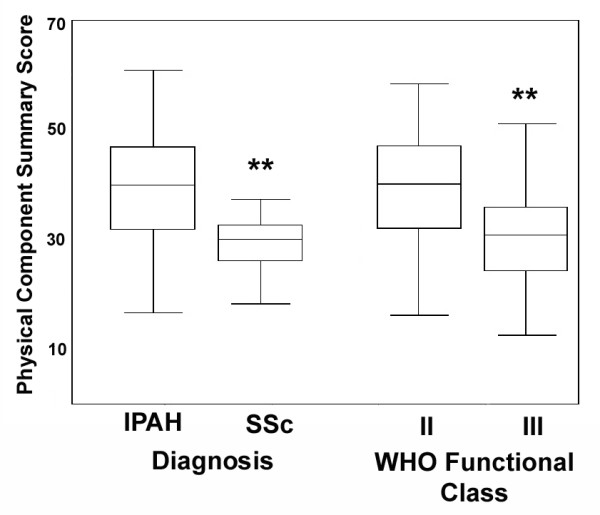
Box and whisker plots of scores on the physical and mental component summary measures of the SF36 according to PAH diagnosis and World Health Organization (WHO) Functional Class. ** indicates p < 0.0001 for the difference between patients with idiopathic pulmonary arterial hypertension (IPAH) and systemic sclerosis (SSc) related PAH, and for the difference between WHO Class II and III patients.
Figure 4
Figure 4
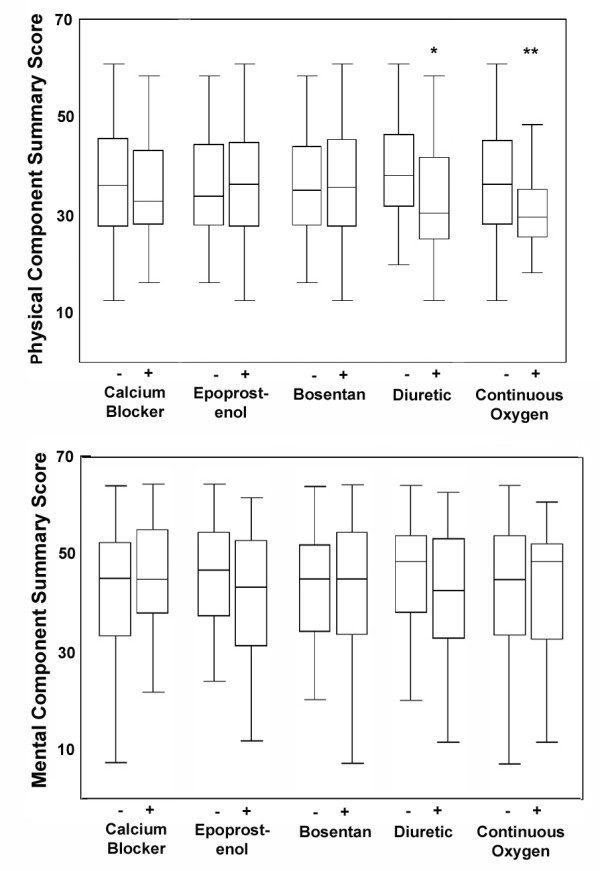
Box and whisker plots of scores on the physical and mental component summary measures of the SF36 according to treatments received at the time HRQOL assessment was performed. * indicates p ≤ 0.001 for the comparison between patients receiving or not receiving diuretics; ** p = 0.03 for the comparison between patients receiving or not receiving continuous oxygen therapy.
Figure 5
Figure 5
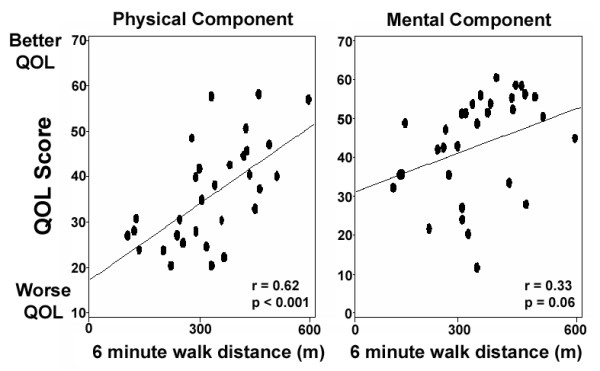
Correlation of six-minute walk distance and health-related quality of life scores. Y-axes indicate scores on the physical and mental component summary scores of the SF-36.
Figure 6
Figure 6
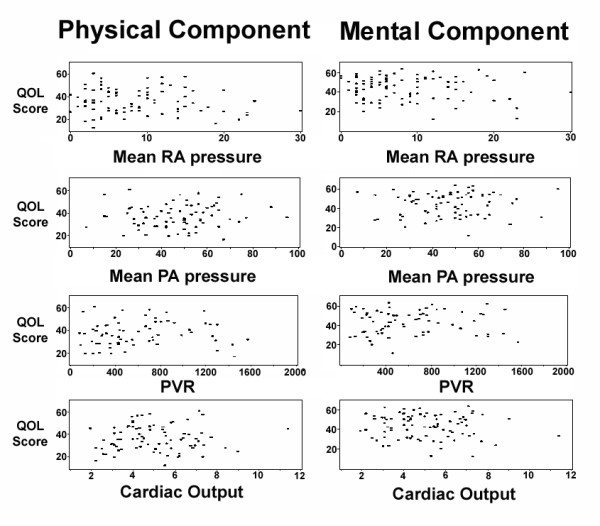
Lack of correlation of hemodynamic values and health-related quality of life scores. RA, right atrial pressure (mmHg); PA, mean pulmonary artery pressure (mmHg); PVR, pulmonary vascular resistance (dyne·sec·m5), Cardiac output = liters/minute. Y-axes indicate the physical and mental component summary scores of the SF-36.
Figure 7
Figure 7
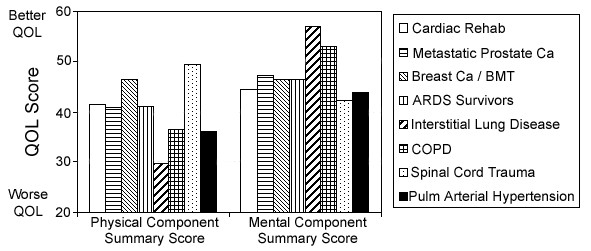
Comparison of health-related quality of life scores between disease states. Shown are mean population scores for the physical and mental component summary scores of the SF-36. Scores shown are derived from previous reports of cardiac rehabilitation [20], metastatic prostate cancer unresponsive to therapy [21], bone marrow transplantation for breast cancer [22], survivors of acute respiratory distress syndrome [23], interstitial lung disease [24], chronic obstructive lung disease [25] and spinal cord injury [26]. Previously published scores were normalized for comparison, as described in methods. Data shown for patients with pulmonary arterial hypertension are from the present study (as in Figure 1), shown here for comparison. Y-axis indicates the physical and mental component summary scores of the SF-36.

References

    1. Rubin LJ. Primary pulmonary hypertension. N Engl J Med. 1997;336:111–117. doi: 10.1056/NEJM199701093360207. - DOI - PubMed
    1. Rich S, Dantzker DR, Ayres SM, Bergofsky EH, Brundage BH, Detre KM, Fishman AP, Goldring RM, Groves BM, Koerner SK. Primary pulmonary hypertension. A national prospective study. Ann Intern Med. 1987;107:216–223. - PubMed
    1. D'Alonzo GE, Barst RJ, Ayres SM, Bergofsky EH, Brundage BH, Detre KM, Fishman AP, Goldring RM, Groves BM, Kernis JT, et al. Survival in patients with primary pulmonary hypertension. Results from a national prospective registry. Ann Intern Med. 1991;115:343–349. - PubMed
    1. Rubin LJ, Galie N. Pulmonary arterial hypertension: a look to the future. J Am Coll Cardiol. 2004;43:89S–90S. doi: 10.1016/j.jacc.2004.02.030. - DOI - PubMed
    1. Hoeper MM, Oudiz RJ, Peacock A, Tapson VF, Haworth SG, Frost AE, Torbicki A. End points and clinical trial designs in pulmonary arterial hypertension: clinical and regulatory perspectives. J Am Coll Cardiol. 2004;43:48S–55S. doi: 10.1016/j.jacc.2004.02.010. - DOI - PubMed

Publication types