. 2005 Aug 10:2:50.
doi: 10.1186/1742-4690-2-50.

Use of endogenous retroviral sequences (ERVs) and structural markers for retroviral phylogenetic inference and taxonomy

Affiliations

Use of endogenous retroviral sequences (ERVs) and structural markers for retroviral phylogenetic inference and taxonomy

Patric Jern et al. Retrovirology. .

Abstract

Background: Endogenous retroviral sequences (ERVs) are integral parts of most eukaryotic genomes and vastly outnumber exogenous retroviruses (XRVs). ERVs with a relatively complete structure were retrieved from the genetic archives of humans and chickens, diametrically opposite representatives of vertebrate retroviruses (over 3300 proviruses), and analyzed, using a bioinformatic program, RetroTector, developed by us. This rich source of proviral information, accumulated in a local database, and a collection of XRV sequences from the literature, allowed the reconstruction of a Pol based phylogenetic tree, more extensive than previously possible. The aim was to find traits useful for classification and evolutionary studies of retroviruses. Some of these traits have been used by others, but they are here tested in a wider context than before.

Results: In the ERV collection we found sequences similar to the XRV-based genera: alpha-, beta-, gamma-, epsilon- and spumaretroviruses. However, the occurrence of intermediates between them indicated an evolutionary continuum and suggested that taxonomic changes eventually will be necessary. No delta or lentivirus representatives were found among ERVs. Classification based on Pol similarity is congruent with a number of structural traits. Acquisition of dUTPase occurred three times in retroviral evolution. Loss of one or two NC zinc fingers appears to have occurred several times during evolution. Nucleotide biases have been described earlier for lenti-, delta- and betaretroviruses and were here confirmed in a larger context.

Conclusion: Pol similarities and other structural traits contribute to a better understanding of retroviral phylogeny. "Global" genomic properties useful in phylogenies are i.) translational strategy, ii.) number of Gag NC zinc finger motifs, iii.) presence of Pro N-terminal dUTPase (dUTPasePro), iv.) presence of Pro C-terminal G-patch and v.) presence of a GPY/F motif in the Pol integrase (IN) C-terminal domain. "Local" retroviral genomic properties useful for delineation of lower level taxa are i.) host species range, ii.) nucleotide compositional bias and iii.) LTR lengths.


Figures
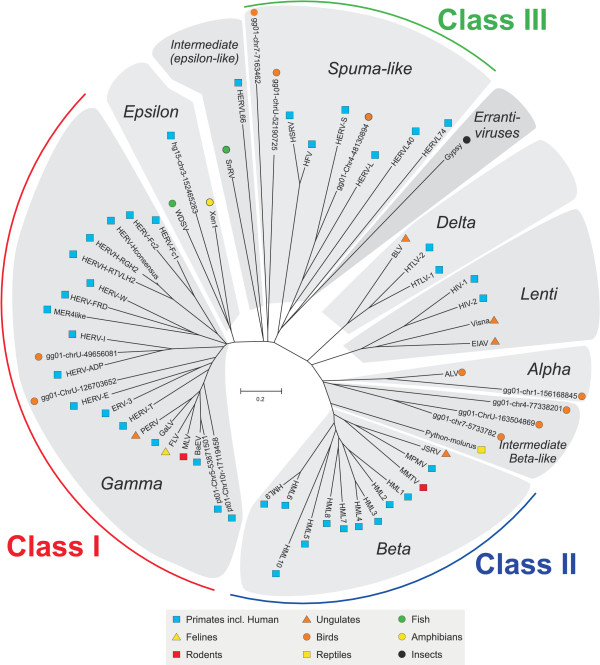
Figure 1
Figure 1
Representative unrooted Pol neighbor joining (NJ) dendrogram. Unrooted Pol neighbor joining (NJ) dendrogram (500 bootstraps consensus) of the seven retroviral genera: alpha-, beta-, gamma-, delta-, epsilon-, lenti- and spuma-like retroviruses. The somewhat more loosely defined (endogenous) retroviral classes are indicated in the periphery. The various host species are indicated with symbols next to each taxonomic unit. The novel sequences are named according to their chromosomal positions within respective genomes. (hg15 and 16: Human genome; gg01: Chicken genome and pt01: chimpanzee genome). The two pt01 sequences were unique to chimpanzee and not found in humans [Jern et al. submitted].
Figure 2
Figure 2
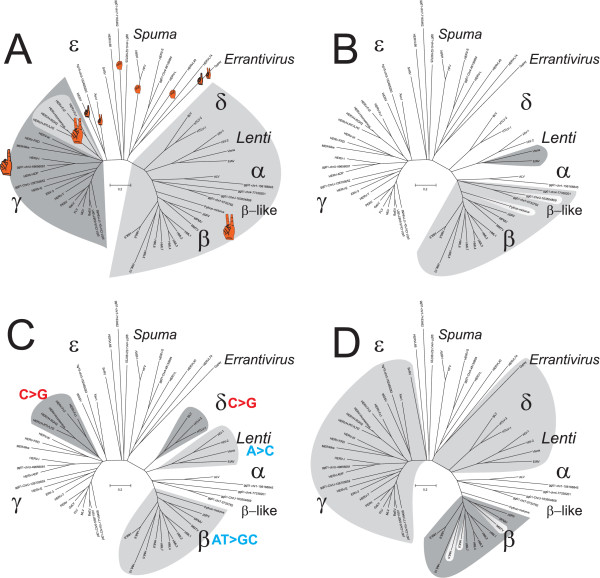
Structural traits projected onto the Pol dendrogram. The pol dendrograms in panels A to D are all derived from figure 1. A. The number of recognized Gag NC zinc finger motifs within respective genera. Detections of two NC zinc fingers are marked in light grey for all genera to the right from deltaretroviruses to betaretroviruses, and also for the gammaretroviral HERV-H. The remaining gammaretroviral elements (dark grey) had one NC zinc finger B. Presence of dUTPase is highlighted in grey. The non-primate lentiviral dUTPasePolA (dark grey) is found within Pol and the dUTPasePro (light grey) are found N-terminal of Pro. The dUTPasePro appears to occasionally have been lost, indicated by the two uncolored intermediate chicken and python ERVs. dUTPasePolB. of foamy viruses is not indicated. C. Nucleotide biases may be useful in demarcating retroviral groups locally and the most obvious found are here highlighted. For more detail see refs [31, 40]. D. Genera with detected Pol C-terminal GPY/F motifs are marked light grey and Pro C-terminal G-patch marked in dark grey (exclusively in betaretroviruses). Some betaretroviruses missed a G-Patch and are therefore unmarked.
Figure 3
Figure 3
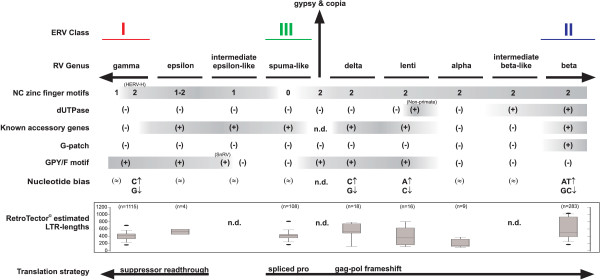
Structural traits summary. Simplified view of the different genotypic traits suggested for retroviral phylogeny inference. The branch for Gypsy and Copia represent an imagined midpoint reference in the tree. The number of NC zinc fingers, presence of dUTPase (dUTPasePolB is not indicated), known accessory genes, C-terminal Pro (G-patch) and Pol (GPY/F) motifs are shown. Nucleotide bias was defined to 25 ± 5 %. (↑) shifted upwards; (↓) shifted downwards; (≈) uncertain bias. Exploration of the LTR lengths of the different groups as detected by RetroTector© are shown as boxplots. In addition, the translational strategy may be used in the phylogeny to separate the gammaretroviruses (including class I ERVs) from spuma-like elements (class III ERVs), deltaretroviruses, lentiviruses, alpharetroviruses and the betaretroviruses (class II ERVs) with respective intermediate groups. The Gypsy and Copia are not included in the translational strategy analysis.

References

    1. Kumar A, Bennetzen JL. Plant retrotransposons. Annu Rev Genet. 1999;33:479–532. doi: 10.1146/annurev.genet.33.1.479. - DOI - PubMed
    1. Gao F, Bailes E, Robertson DL, Chen Y, Rodenburg CM, Michael SF, Cummins LB, Arthur LO, Peeters M, Shaw GM, Sharp PM, Hahn BH. Origin of HIV-1 in the chimpanzee Pan troglodytes troglodytes. Nature. 1999;397:436–441. doi: 10.1038/17130. - DOI - PubMed
    1. Yohn CT, Jiang Z, McGrath SD, Hayden KE, Khaitovich P, Johnson ME, Eichler MY, McPherson JD, Zhao S, Paabo S, Eichler EE. Lineage-Specific Expansions of Retroviral Insertions within the Genomes of African Great Apes but Not Humans and Orangutans. PLoS Biol. 2005;3:1–11. doi: 10.1371/journal.pbio.0030110. - DOI - PMC - PubMed
    1. International Human Genome Sequencing Consortium Initial sequencing and analysis of the human genome. Nature. 2001;409:860–921. doi: 10.1038/35057062. - DOI - PubMed
    1. Unpublished data from the Washington University and MIT/Broad Institute Sequencing Centers (directed by Rick Wilson and Eric Lander, respectively) are publicly released at [http://genome.ucsc.edu/]. See also NHGRI Press Release [www.nih.gov/news/pr/dec2003/nhgri-10.htm].

Publication types

LinkOut - more resources