Comparative Study
. 2005 Aug 23;102(34):12071-6.
doi: 10.1073/pnas.0502383102. Epub 2005 Aug 10.

Brain and muscle Arnt-like protein-1 (BMAL1), a component of the molecular clock, regulates adipogenesis

Affiliations
Comparative Study

Brain and muscle Arnt-like protein-1 (BMAL1), a component of the molecular clock, regulates adipogenesis

Shigeki Shimba et al. Proc Natl Acad Sci U S A. .

Abstract

Brain and muscle Arnt-like protein-1 (BMAL1; also known as MOP3 or Arnt3) is a transcription factor known to regulate circadian rhythm. Here, we established its involvement in the control of adipogenesis and lipid metabolism activity in mature adipocytes. During adipose differentiation in 3T3-L1 cells, the level of BMAL1 mRNA began to increase 4 days after induction and was highly expressed in differentiated cells. In white adipose tissues isolated from C57BL/6J mice, BMAL1 was predominantly expressed in a fraction containing adipocytes, as compared with the stromal-vascular fraction. BMAL1 knockout mice embryonic fibroblast cells failed to be differentiated into adipocytes. Importantly, adding BMAL1 back by adenovirus gene transfer restored the ability of BMAL1 knockout mice embryonic fibroblast cells to differentiate. Knock-down of BMAL1 expression in 3T3-L1 cells by an RNA interference technique allowed the cells to accumulate only minimum amounts of lipid droplets in the cells. Adenovirus-mediated expression of BMAL1 in 3T3-L1 adipocytes resulted in induction of several factors involved in lipogenesis. The promoter activity of these genes was stimulated in a BMAL1-dependent manner. Interestingly, expression of these factors showed clear circadian rhythm in mice adipose tissue. Furthermore, overexpression of BMAL1 in adipocytes increased lipid synthesis activity. These results indicate that BMAL1, a master regulator of circadian rhythm, also plays important roles in the regulation of adipose differentiation and lipogenesis in mature adipocytes.


Figures
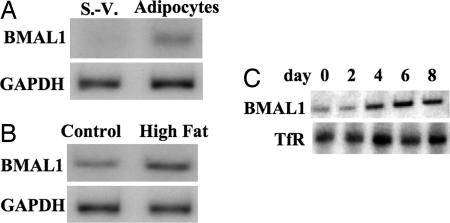
Fig. 1.
Fig. 1.
Expression of BMAL1 during adipose differentiation. (A) White adipose tissue was excised from three male C57BL/6J mice (6 weeks old), mixed, and fractionated into adipocyte and a stromal–vascular (S.-V.) fractions. The total RNA was isolated, and the expression of BMAL1 mRNA was determined by Northern blot analysis. (B) Obese C57BL/6J mice were generated by feeding with a high-fat diet for 4 weeks. White adipose tissue was excised from three each of control mice and obese mice, and the expression of BMAL1 mRNA was determined by Northern blot analysis. (C) Differentiation of 3T3-L1 cells was induced by the standard protocol. The expression of BMAL1 mRNA during adipose differentiation in 3T3-L1 cells was determined by Northern blot analysis. TfR, transferrin receptor.
Fig. 2.
Fig. 2.
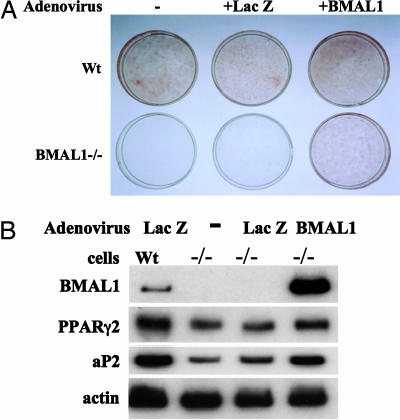
Comparison of adipose differentiation potency of wild-type (Wt) MEF and BMAL1 knockout MEF. (A) MEFs isolated from C57BL/6J mice (wild-type) or BMAL1 knockout mice (BMAL1–/–) were infected with an adenovirus carrying LacZ or BMAL1 at a multiplicity of infection of ≈10 for 24 h. The cells were then induced to differentiate in the presence of pioglitazone (5 μM) for 10 days and fixed and stained with oil red O. (B) Total RNA was extracted, and the expression of adipocyte-related genes was determined by Northern blot analysis.
Fig. 3.
Fig. 3.
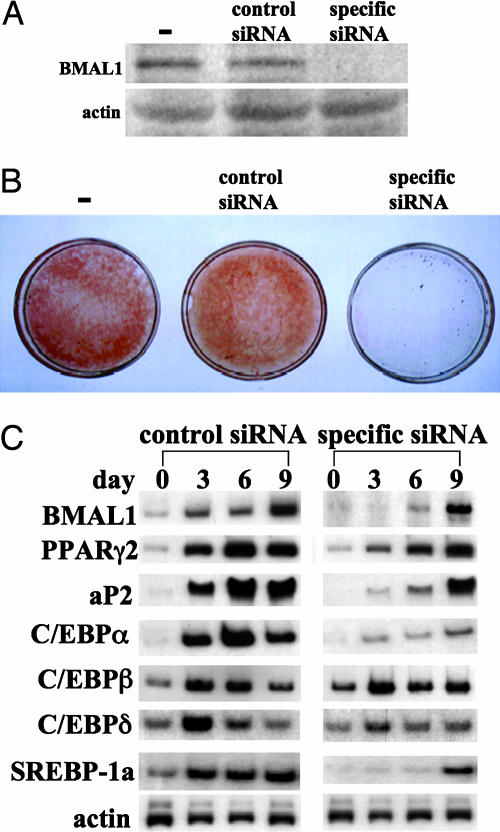
Effects of knock-down of BMAL1 expression on adipogenesis in 3T3-L1 cells. Scrambled siRNA (control) or specific siRNA for BMAL1 was introduced into 3T3-L1 cells by electroporation. One day after transfection, cells were induced to differentiate by standard protocol. (A) The BMAL1 protein level was determined after 72 h of electroporation by Western blot. (B) Cells differentiated for 9 d were fixed and stained with oil red O. (C) Total RNA was extracted at the indicated time points, and the expression of adipocyte-related genes was determined by Northern blot analysis.
Fig. 4.
Fig. 4.
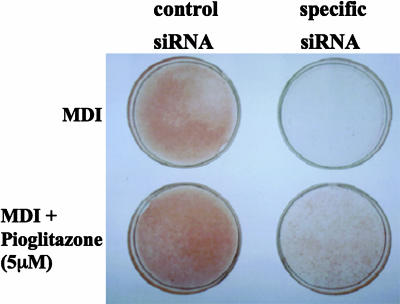
Restoration of the differentiation potential of BMAL1 knock-down cells by treatment with the PPARγ ligand. 3T3-L1 preadipocytes electroporated with scrambled siRNA (control) or specific siRNA for BMAL1 were treated with differentiation medium containing the indicated reagents. On day 7, the cells were fixed and stained with oil red O. M, IBMX. D, DEX. I, insulin.
Fig. 5.
Fig. 5.
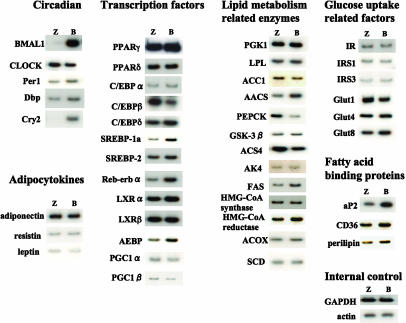
Effects of BMAL1 overexpression on expression of lipogenesis-related factors in 3T3-L1 adipocytes. 3T3-L1 adipocytes were infected with an adenovirus carrying LacZ (Z) or BMAL1 (B) at a multiplicity of infection of ≈30 for 24 h. Total RNA was extracted, and the expression of genes was determined by Northern blot analysis. The results shown are representative of three independent virus preparations with similar results. Dbp, albumin D site-binding protein; LXR, liver X receptor; AEBP, adipocyte enhancer-binding protein; PGC, PPARγ coactivator; PGK, phosphoglycerate kinase; LPL, lipoprotein lipase; ACC1, acetyl-CoA carboxylase 1; PEPCK, phosphoenolpyruvate carboxykinase; GSK-3β, glycogen synthase kinase-3β; AK4, adenylate kinase 4; ACS4, acyl-CoA synthetase 4; ACOX, acyl-CoA oxidase; SCD, stearoyl-CoA desaturase; IR, insulin receptor; IRS, insulin receptor substrate; Glut, glucose transporter.
Fig. 6.
Fig. 6.
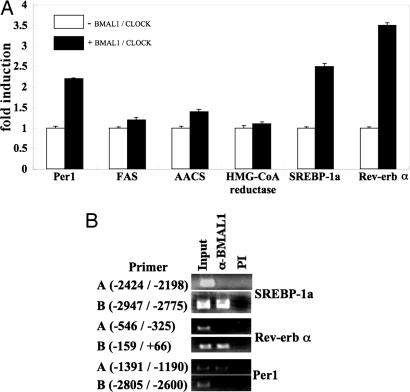
BMAL1 as activator of the promoter activity of SREBP-1a and Rev-erb α. (A) BMAL1 and CLOCK expression plasmids (50 ng each) were transfected into HEK-293 cells with the reporter plasmid (50 ng) carrying the promoter region of the indicated genes. For all constructs, the pRL-SV40 vector was cotransfected to correct for differences in transfection efficiency. The normalized luciferase activity for the samples with the expression vector of BMAL1 and CLOCK (+) is expressed as n-fold induction relative to that without expression vector of BMAL1 and CLOCK (–). The averages of three independent experiments are shown. (B) Chromatin-associated fragmented DNA from 3T3-L1 adipocytes was immunoprecipitated with preimmune (PI) serum or antibodies to BMAL1. Precipitated DNA fragments were subjected to PCR amplification along with specific primers flanking the putative BMAL1/CLOCK binding site. Primer sets A and B bind to different regions on the genes. The position of the primer binding site in each gene is indicated. In all cases, only the expected single 200-bp PCR product was observed.
Fig. 7.
Fig. 7.
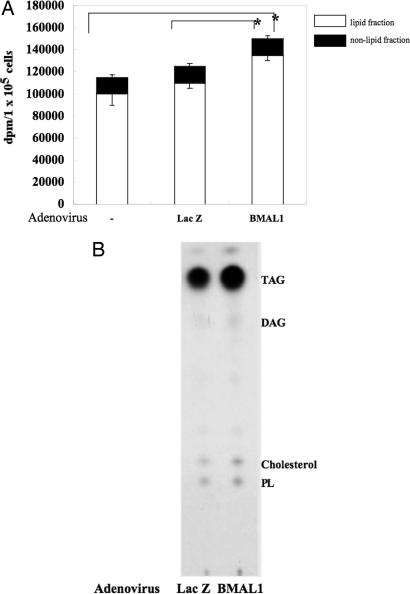
BMAL1 as an enhancer of lipid synthesis activity in 3T3-L1 adipocytes. 3T3-L1 adipocytes were infected with an adenovirus carrying LacZ or BMAL1 at a multiplicity of infection of ≈30 for 24 h. (A) The infected cells were incubated with 0.5 mM [14C]sodium acetate in differentiation medium for 90 min, after which the cells were harvested for measurement of 14C-labeled fatty acids and cholesterol. Values are the means of five different experiments. Asterisks indicate significant differences (P < 0.05) from the value of uninfected cells (–) or LacZ-adenovirus infected cells. (B) 14C-labeled fatty acids and cholesterol extracted from the cells were separated by TLC. Phospholipids (PL), cholesterol, diacylglycerol (DAG), and triacylglycerol (TAG) are indicated.

References

    1. Spiegelman, B. M. & Flier, J. S. (2001) Cell 104, 531–543. - PubMed
    1. Ahima, R. S. & Flier, J. S. (2000) Trends Endocrinol. Metab. 11, 327–332. - PubMed
    1. Seaman, G. V., Engel, R., Swank, R. I. & Hissen, W. (1965) Nature 207, 833–835. - PubMed
    1. Malherbe, C., De Gasparo, M., De Hertogh, R. & Hoet, J. J. (1969) Diabetologia 5, 397–404. - PubMed
    1. Gagliardino, J. J. & Hernandez, R. E. (1971) Endocrinology 88, 1532–1534. - PubMed

Publication types

MeSH terms

LinkOut - more resources