


Myomodulin increases Ih and inhibits the NA/K pump to modulate bursting in leech heart interneurons
- PMID: 16093342
- PMCID: PMC1560091
- DOI: 10.1152/jn.00340.2005
Myomodulin increases Ih and inhibits the NA/K pump to modulate bursting in leech heart interneurons
Abstract
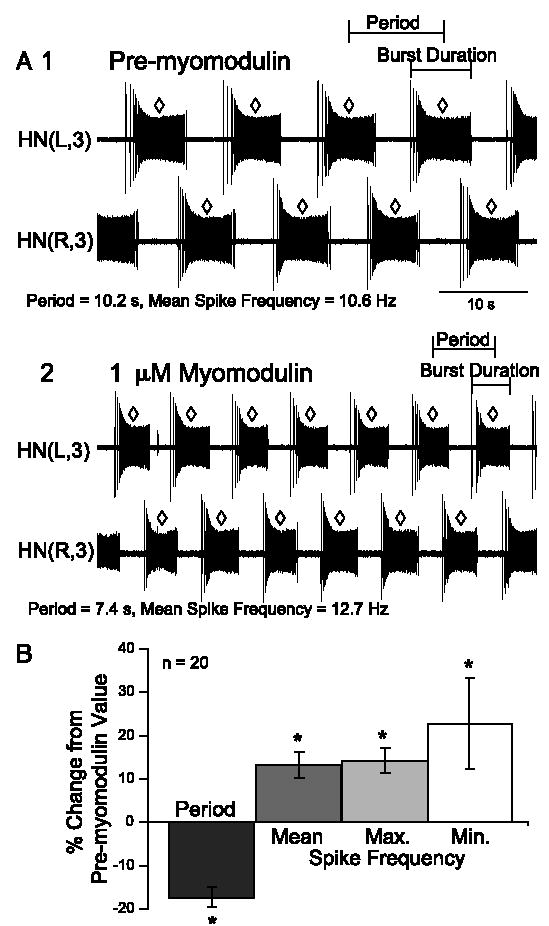
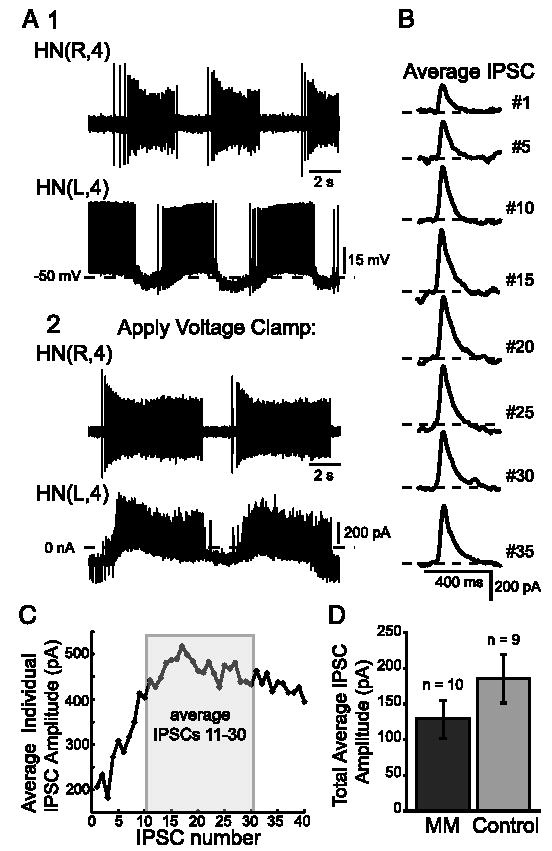
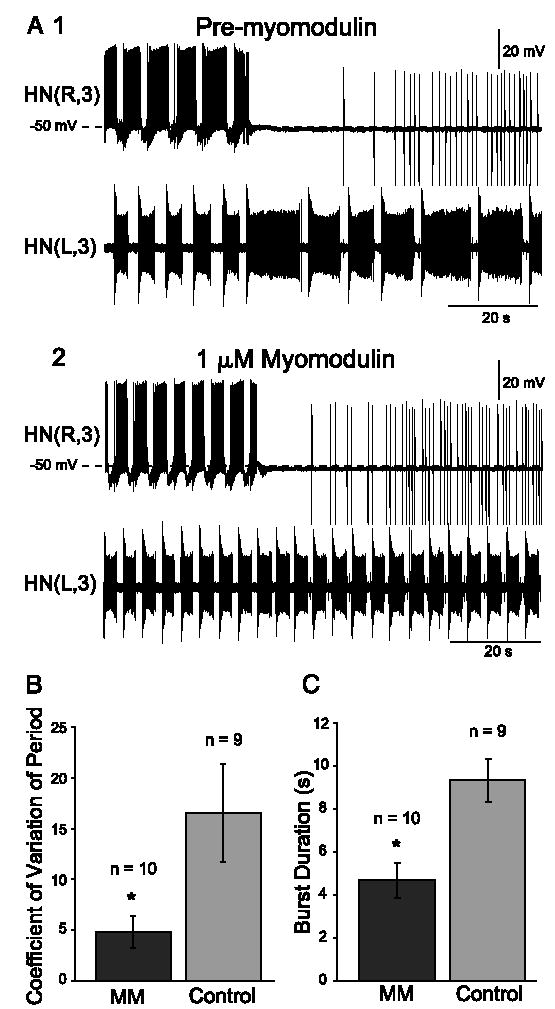
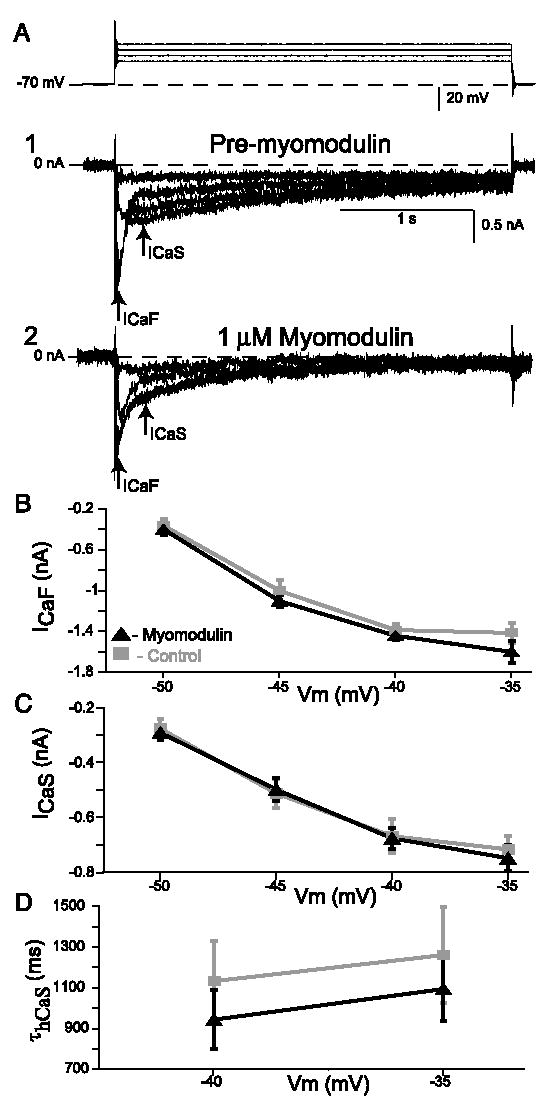
In the medicinal leech, a rhythmically active 14-interneuron network composes the central pattern generator for heartbeat. In two segmental ganglia, bilateral pairs of reciprocally inhibitory heart interneurons (oscillator interneurons) produce a rhythm of alternating bursts of action potentials that paces activity in the pattern-generating network. The neuropeptide myomodulin decreases the period of this bursting and increases the intraburst spike frequency when applied to isolated ganglia containing these oscillator interneurons. Myomodulin also decreases period, increases spike frequency, and increases the robustness of endogenous bursting in synaptically isolated (with bicuculline) oscillator interneurons. In voltage-clamp experiments using hyperpolarizing ramps, we identify an increase in membrane conductance elicited by myomodulin with the properties of a hyperpolarization-activated current. Voltage steps confirm that myomodulin indeed increases the maximum conductance of the hyperpolarization-activated current I(h). In similar experiments using Cs(+) to block I(h), we demonstrate that myomodulin also causes a steady offset in the ramp current that is not associated with an increase in conductance. This current offset is blocked by ouabain, indicating that myomodulin inhibits the Na/K pump. In current-clamp experiments, when I(h) is blocked with Cs(+), myomodulin decreases period and increases spike frequency of alternating bursting in synaptically connected oscillator interneurons, suggesting that inhibiting the Na/K pump modulates these burst characteristics. These observations indicate that myomodulin decreases period and increases spike frequency of endogenous bursting in synaptically isolated oscillator heart interneurons and alternating bursting of reciprocally inhibitory pairs of interneurons, at least in part, by increasing I(h) and by decreasing the Na/K pump.
Figures



References
-
- Aizman O, Brismar H, Uhlen P, Zettergren E, Levey AI, Forssberg H, Greengard P, Aperia A. Anatomical and physiological evidence for D1 and D2 dopamine receptor colocalization in neostriatal neurons. Nat Neurosci. 2000;3:226–230. - PubMed
-
- Angstadt JD, Friesen WO. Synchronized oscillatory activity in leech neurons induced by calcium channel blockers. J Neurophysiol. 1991;66:1858–1873. - PubMed
-
- Arbas EA. Rate modification in the heartbeat central pattern generator of the medicinal leech. J Comp Physiol A Sens Neural Behav Physiol. 1984;155:783–794.
Publication types
MeSH terms
Substances
Grants and funding
LinkOut - more resources
Full Text Sources
Miscellaneous
