


Three subsets of sequence complexity and their relevance to biopolymeric information
- PMID: 16095527
- PMCID: PMC1208958
- DOI: 10.1186/1742-4682-2-29
Three subsets of sequence complexity and their relevance to biopolymeric information
Abstract
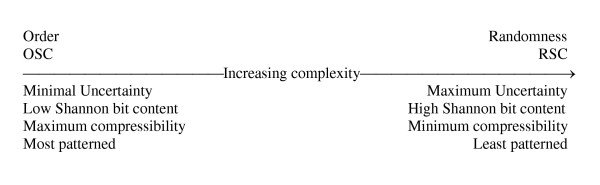
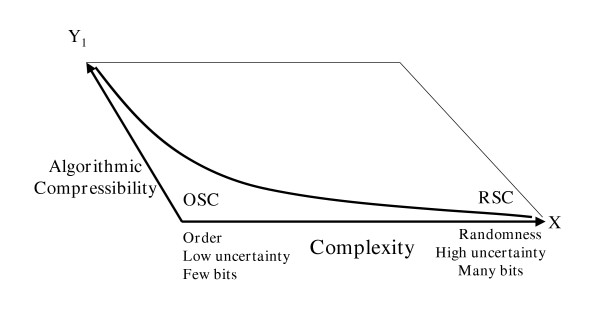
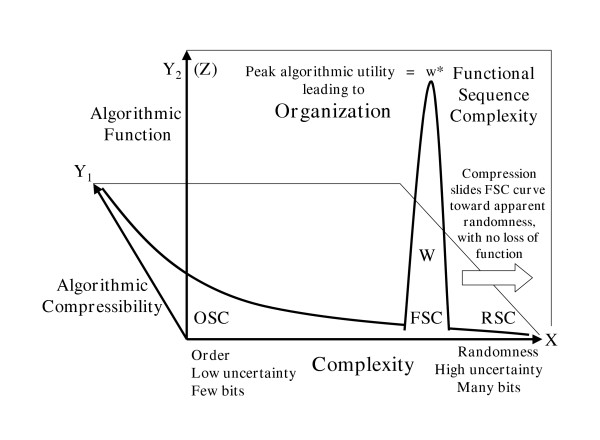
Genetic algorithms instruct sophisticated biological organization. Three qualitative kinds of sequence complexity exist: random (RSC), ordered (OSC), and functional (FSC). FSC alone provides algorithmic instruction. Random and Ordered Sequence Complexities lie at opposite ends of the same bi-directional sequence complexity vector. Randomness in sequence space is defined by a lack of Kolmogorov algorithmic compressibility. A sequence is compressible because it contains redundant order and patterns. Law-like cause-and-effect determinism produces highly compressible order. Such forced ordering precludes both information retention and freedom of selection so critical to algorithmic programming and control. Functional Sequence Complexity requires this added programming dimension of uncoerced selection at successive decision nodes in the string. Shannon information theory measures the relative degrees of RSC and OSC. Shannon information theory cannot measure FSC. FSC is invariably associated with all forms of complex biofunction, including biochemical pathways, cycles, positive and negative feedback regulation, and homeostatic metabolism. The algorithmic programming of FSC, not merely its aperiodicity, accounts for biological organization. No empirical evidence exists of either RSC of OSC ever having produced a single instance of sophisticated biological organization. Organization invariably manifests FSC rather than successive random events (RSC) or low-informational self-ordering phenomena (OSC).
Figures
References
-
- Shannon CE, Weaver W. The Mathematical Theory of Communication. Urbana, IL , University of Illinois Press; 1949.
-
- Shannon C. Part I and II: A mathematical theory of communication. The Bell System Technical Journal. 1948;XXVII:379–423.
-
- Shannon C. Part III: A mathematical theory of communication. The Bell System Technical Journal. 1948;XXVII:623–656.
-
- Kolmogorov AN. Three approaches to the definition of the concept "quantity of information". Problems Inform Transmission. 1965;1:1–7.
-
- Li M, Vitanyi P. An Introduction to Kolmogorov Complexity and Its Applications. In: Gries DSFB, editor. Graduate Texts in Computer Science. 2. New York , Springer-Verlag; 1997. p. 637.
Publication types
MeSH terms
Substances
LinkOut - more resources
Full Text Sources
