


Spiders that decorate their webs at higher frequency intercept more prey and grow faster
- PMID: 16096085
- PMCID: PMC1559872
- DOI: 10.1098/rspb.2005.3160
Spiders that decorate their webs at higher frequency intercept more prey and grow faster
Abstract
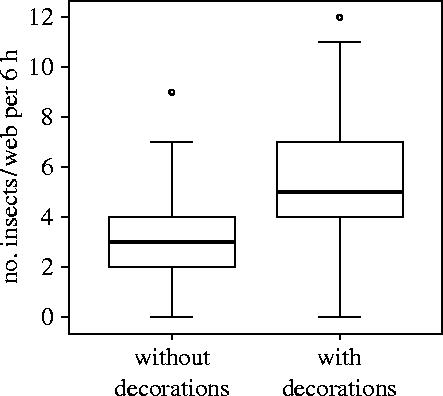
Many orb-weaving spiders decorate their webs with extra, bright white, ultraviolet light reflecting silk. Previous studies suggest that these decorations increase a spider's foraging efficiency by improving web attractiveness, which is known as the prey-attraction hypothesis. One assumption of this hypothesis is that individuals which decorate their webs at a higher frequency are expected to have a higher growth rate. Using a decoration-building orb-weaving spider, Argiope versicolor, I show a strong positive relationship between the growth rate in terms of weight gain and the frequency of decoration-building, as well as the rate of insect interception. This is the first study to reveal a fitness consequence of decorating behaviour in spiders.
Figures


References
-
- Bélisle C, Cresswell J. The effects of limited memory capacity on foraging behavior. Theor. Popul. Biol. 1997;52:78–90. - PubMed
-
- Bjorkman-Chiswell B.T, Kulinski M.M, Muscat R.L, Nguyen K.A, Norton B.A, Symonds M.R, Westhorpe G.E, Elgar M.A. Web-building spiders attract prey by storing decaying matter. Naturwissenschaften. 2004;91:245–248. - PubMed
-
- Blackledge T.A. Signal conflict in spider webs driven by predators and prey. Proc. R. Soc. B. 1998a;265:1991–1996. - DOI
-
- Blackledge T.A. Stabilimentum variation and foraging success in Argiope aurantia and Argiope trifasciata (Araneae: Araneidae) J. Zool. Lond. 1998b;246:21–27.
-
- Blackledge T.A, Wenzel J.W. Do stabilimenta in orb webs attract prey or defend spiders? Behav. Ecol. 1999;10:372–376.
Publication types
MeSH terms
Substances
LinkOut - more resources
Full Text Sources
