Randomised controlled trial of the Lidcombe programme of early stuttering intervention
- PMID: 16096286
- PMCID: PMC1226241
- DOI: 10.1136/bmj.38520.451840.E0
Randomised controlled trial of the Lidcombe programme of early stuttering intervention
Abstract
Objectives: To evaluate the efficacy of the Lidcombe programme of early stuttering intervention by comparison to a control group.
Design: A pragmatic, open plan, parallel group, randomised controlled trial with blinded outcome assessment.
Setting: Two public speech clinics in New Zealand.
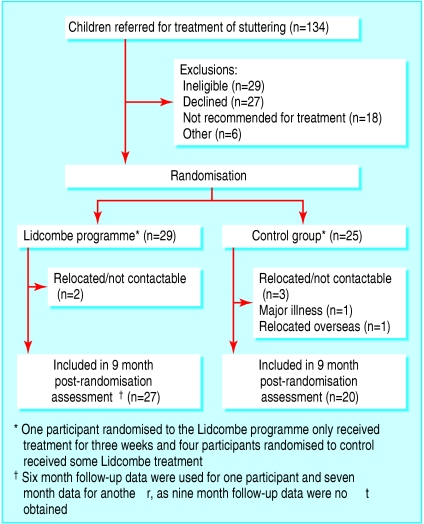
Participants: Stuttering preschool children who presented to the speech clinics for treatment. Inclusion criteria were age 3-6 years and frequency of stuttering of at least 2% syllables stuttered. Exclusion criteria were onset of stuttering during the six months before recruitment and treatment for stuttering during the previous 12 months. 54 participants were randomised: 29 to the Lidcombe programme arm and 25 to the control arm. 12 of the participants were girls.
Intervention: Lidcombe programme of early stuttering intervention.
Main outcome measures: Frequency of stuttering was measured as the proportion of syllables stuttered, from audiotaped recordings of participants' conversational speech outside the clinic. Parents in both arms of the trial collected speech samples in three different speaking situations before randomisation and at three, six, and nine months after randomisation.
Results: Analysis showed a highly significant difference (P = 0.003) at nine months after randomisation. The mean proportion of syllables stuttered at nine months after randomisation was 1.5% (SD 1.4) for the treatment arm and 3.9% (SD 3.5) for the control arm, giving an effect size of 2.3% of syllables stuttered (95% confidence interval 0.8 to 3.9). This effect size was more than double the minimum clinically worthwhile difference specified in the trial protocol.
Conclusions: The results provide evidence from a randomised controlled trial to support early intervention for stuttering. The Lidcombe programme is an efficacious treatment for stuttering in children of preschool age.
Figures
References
-
- Bloodstein O. A handbook on stuttering. San Diego, CA: Singular Publishing Group, 1995.
-
- Yairi E, Ambrose N. Early childhood stuttering I: persistency and recovery rates. J Speech Lang Hear Res 1999;42: 1097-12. - PubMed
-
- Yairi, E, Ambrose N, Paden EP, Throneburg RN. Predictive factors of persistence and recovery: pathways of childhood stuttering. J Commun Disord 1996;29: 51-77. - PubMed
-
- Craig AR, Calver P. Following up on treated stutterers: studies of perceptions of fluency and job status. J Speech Hear R 1991;34: 279-84. - PubMed
-
- Hayhow R, Cray AM, Enderby P. Stammering and therapy views of people who stammer. J Fluency Disord 2002;27: 1-16. - PubMed
Publication types
MeSH terms
LinkOut - more resources
Full Text Sources
Medical