. 2005 Aug 30;102(35):12449-54.
doi: 10.1073/pnas.0505530102. Epub 2005 Aug 12.

MicroRNAs acting in a double-negative feedback loop to control a neuronal cell fate decision

Affiliations

MicroRNAs acting in a double-negative feedback loop to control a neuronal cell fate decision

Robert J Johnston Jr et al. Proc Natl Acad Sci U S A. .

Abstract

The elucidation of the architecture of gene regulatory networks that control cell-type specific gene expression programs represents a major challenge in developmental biology. We describe here a cell fate decision between two alternative neuronal fates and the architecture of a gene regulatory network that controls this cell fate decision. The two Caenorhabditis elegans taste receptor neurons "ASE left" (ASEL) and "ASE right" (ASER) share many bilaterally symmetric features, but each cell expresses a distinct set of chemoreceptors that endow the gustatory system with the capacity to sense and discriminate specific environmental inputs. We show that these left/right asymmetric fates develop from a precursor state in which both ASE neurons express equivalent features. This hybrid precursor state is unstable and transitions into the stable ASEL or ASER terminal end state. Although this transition is spatially stereotyped in wild-type animals, mutant analysis reveals that each cell has the potential to transition into either the ASEL or ASER stable end state. The stability and irreversibility of the terminal differentiated state is ensured by the interactions of two microRNAs (miRNAs) and their transcription factor targets in a double-negative feedback loop. Simple feedback loops are found as common motifs in many gene regulatory networks, but the loop described here is unusually complex and involves miRNAs. The interaction of miRNAs in double-negative feedback loops may not only be a means for miRNAs to regulate their own expression but may also represent a general paradigm for how terminal cell fates are selected and stabilized.


Figures
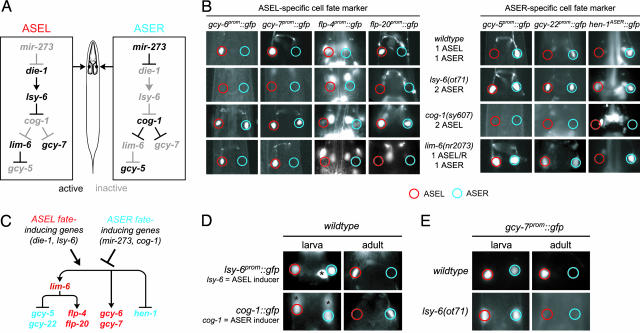
Fig. 1.
Fig. 1.
Mutations in lsy genes cause a state transition between the ASEL and ASER fates. (A) Gene regulatory factors controlling ASE laterality, as deduced by our previous genetic analysis (–6). The permissively acting, ASEL/R-expressed genes unc-37/Groucho, lin-49, and ceh-36 (4) are left out for clarity. mir-273 likely acts together with other mir-273-related miRNAs (D. Didiano and O.H., unpublished data), yet throughout this paper, we only show mir-273 for clarity. (B) ASEL- and ASER-specific cell fate markers and their regulation by lsy genes. ASER-specific expression can be observed with a subfragment from the hen-1 promoter (hen-1ASER::gfp). In all cases, reporter gene expression in ASE was unambiguously determined by using a chromosomally integrated rfp transgene in the genetic background, which is expressed in ASEL/R. Fig. 5, which is published as supporting information on the PNAS web site, shows the quantification of data. (C) Summary of the genetic interactions deduced from B. (D) Early bilateral expression of the ASEL inducer lsy-6 and of the ASER inducer cog-1. Early bilateral expression can also be observed for gcy-6, gcy-7, and lim-6 (Fig. 6, which is published as supporting information on the PNAS web site, shows the quantification of all observations). *, gfp-expressing cells other than ASE, which are out of focus in Right. (E) Even if both ASE neurons are fated to become ASER in class II lsy-6 mutant animals, they initially express both ASEL and ASER markers. See Fig. 6 for quantification of effects.
Fig. 2.
Fig. 2.
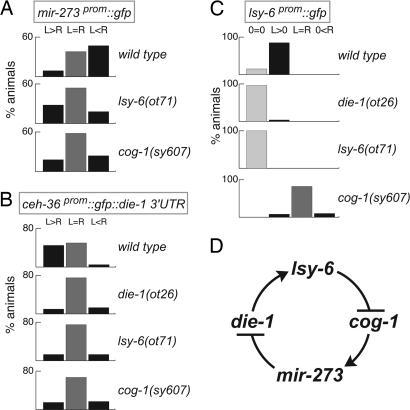
The miRNAs lsy-6 and mir-273 act in a bistable feedback loop. “L > R” and “L < R” refer to relative gfp expression levels in ASEL vs. ASER, “L = R” to equal gfp levels (weak or strong), and “0 = 0” to no expression (used only in C because of potential mosaicism of the extrachromosomal lines in A and B). Sample size, n = 34 to >100 adult animals. (A) lsy-6 and cog-1 are required for the asymmetric expression of mir-273prom::gfp. (B) die-1, lsy-6, and cog-1 are required for asymmetric expression of the die-1 sensor gene. (C) die-1, lsy-6, and cog-1 are required for asymmetric expression of lsy-6prom::gfp. (D) Model that summarizes genetic regulatory interactions.
Fig. 3.
Fig. 3.
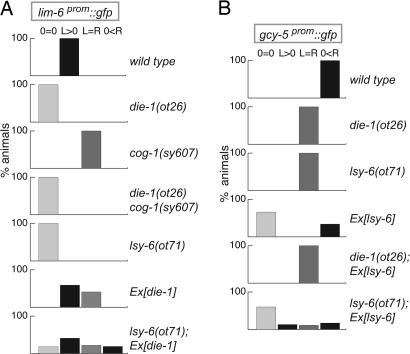
die-1 is the output regulator of effector genes. “0 = 0” refers to no gfp expression, “L > 0” or “0 < R” to exclusive gfp expression in ASEL or ASER, and “L = R” to equal expression. Sample size, n = 32 to >100 adult animals. (A) cog-1 requires die-1 and die-1 does not require lsy-6 to regulate lim-6. Ectopic expression of die-1 in ASER is observed in transgenic animals, which carry extra copies of the die-1 genomic locus (Ex[die-1]). These animals activate lim-6prom::gfp independent of lsy-6. (B) lsy-6 requires die-1 to regulate gcy-5 expression. lsy-6 was ectopically expressed in both ASEL and ASER under control of the ceh-36 promoter (Ex[lsy-6]).
Fig. 4.
Fig. 4.
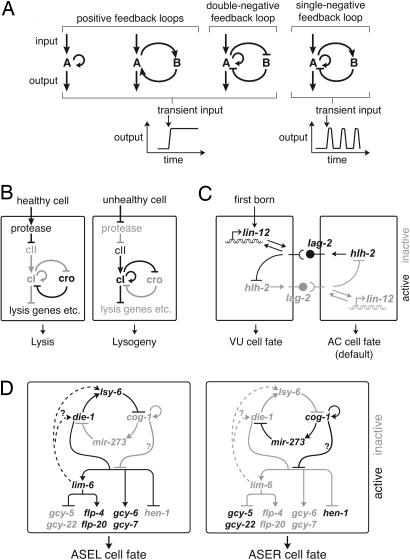
Feedback loops and bistable systems. (A) Architecture of different types of feedback loops. In the multicomponent loops, inputs and outputs can lead into or out of the loop from either “A” or “B.” Depending on the signs of the individual interaction, loops can either produce stable or oscillating outputs (11, 14, 18). (B) The phage lambda system displays bistable behavior regulated by a simple double-negative feedback loop (12). (C) In the AC/VU cell fate decision in vulval development in C. elegans, two equipotent germline precursor cells interact through the Notch/lin-12 receptor and its ligand Delta/lag-2 to induce two distinct cell fates (13). (D) Summary of the ASE bistable system. The feedback loop is likely to contain more components than those shown here because genetic screens for mutants affecting ASEL/R asymmetry uncovered a number of additional, as yet uncharacterized genes (unpublished data).

References

    1. Yu, S., Avery, L., Baude, E. & Garbers, D. L. (1997) Proc. Natl. Acad. Sci. USA 94, 3384–3387. - PMC - PubMed
    1. Pierce-Shimomura, J. T., Faumont, S., Gaston, M. R., Pearson, B. J. & Lockery, S. R. (2001) Nature 410, 694–698. - PubMed
    1. Hobert, O., Tessmar, K. & Ruvkun, G. (1999) Development (Cambridge, U.K.) 126, 1547–1562. - PubMed
    1. Chang, S., Johnston, R. J., Jr., & Hobert, O. (2003) Genes Dev. 17, 2123–2137. - PMC - PubMed
    1. Chang, S., Johnston, R. J., Frokjaer-Jensen, C., Lockery, S. & Hobert, O. (2004) Nature 430, 785–789. - PubMed

Publication types

LinkOut - more resources