


doi: 10.1529/biophysj.104.052290.
Epub 2005 Aug 12.
Interaction between lipid monolayers and poloxamer 188: an X-ray reflectivity and diffraction study
Affiliations
- PMID: 16100276
- PMCID: PMC1366812
- DOI: 10.1529/biophysj.104.052290
Item in Clipboard
Interaction between lipid monolayers and poloxamer 188: an X-ray reflectivity and diffraction study
Biophys J.
2005 Nov.
Abstract
The mechanism by which poloxamer 188 (P188) seals a damaged cell membrane is examined using the lipid monolayer as a model system. X-ray reflectivity and grazing-incidence x-ray diffraction results show that at low nominal lipid density, P188, by physically occupying the available area and phase separating from the lipids, forces the lipid molecules to pack tightly and restore the barrier function of the membrane. Upon compression to bilayer equivalent pressure, P188 is squeezed out from the lipid monolayer, allowing a graceful exit of P188 when the membrane integrity is restored.
Figures
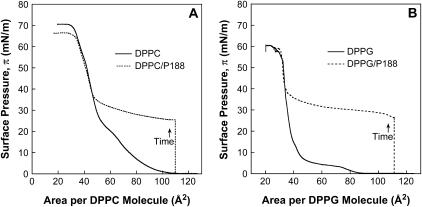
Lateral compression isotherms of (A) DPPC (solid line) and DPPC/P188 (dashed line) on a pure water subphase at 30°C. (B) DPPG (solid line) and DPPG/P188 (dashed line) on water subphase. For both the lipid/P188 systems, compression commenced 40 min after P188 injection. At surface pressures ≥36 mN/m for DPPC film, or ≥38 mN/m for DPPG film, the isotherms of the P188-treated systems overlap those of the pure lipids, indicating that P188 is “squeezed out” of the film at such surface pressures.
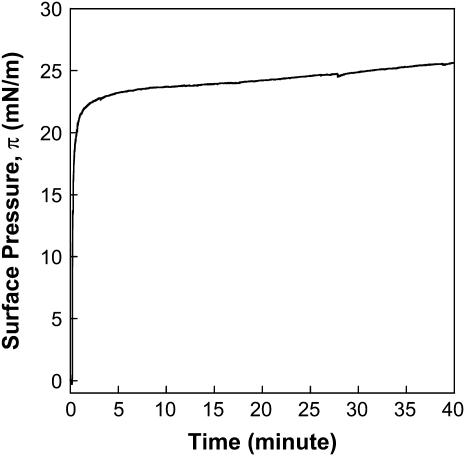
Change in surface pressure for a P188-treated DPPC monolayer on a water subphase at 30°C with time. P188 was introduced into water subphase at time = 0 when the pure lipid film gave a surface pressure of 0 mN/m.
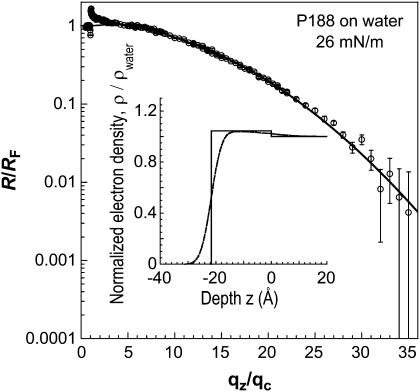
X-ray reflectivity data and fit for P188 at the air-water interface at 30°C. The double cusp of R/RF near qz = qc is an artifact. It comes from dividing the measured R(qz) (which is affected by finite resolution) by the ideally calculated Fresnel law RF(qz). Therefore, only data for qz > 3qc were included in the analysis. The inset is the corresponding normalized electron density profile ρ(z)/ρwater in smeared (by interfacial roughness) and unsmeared forms. z = 0 signifies the start of the water subphase.
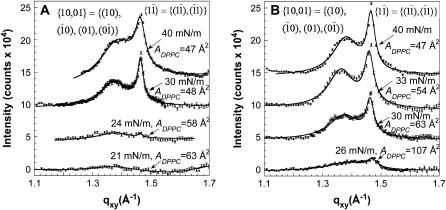
Bragg peaks from GIXD on a water subphase at 30°C for (A) pure DPPC and (B) DPPC/P188 films at various ADPPC. For clarity, the data have been offset vertically. The two GIXD Bragg peaks observed for DPPC at 40 mN/m indicate a distorted hexagonal packing of the lipid tails in a 2-D unit cell with parameters a = b = 5.05 Å, γ = 116.6°. The Miller indices {h, k} (distorted hexagonal lattice) are indicated for each peak. In B, the diffraction peak observed at ADPPC = 107 Å2 corresponds to a highly condensed lipid phase comparable to pure DPPC at ADPPC = 47 Å2, despite the large nominal ADPPC. The molecular packing parameters used in the fitting are listed in Table 1.
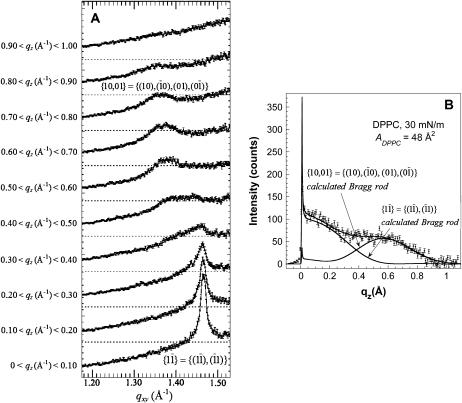
(A) Scattering intensity as a function of in-plane scattering vector component qxy for different qz intervals (intensity integrated over the vertical scattering vector qz in 10 successive 0.1-Å−1-wide qz-windows, as indicated) for a pure DPPC film on a water subphase at 30°C and 30 mN/m. (B) Bragg rod profiles for  and
and Bragg peaks for a pure DPPC film on a water subphase at 30°C and 30 mN/m. The Bragg rods were fitted (solid line) by approximating the coherently scattering part of the acyl chain by a cylinder of constant electron density. The sharp peak at qz = 0.01 Å−1 is the so-called Yoneda-Vineyard peak (Vineyard (54)), which arises from the interference between x-rays diffracted up into the Bragg rod and x-rays diffracted down and then reflected up by the interface.
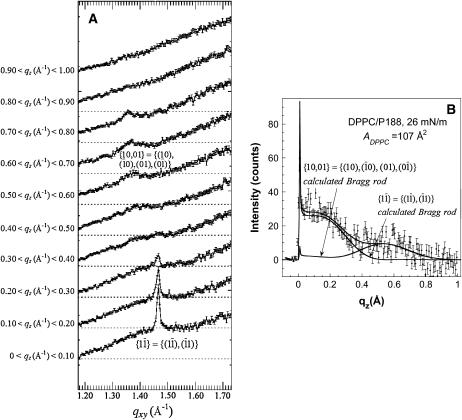
(A) Scattering intensity as a function of in-plane scattering vector component qxy for different qz intervals (intensity integrated over the vertical scattering vector qz in 10 successive 0.1-Å−1-wide qz-windows, as indicated) for the P188-treated DPPC film on a water subphase at 107 Å2/DPPC molecule and 30°C. (B) Background subtracted Bragg rod intensity distribution along qz vector integrated over the qxy range of the Bragg peaks. The rod was fitted (solid line) by approximating the coherently scattering part of the DPPC tail by a cylinder of a constant electron density.
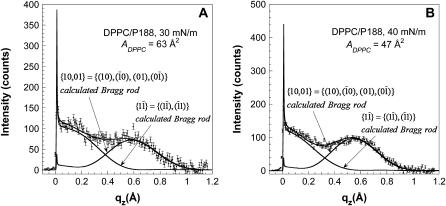
Bragg rod profiles for Bragg rods in the {10,01} and {1 } directions for a DPPC/P188 film on a water subphase at (A) ADPPC = 63 Å2 and (B) ADPPC = 47 Å2, both at 30°C. The rods were fitted (solid line) by approximating the coherently scattering part of the alkyl chain by a cylinder of constant electron density.
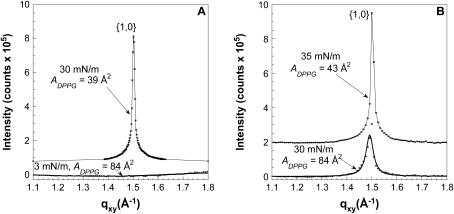
Bragg peaks at different packing densities from GIXD on a water subphase at 30°C of (A) pure DPPG and (B) DPPG/P188 films. For clarity, the data have been offset vertically.
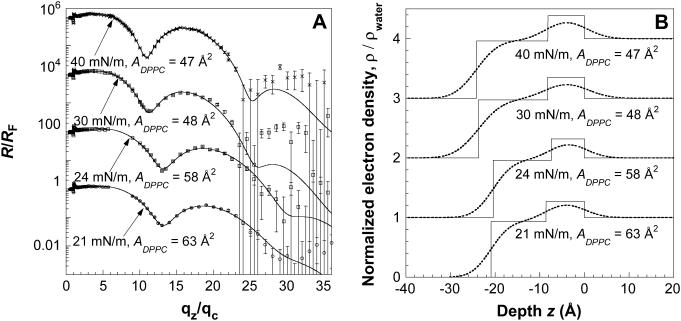
(A) X-ray reflectivity data for a DPPC monolayer on a water subphase at various surface packing densities at 30°C. The solid lines are fits to the data using box models, as discussed in the text. (B) The corresponding normalized electron density profiles for XR data. For clarity, the data have been offset vertically for all panels. z = 0 signifies the start of the water subphase. The fitting parameters are listed in Table 3.
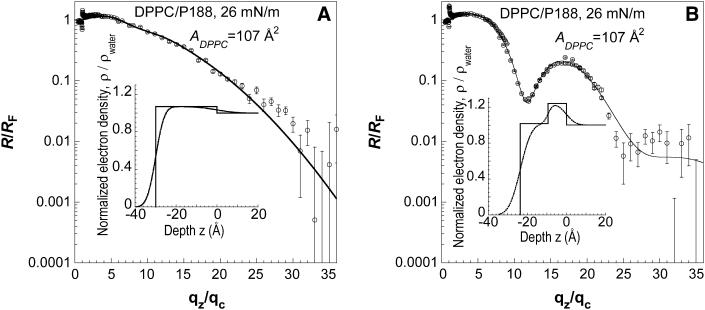
X-ray reflectivity data and fit for a DPPC/P188 film at (A) the P188-rich portion and (B) the DPPC-rich portion. The insets are the corresponding normalized electron density profile ρ(z)/ρwater in smeared (by interfacial roughness) and unsmeared forms. z = 0 signifies the start of the water subphase. The fitting parameters are listed in Table 4.
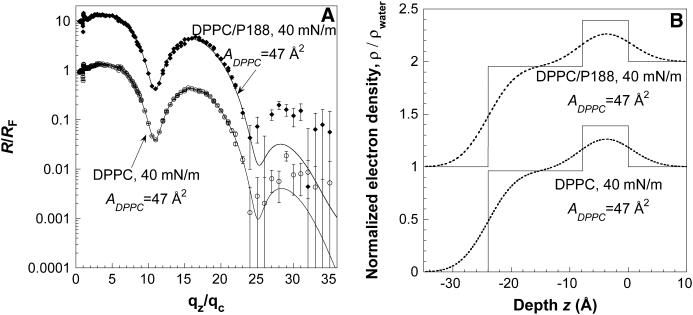
(A) X-ray reflectivity data for DPPC and DPPC/P188 films on a water subphase at ADPPC = 47 Å2. The solid lines are fits to the data using the box models discussed in the text. (B) The corresponding normalized electron density profiles for the XR data. z = 0 signifies the start of the water subphase. For clarity, the data have been offset vertically. The fitting parameters are listed in Table 4.
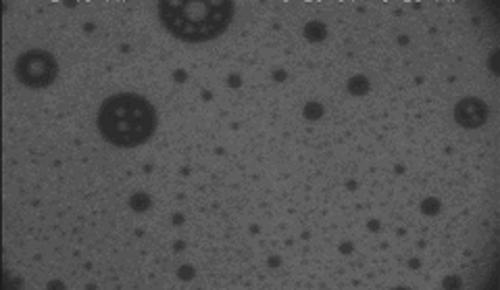
Fluorescence micrograph of a DPPC monolayer at ADPPC = 110 Å2, showing the coexistence of gas (dark) and liquid-expanded (bright) phases. The width of the micrograph is 550 mm.

Fluorescence micrographs after P188 injection at a nominal area of ADPPC = 110 Å2. (A) dark-gray (DPPC-rich); (B) one example showing coexistence of dark and light gray; (C) light gray (DPPC poor). The width of each micrograph is 550 mm.
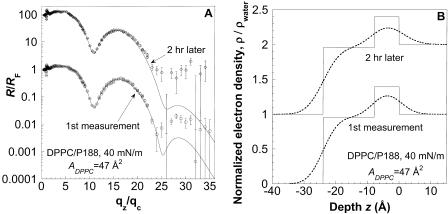
(A) X-ray reflectivity data for a DPPC/P188 film on a water subphase at 40 mN/m with time elapse of 2 h in between. The solid lines are fits to the data using box models discussed in the text. (B) The corresponding normalized electron density profiles for XR data. z = 0 signifies the start of water subphase. For clarity, the data have been offset vertically.
References
-
- Lee, R. C., and M. S. Kolodney. 1987. Electrical injury mechanisms: electrical breakdown of cell membranes. Plast. Reconstr. Surg. 80:672–679. - PubMed
-
- Lee, R. C., D. C. Gaylor, D. Bhatt, and D. A. Israel. 1988. Role of cell membrane rupture in the pathogenesis of electrical trauma. J. Surg. Res. 44:709–719. - PubMed
-
- Lee, R. C., and M. S. Kolodney. 1987. Electrical injury mechanisms: dynamics of the thermal response. Plast. Reconstr. Surg. 80:663–671. - PubMed
-
- Lee, R. C., D. Zhang, and J. Hannig. 2000. Biophysical injury mechanisms in electrical shock trauma. Annu. Rev. Biomed. Eng. 02:477–509. - PubMed
Publication types
MeSH terms
Substances
LinkOut - more resources
Full Text Sources
Other Literature Sources
