


Role of aromatase inhibitors in breast cancer
- PMID: 16100519
- PMCID: PMC2361691
- DOI: 10.1038/sj.bjc.6602688
Role of aromatase inhibitors in breast cancer
Abstract
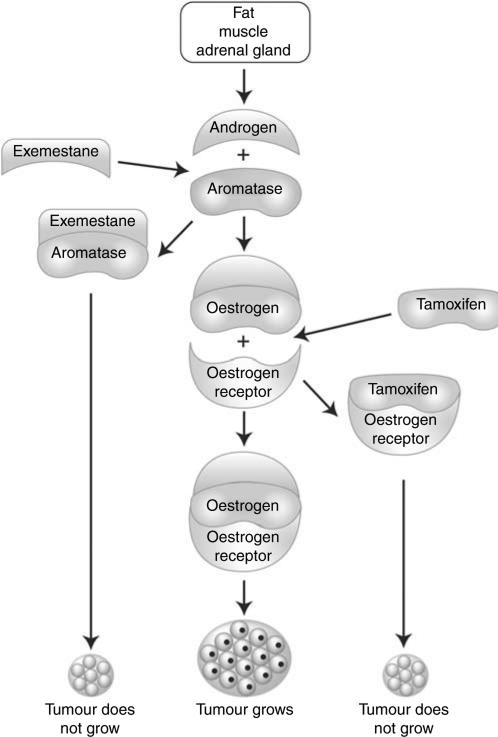
Primarily, the role of the aromatase inhibitors has been investigated in postmenopausal women with breast cancer, although it is also now being assessed in premenopausal patients following ovarian ablation/suppression. Aromatase inhibitors markedly suppress endogenous oestrogens without directly interacting with oestrogen receptors, and thus have a different mechanism of action to the antioestrogen, tamoxifen. The inhibitors may be divided into subgroups according to their structure (steroidal and nonsteroidal), and there appears to be a lack of cross-resistance between the classes of aromatase inhibitors enabling them to be used sequentially and potentially to prolong endocrine hormone therapy. In addition, with increased efficacy and favourable safety and tolerability profiles, the aromatase inhibitors are starting to challenge tamoxifen as first choice endocrine treatment in a number of settings. Potential differences in side-effect profiles may appear between the steroidal and nonsteroidal aromatase inhibitors when used in long-term settings. Thus, it has been suggested that the steroidal agents have favourable end organ effects; for example, the steroidal inhibitor, exemestane, has minimal negative effects on bone and lipid metabolism in animal and clinical studies. This paper provides an overview of the current and future roles of aromatase inhibitors for breast cancer treatment.
Figures
References
-
- ATAC (Arimidex, Tamoxifen Alone or in Combination) Trialists’ Group (2002) Anastrozole alone or in combination with tamoxifen versus tamoxifen alone for adjuvant treatment of postmenopausal women with early breast cancer: first results of the ATAC randomised trial. Lancet 359: 2131–2139 - PubMed
-
- Baum M (1999) Use of aromatase inhibitors in the adjuvant treatment of breast cancer. Endocr Relat Cancer 6: 231–234 - PubMed
-
- Bertelli G, Garrone O, Merlano M (2002) Sequential use of aromatase inactivators and inhibitors in advanced breast cancer. Proc Am Soc Clin Oncol 21: 60a (Abstract 238)
-
- Bevilacqua G, Silingardi V, Marchetti P (2001) Exemestane for the prevention of breast cancer in postmenopausal unaffected carriers of BRACA 1/2 mutations: aromasin prevention study (ApreS). Breast Cancer Res Treat 69: 226 (Abstract 139)
Publication types
MeSH terms
Substances
LinkOut - more resources
Full Text Sources
Medical
