. 2005 Aug 30;102(35):12321-5.
doi: 10.1073/pnas.0502392102. Epub 2005 Aug 17.

Conformable, flexible, large-area networks of pressure and thermal sensors with organic transistor active matrixes

Affiliations

Conformable, flexible, large-area networks of pressure and thermal sensors with organic transistor active matrixes

Takao Someya et al. Proc Natl Acad Sci U S A. .

Abstract

Skin-like sensitivity, or the capability to recognize tactile information, will be an essential feature of future generations of robots, enabling them to operate in unstructured environments. Recently developed large-area pressure sensors made with organic transistors have been proposed for electronic artificial skin (E-skin) applications. These sensors are bendable down to a 2-mm radius, a size that is sufficiently small for the fabrication of human-sized robot fingers. Natural human skin, however, is far more complex than the transistor-based imitations demonstrated so far. It performs other functions, including thermal sensing. Furthermore, without conformability, the application of E-skin on three-dimensional surfaces is impossible. In this work, we have successfully developed conformable, flexible, large-area networks of thermal and pressure sensors based on an organic semiconductor. A plastic film with organic transistor-based electronic circuits is processed to form a net-shaped structure, which allows the E-skin films to be extended by 25%. The net-shaped pressure sensor matrix was attached to the surface of an egg, and pressure images were successfully obtained in this configuration. Then, a similar network of thermal sensors was developed with organic semiconductors. Next, the possible implementation of both pressure and thermal sensors on the surfaces is presented, and, by means of laminated sensor networks, the distributions of pressure and temperature are simultaneously obtained.


Figures
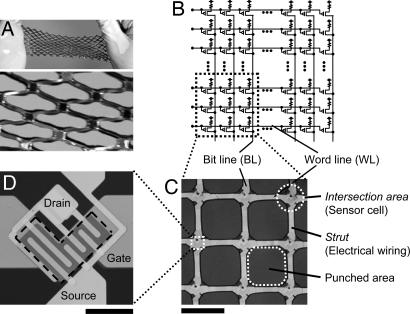
Fig. 1.
Fig. 1.
A conformable network of pressure sensors. (A) A plastic film with organic transistors and pressure-sensitive rubber is processed mechanically to form a unique net-shaped structure, which makes a film device extendable by 25%. A magnified view of extended net-structures is also shown. (B and C) The circuit diagram of the pressure sensor network is shown (B) together with a picture of the 3 × 3 sensor cells (C). A word line, denoted as WL, is connected to the gate electrodes, and a bit line, denoted as BL, is connected to the drain electrodes. The circuit diagram of the thermal sensor network can be obtained by replacing the resistances with diodes. (Scale bar: 4 mm.) (D) The optical microscopic image of an organic transistor before shaping the net or integrating it with sensors. The dotted line indicates the semiconductor channel layer. (Scale bar: 1 mm.)
Fig. 2.
Fig. 2.
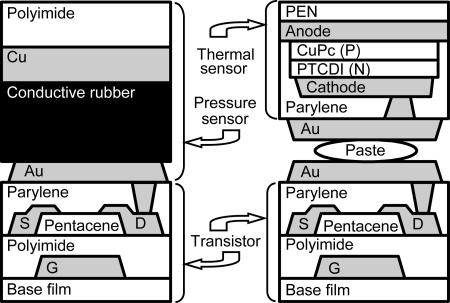
The device structures. A cross-sectional illustration of the pressure (Left) and the thermal (Right) sensor cells with organic transistors is shown.
Fig. 3.
Fig. 3.
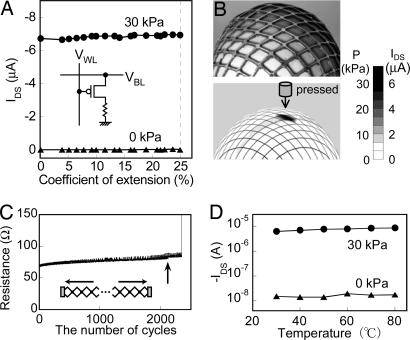
Pressure sensor network. (A) The IDS (at VDS = VGS =–40 V) with and without application of pressure is monitored as a function of the coefficient of expansion. The dotted line represents the tension of device failure. (B) An image of pressure sensor matrix put on an egg (Upper) is shown together with a spatial distribution of pressure (Lower). The current of each sensor cell is measured by applying a voltage bias of VDS =–20 V and VGS =–20 V under the application of local pressure. (C) The results of the endurance test performed by measuring stress cycles, where each cycle comprised an extension of the film by 20% followed by the release of the stress. The resistance between both edges of the test structures is monitored as a function of the number of tension cycles. The vertical arrow represents the breaking of either one side or the other of the gold wire. The test structure is shown in the Inset. (D) Saturation currents IDS (at VDS = VGS =–40 V) are measured for a sensor cell of the pressure sensor network at various temperatures under the application of pressure (30 kPa) and release (0 kPa).
Fig. 4.
Fig. 4.
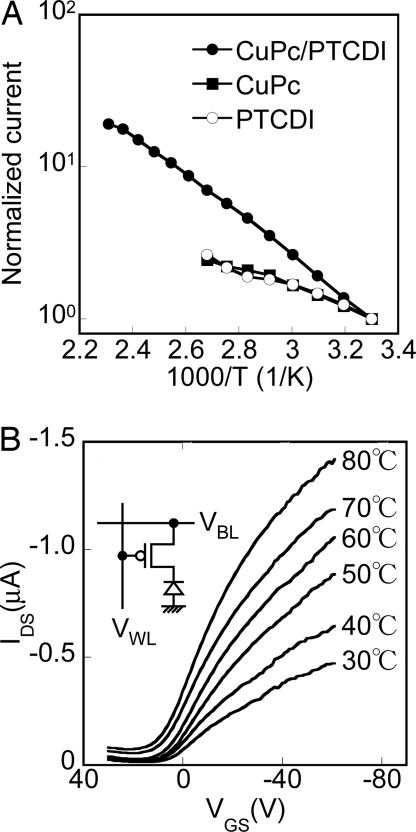
Thermal sensor network. (A) Temperature dependence of current is measured under voltage bias of 2 V, and data normalized by current at room temperature are plotted as a function of 1,000/T for three samples: stand-alone thermal sensors, denoted by solid circles, consisting of double organic semiconductors (30-nm-thick CuPc and 50-nm-thick PTCDI), and single organic semiconductor (80-nm-thick CuPc or 80-nm-thick PTCDI, denoted by solid squares and open circles, respectively) sandwiching between ITO and Au electrodes. (B) One cell of the thermal sensor network devices consisting of the diode-based thermal sensors and transistors is characterized at various temperatures from 30°C to 80°C.
Fig. 5.
Fig. 5.
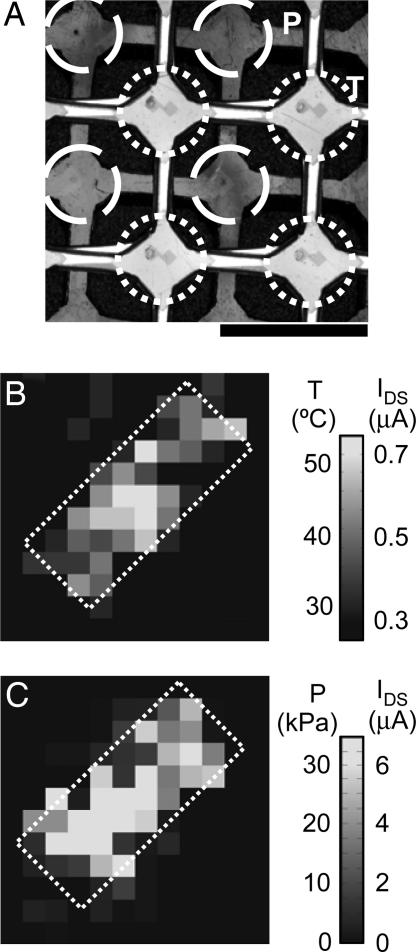
Integration of pressure and thermal sensor networks. (A) A possible implementation of thermal and pressure sensor films. The pressure and thermal sensors are represented by P and T, respectively. (Scale bar: 4 mm.) (B) The spatial distribution of temperature that is converted from the temperature-dependent current in the thermal sensor network. A copper block (15 × 37 mm2) whose temperature is maintained at 50°C is positioned diagonally (indicated by the dotted line). The sensing area is 44 × 44 mm2. (C) Simultaneously, the spatial distribution of pressure is measured with the pressure sensor network.

References

    1. Tsumura, A., Koezuka, H. & Ando, T. (1986) Appl. Phys. Lett. 49, 1210–1212.
    1. Dimitrakopoulos, C. D. & Malenfant, P. R. L. (2002) Adv. Mater. 14, 99–117.
    1. Dodabalapur, A., Torsi, L. & Katz, H. E. (1995) Science 268, 270–271. - PubMed
    1. Crone, B., Dodabalapur, A., Lin, Y.-Y., Filas, R. W., Bao, Z., LaDuca, A., Sarpeshkar, R., Katz, H. E. & Li, W. (2000) Nature 403, 521–523. - PubMed
    1. Drury, C. J., Mutsaers, C. M. J., Hart, C. M., Matters, M. & Leeuw, D. M. (1998) Appl. Phys. Lett. 73, 108–110.

Publication types

LinkOut - more resources