


A priori postulated and real power in cluster randomized trials: mind the gap
- PMID: 16109162
- PMCID: PMC1190183
- DOI: 10.1186/1471-2288-5-25
A priori postulated and real power in cluster randomized trials: mind the gap
Abstract
Background: Cluster randomization design is increasingly used for the evaluation of health-care, screening or educational interventions. The intraclass correlation coefficient (ICC) defines the clustering effect and be specified during planning. The aim of this work is to study the influence of the ICC on power in cluster randomized trials.
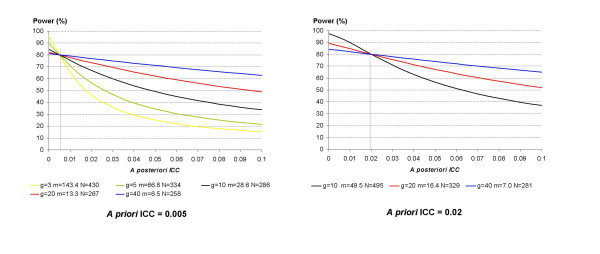
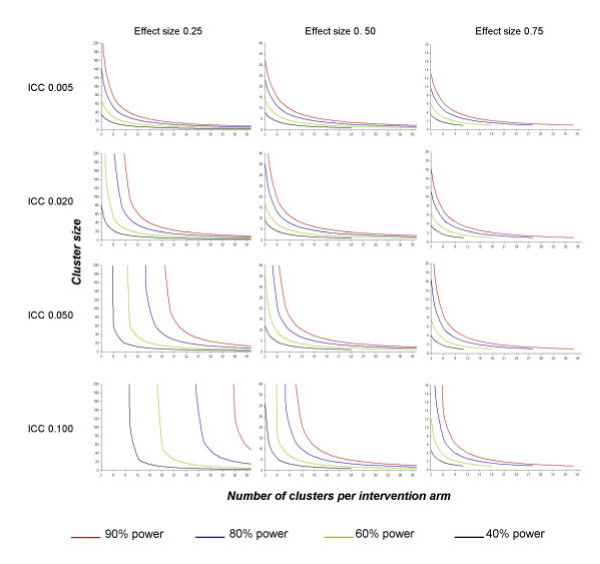
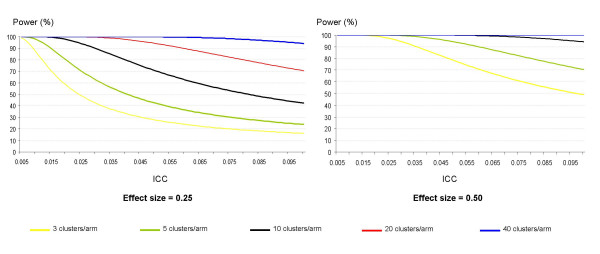
Methods: Power contour graphs were drawn to illustrate the loss in power induced by an underestimation of the ICC when planning trials. We also derived the maximum achievable power given a specified ICC.
Results: The magnitude of the ICC can have a major impact on power, and with low numbers of clusters, 80% power may not be achievable.
Conclusion: Underestimating the ICC during planning cluster randomized trials can lead to a seriously underpowered trial. Publication of a priori postulated and a posteriori estimated ICCs is necessary for a more objective reading: negative trial results may be the consequence of a loss of power due to a mis-specification of the ICC.
Figures
References
-
- Donner A, Klar N. Design and Analysis of Cluster Randomization Trials in Health Research. London, England: Arnold; 2000.
-
- Murray DM. Design and Analysis of Group-Randomized Trials. New York, NY: Oxford University Press Inc; 1998.
Publication types
MeSH terms
LinkOut - more resources
Full Text Sources
Miscellaneous
