


Discordant 16S and 23S rRNA gene phylogenies for the genus Helicobacter: implications for phylogenetic inference and systematics
- PMID: 16109952
- PMCID: PMC1196133
- DOI: 10.1128/JB.187.17.6106-6118.2005
Discordant 16S and 23S rRNA gene phylogenies for the genus Helicobacter: implications for phylogenetic inference and systematics
Abstract
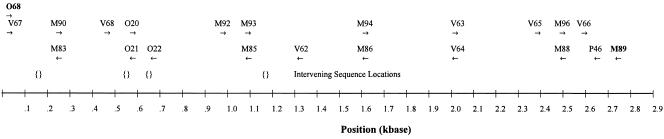
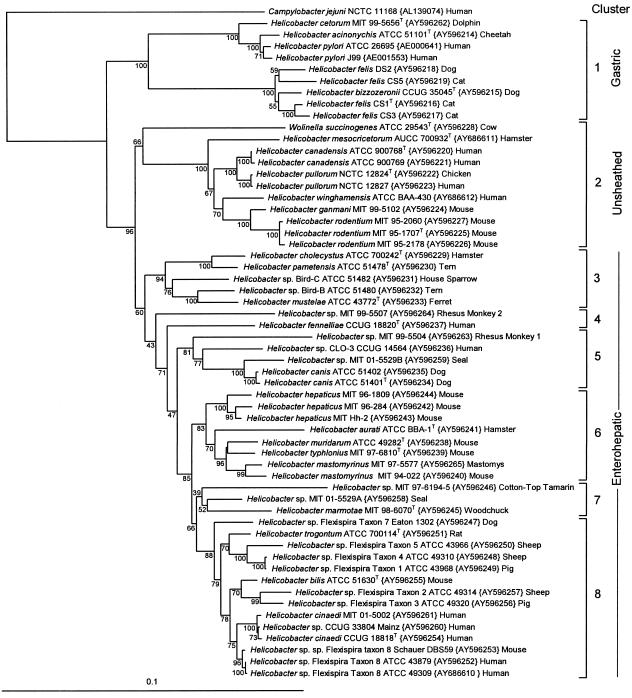
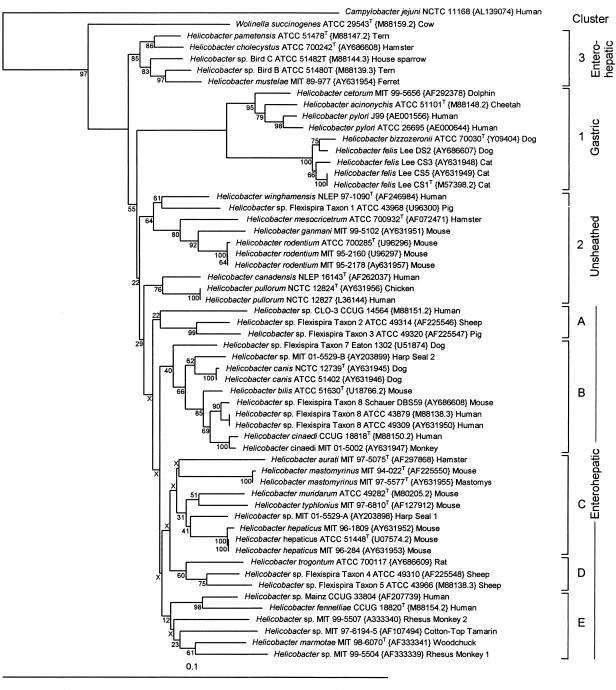
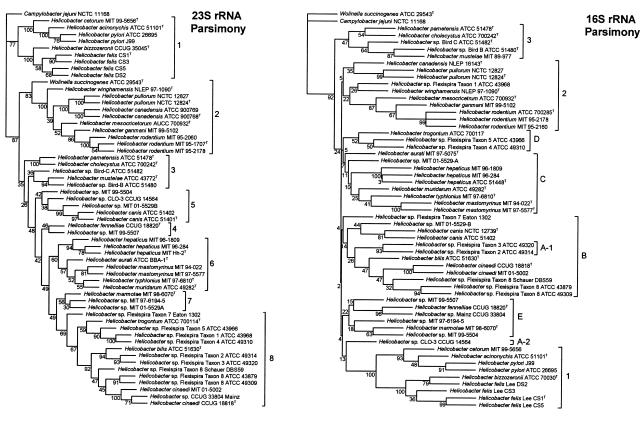
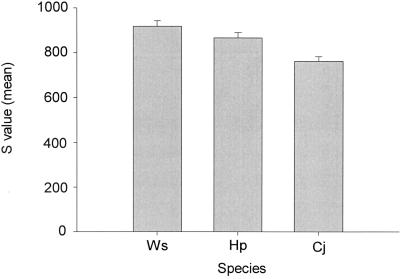
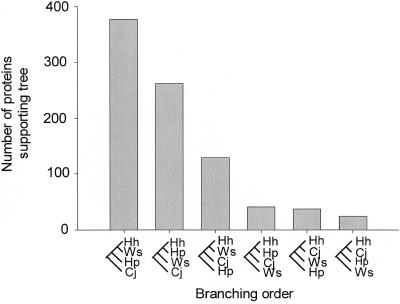
Analysis of 16S rRNA gene sequences has become the primary method for determining prokaryotic phylogeny. Phylogeny is currently the basis for prokaryotic systematics. Therefore, the validity of 16S rRNA gene-based phylogenetic analyses is of fundamental importance for prokaryotic systematics. Discrepancies between 16S rRNA gene analyses and DNA-DNA hybridization and phenotypic analyses have been noted in the genus Helicobacter. To clarify these discrepancies, we sequenced the 23S rRNA genes for 55 helicobacter strains representing 41 taxa (>2,700 bases per sequence). Phylogenetic-tree construction using neighbor-joining, parsimony, and maximum likelihood methods for 23S rRNA gene sequence data yielded stable trees which were consistent with other phenotypic and genotypic methods. The 16S rRNA gene sequence-derived trees were discordant with the 23S rRNA gene trees and other data. Discrepant 16S rRNA gene sequence data for the helicobacters are consistent with the horizontal transfer of 16S rRNA gene fragments and the creation of mosaic molecules with loss of phylogenetic information. These results suggest that taxonomic decisions must be supported by other phylogenetically informative macromolecules, such as the 23S rRNA gene, when 16S rRNA gene-derived phylogeny is discordant with other credible phenotypic and genotypic methods. This study found Wolinella succinogenes to branch with the unsheathed-flagellum cluster of helicobacters by 23S rRNA gene analyses and whole-genome comparisons. This study also found intervening sequences (IVSs) in the 23S rRNA genes of strains of 12 Helicobacter species. IVSs were found in helices 10, 25, and 45, as well as between helices 31' and 27'. Simultaneous insertion of IVSs at three sites was found in H. mesocricetorum.
Figures
References
-
- Altschul, S. F., W. Gish, W. Miller, E. W. Myers, and D. J. Lipman. 1990. Basic local alignment search tool. J. Mol. Biol. 215:403-410. - PubMed
-
- Baar, C., M. Eppinger, G. Raddatz, J. Simon, C. Lanz, O. Klimmek, R. Nandakumar, R. Gross, A. Rosinus, H. Keller, P. Jagtap, B. Linke, F. Meyer, H. Lederer, and S. C. Schuster. 2003. Complete genome sequence and analysis of Wolinella succinogenes. Proc. Natl. Acad. Sci. USA 100:11690-11695. - PMC - PubMed
-
- Boone, D. R., R. W. Castenholz, and G. M. Garrity (ed.). 2001. Bergey's manual of systemic bacteriology: the Archaea and the deeply branching and phototrophic Bacteria, 2nd ed., vol. I. Springer, New York, N.Y.
-
- Brochier, C., E. Bapteste, D. Moreira, and H. Philippe. 2002. Eubacterial phylogeny based on translational apparatus proteins. Trends Genet. 18:1-5. - PubMed
Publication types
MeSH terms
Substances
Grants and funding
LinkOut - more resources
Full Text Sources
Other Literature Sources
Molecular Biology Databases
