. 2005 Dec 15;392(Pt 3):537-44.
doi: 10.1042/BJ20050806.

The calcium-dependent ATP-Mg/Pi mitochondrial carrier is a target of glucose-induced calcium signalling in Saccharomyces cerevisiae

Affiliations

The calcium-dependent ATP-Mg/Pi mitochondrial carrier is a target of glucose-induced calcium signalling in Saccharomyces cerevisiae

Santiago Cavero et al. Biochem J. .

Abstract

Sal1p is a mitochondrial protein that belongs to the SCaMC (short calcium-binding mitochondrial carrier) subfamily of mitochondrial carriers. The presence of calcium-binding motifs facing the extramitochondrial space allows the regulation of the transport activity of these carriers by cytosolic calcium and provides a new mechanism to transduce calcium signals in mitochondria without the requirement of calcium entry in the organelle. We have studied its transport activity, finding that it is a carboxyatractyloside-resistant ATP-Mg carrier. Mitochondria from a disruption mutant of SAL1 have a 50% reduction in the uptake of ATP. We have also found a clear stimulation of ATP-transport activity by calcium, with an S(0.5) of approx. 30 microM. Our results also suggest that Sal1p is a target of the glucose-induced calcium signal which is non-essential in wild-type cells, but becomes essential for transport of ATP into mitochondria in yeast lacking ADP/ATP translocases.


Figures

Figure 1
Figure 1. Sal1p–yEGFP and endogenous Sal1p localize to mitochondria
(A) Fluorescence microscopy of wild-type W303 cells expressing Sal1p–yEGFP (yeast Sal1p carrier fused to yEGFP from the pYeDP-SAL1-yEGFP vector) or yEGFP (from pYeDP-yEGFP vector) during exponential growth in 2% galactose. MitoTracker Red was used to locate mitochondria in the cells expressing Sal1p–yEGFP (MitoTracker), and phase-contrast microscopy was used to monitor the integrity of the cells. The same cells were visualized first with the MitoTracker filter set and then with a GFP filter set. Identical fields are presented. Scale bar, 5 μm. BF, bright field. (B) Immunoblot of subcellular fractions of wild-type W303 cells expressing Sal1p–yEGFP (left-hand panel) or yEGFP (right-hand panel) during exponential growth on 2% galactose. Blots were probed with antibodies against GFP and porin. M, mitochondria; PM, post-mitochondrial supernatant. Molecular-mass sizes are given in kDa. (C) Endogenous Sal1p was detected in the mitochondrial fraction. Subcellular fractions of wild-type W303 cells during exponential growth on 2% galactose were analysed by Western blotting with antibodies against Sal1p, Porin, P0, CPY and Vps10p. H, total homogenate; M, mitochondria; PM, post-mitochondrial supernatant.
Figure 2
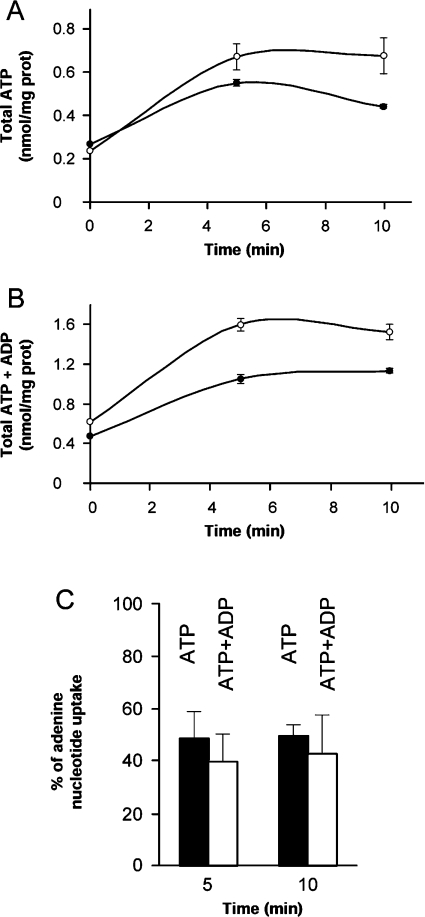
Figure 2. ATP transport in mitochondria
Mitochondria (2 mg of protein/ml) from wild-type (○) or sal1Δ (●) yeast were incubated with 4 mM ATP for 0, 5 or 10 min at 30 °C, and the levels of ATP (A) and ATP+ADP (B) were determined enzymatically. The free calcium concentration of the assay was 6.42 μM. Results are the means±S.E.M. for a representative experiment performed in triplicate. (C) Percentage of nucleotide uptake by the sal1Δ strain after incubation with 4 mM ATP for 5 or 10 min at 30 °C. The uptake of the wild-type strain was considered to be 100%. Results are means±S.E.M. for three independent experiments. The difference between wild-type and sal1Δ strains was significant (P<0.05; Student's t test).
Figure 3
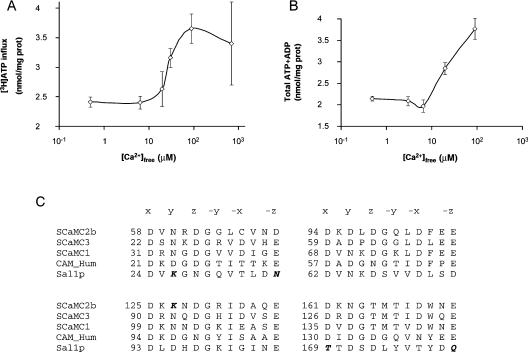
Figure 3. Activation by calcium of ATP uptake
Mitochondria (2 mg of protein/ml) from wild-type cells were incubated with [3H]ATP (A) or unlabelled ATP (B) for 5 min at 30 °C and the indicated calcium concentrations. ATP influx in (A) was corrected for external ATP with [14C]sucrose. The content of ATP+ADP in (B) was determined enzymatically. Results are means±S.E.M. for three independent experiments (A) and for a representative experiment performed in triplicate (B). (C) Alignment of the four putative EF-hand domains in Sal1p, SCaMC1, SCaMC2b, SCaMC3 and human calmodulin (GenBank® accession numbers P48233, AJ619987, AJ619990, AJ619988 and P02593 respectively). The alignment was carried out with the ClustalW program. The amino acids that contribute to the octahedral calcium co-ordination cage are labelled x, y, z, −x, −y and −z. The amino acids that do not satisfy the co-ordination bond of canonical EF-hands are in italic bold type.
Figure 4
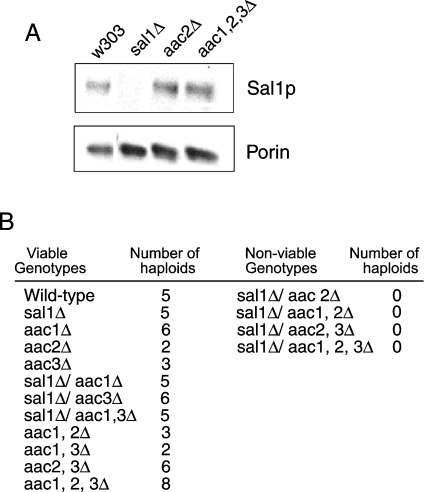
Figure 4. Sal1p levels in glucose-grown yeast and effects of SAL1 and AAC deletions on viability
(A) Western-blot analysis of mitochondria (10 μg) extracted from W303, sal1Δ, aac2Δ and aac1,2,3Δ strains grown in YPD medium. (B) Genotypes of the meiotic progeny of diploid yeast heterozygous for SAL1 and AAC1, AAC2 and AAC3 gene disruptions. Three independent sporulation experiments were performed, with a total of 95 tetrads dissected. The results of one representative experiment are shown. Sporulation of heterozygous strains for AGC1 (the aspartate–glutamate carrier) and AAC1,2,3 gene disruptions gave rise to all possible combinations (results not shown), showing that the lethality of the simultaneous disruption in SAL1 and AAC2 is specific.
Figure 5
Figure 5. Kinetics of bud emergence for W303 (A) and aac1,2,3Δ (B) strains
Yeast in stationary phase for 2 days were exposed to 2% glucose (□), water (◇) or 2% glucose plus 10 mM EGTA (△) for 2 h and were then transferred to YPD medium. The percentage of cells with buds was determined at various times after transfer to rich medium. Results are means±S.E.M. for three fields, with more than 100 cells/field. The experiment was repeated three times with similar results.

References

    1. Carafoli E. The calcium-signalling saga: tap water and protein crystals. Nat. Rev. Mol. Cell Biol. 2003;4:326–332. - PubMed
    1. Carafoli E. Historical review: mitochondria and calcium: ups and downs of an unusual relationship. Trends Biochem. Sci. 2003;28:175–181. - PubMed
    1. del Arco A., Satrústegui J. Molecular cloning of Aralar, a new member of the mitochondrial carrier superfamily that binds calcium and is present in human muscle and brain. J. Biol. Chem. 1998;273:23327–23334. - PubMed
    1. del Arco A., Agudo M., Satrústegui J. Characterization of a second member of the subfamily of calcium-binding mitochondrial carriers expressed in human non-excitable tissues. Biochem. J. 2000;345:725–732. - PMC - PubMed
    1. del Arco A., Satrústegui J. Identification of a novel human subfamily of mitochondrial carriers with calcium-binding domains. J. Biol. Chem. 2004;279:24701–24713. - PubMed

Publication types

MeSH terms