


Sequence variation within botulinum neurotoxin serotypes impacts antibody binding and neutralization
- PMID: 16113261
- PMCID: PMC1231122
- DOI: 10.1128/IAI.73.9.5450-5457.2005
Sequence variation within botulinum neurotoxin serotypes impacts antibody binding and neutralization
Abstract
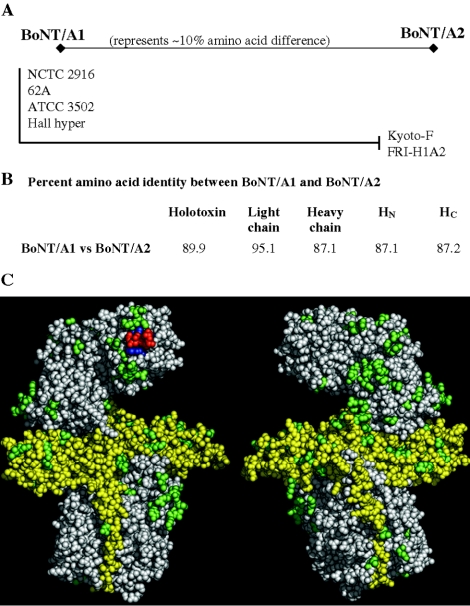
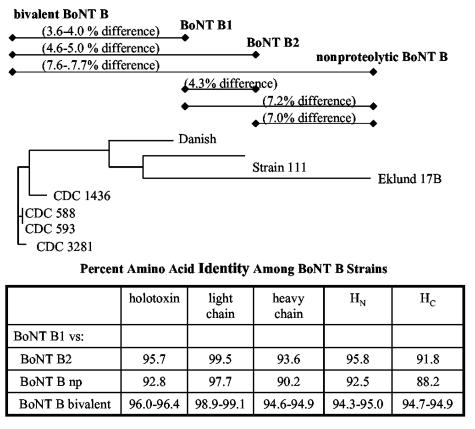
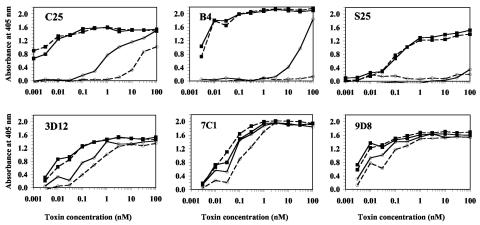
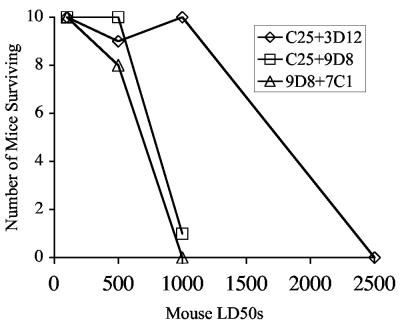
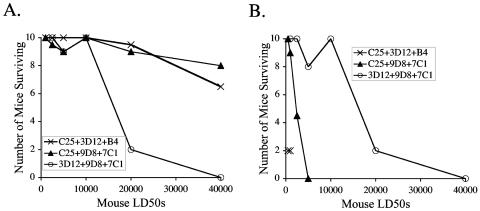
The botulinum neurotoxins (BoNTs) are category A biothreat agents which have been the focus of intensive efforts to develop vaccines and antibody-based prophylaxis and treatment. Such approaches must take into account the extensive BoNT sequence variability; the seven BoNT serotypes differ by up to 70% at the amino acid level. Here, we have analyzed 49 complete published sequences of BoNTs and show that all toxins also exhibit variability within serotypes ranging between 2.6 and 31.6%. To determine the impact of such sequence differences on immune recognition, we studied the binding and neutralization capacity of six BoNT serotype A (BoNT/A) monoclonal antibodies (MAbs) to BoNT/A1 and BoNT/A2, which differ by 10% at the amino acid level. While all six MAbs bound BoNT/A1 with high affinity, three of the six MAbs showed a marked reduction in binding affinity of 500- to more than 1,000-fold to BoNT/A2 toxin. Binding results predicted in vivo toxin neutralization; MAbs or MAb combinations that potently neutralized A1 toxin but did not bind A2 toxin had minimal neutralizing capacity for A2 toxin. This was most striking for a combination of three binding domain MAbs which together neutralized >40,000 mouse 50% lethal doses (LD(50)s) of A1 toxin but less than 500 LD(50)s of A2 toxin. Combining three MAbs which bound both A1 and A2 toxins potently neutralized both toxins. We conclude that sequence variability exists within all toxin serotypes, and this impacts monoclonal antibody binding and neutralization. Such subtype sequence variability must be accounted for when generating and evaluating diagnostic and therapeutic antibodies.
Figures
References
-
- Amersdorfer, P., C. Wong, S. Chen, T. Smith, S. Desphande, R. Sheridan, R. Finnern, and J. D. Marks. 1997. Molecular characterization of murine humoral immune response to botulinum neurotoxin type A binding domain as assessed using phage antibody libraries. Infect. Immun. 65:3743-3752. - PMC - PubMed
-
- Amersdorfer, P., C. Wong, T. Smith, S. Chen, S. Deshpande, R. Sheridan, and J. D. Marks. 2002. Genetic and immunological comparison of anti-botulinum type A antibodies from immune and non-immune human phage libraries. Vaccine 20:1640-1648. - PubMed
-
- Arnon, S. A., R. Schecter, T. V. Inglesby, D. A. Henderson, J. G. Bartlett, M. S. Ascher, E. Eitzen, A. D. Fine, J. Hauer, M. Layton, S. Lillibridge, M. T. Osterholm, T. O'Toole, G. Parker, T. M. Perl, P. K. Russell, D. L. Swerdlow, and K. Tonat. 2001. Botulinum toxin as a biological weapon. JAMA 285:1059-1070. - PubMed
-
- Arnon, S. S. 1993. Clinical trial of human botulism immune globulin, p. 477-482. In B. R. DasGupta (ed.), Botulinum and tetanus neurotoxins: neurotransmission and biomedical aspects. Plenum Press, New York, N.Y.
Publication types
MeSH terms
Substances
Grants and funding
LinkOut - more resources
Full Text Sources
Other Literature Sources
Medical
Research Materials
