. 2005 Sep;73(9):5530-9.
doi: 10.1128/IAI.73.9.5530-5539.2005.

Role of FliF and FliI of Listeria monocytogenes in flagellar assembly and pathogenicity

Affiliations

Role of FliF and FliI of Listeria monocytogenes in flagellar assembly and pathogenicity

Armelle Bigot et al. Infect Immun. 2005 Sep.

Erratum in

  • Infect Immun. 2007 Feb;75(2):1063-4

Abstract

Flagellar structures have been shown to participate in virulence in a variety of intestinal pathogens. Here, we have identified two potential flagellar genes of Listeria monocytogenes: lmo0713, encoding a protein similar to the flagellar basal body component FliF, and lmo0716, encoding a protein similar to FliI, the cognate ATPase energizing the flagellar export apparatus. Expression of fliF and fliI appears to be downregulated at 37 degrees C, like that of flaA, encoding flagellin. By constructing two chromosomal deletion mutants, we show that inactivation of either fliF or fliI (i) abolishes bacterial motility and flagella production, (ii) impairs adhesion and entry into nonphagocytic epithelial cells, and (iii) also reduces uptake by bone marrow-derived macrophages. However, the DeltafliF and DeltafliI mutations have only a minor impact on bacterial virulence in the mouse model, indicating that the flagellar secretion apparatus itself is not essential for survival in this animal model. Finally, among 100 human clinical isolates of L. monocytogenes tested, we found 20 strains still motile at 37 degrees C. Notably, all these strains adhered less efficiently than strain EGD-e to Caco-2 cells at 37 degrees C but showed no defect of intracellular multiplication. These data suggest that expression of the flagella at 37 degrees C might hinder optimal adhesion to epithelial cells but has no impact on intracytosolic survival of L. monocytogenes.


Figures
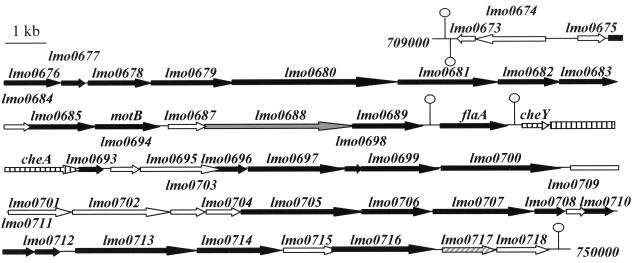
FIG. 1.
FIG. 1.
Genetic organization of the flagellar genes of L. monocytogenes EGD-e (between 709 and 750 kb). Black arrow, flagellar genes; vertically striped arrow, signalization pathways; diagonally striped arrow, other functions; gray arrow, similar to unknown protein; white arrow, no similarity; open circle with line, transcription terminator.
FIG. 2.
FIG. 2.
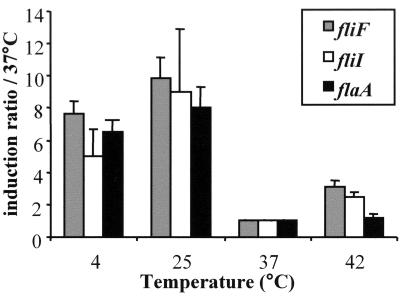
Transcriptional analysis of the expression of flaA, fliF, and fliI at different temperatures. Gene expression was measured by real-time PCR from bacteria in exponential phase of growth (in BHI broth). The amount of each gene mRNA was normalized by the amount of gyr mRNA (constant under these conditions). Induction ratios were then compared to the 37°C condition. Values shown are means of results from at least three assays for different mRNA preparations for each temperature. Error bars indicate the standard deviations.
FIG. 3.
FIG. 3.
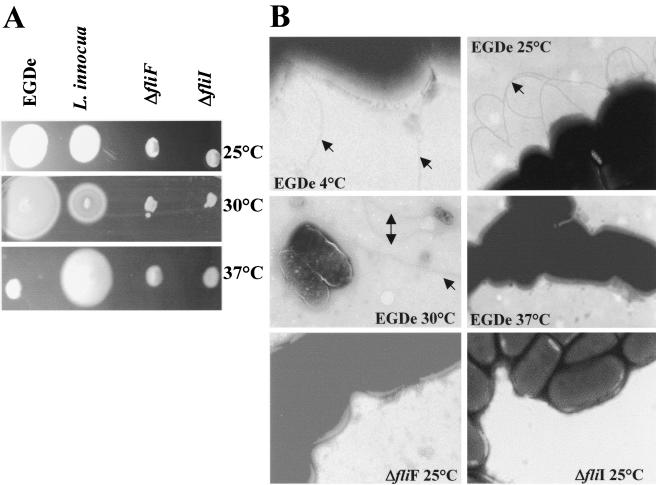
Motility and flagellation of L. monocytogenes EGD-e, ΔfliF, ΔfliI, and L. innocua. (A) Motility assayed on 0.4% BHI agar plates. (B) Flagellation observed with electron microscopy (negative contrast obtained with 2% phosphotungstic acid). Flagella are indicated with arrows.
FIG. 4.
FIG. 4.
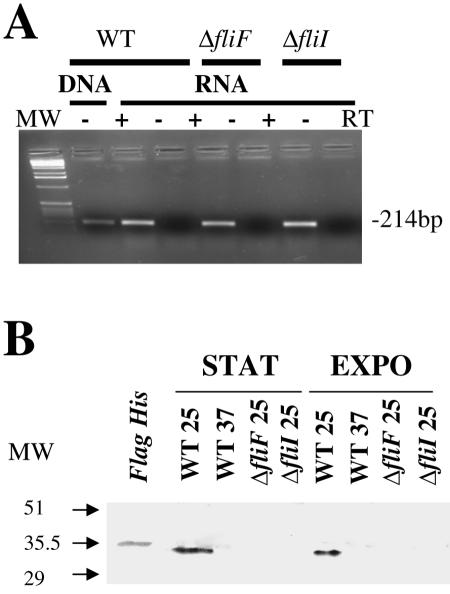
Expression of flagellin in EGD-e, ΔfliF, and ΔfliI strains. (A) Transcriptional analysis by RT-PCR using primers inside the flaA sequence. (B) Western blot analysis. Bacterial cultures from exponential (EXPO; OD600 of 0.4) or stationary phase (STAT; OD600 of 1.5) were collected by centrifugation, and total extract was obtained with a Fast Prep apparatus. Anti-Listeria serum H-AB purchased from Eurobio (France) was used as the primary antibody at a dilution of 1/500. An E. coli BL21 strain expressing EGD-e FlaA protein with a six-histidine tag (Flag His panel) was used as a positive control for protein detection.
FIG. 5.
FIG. 5.
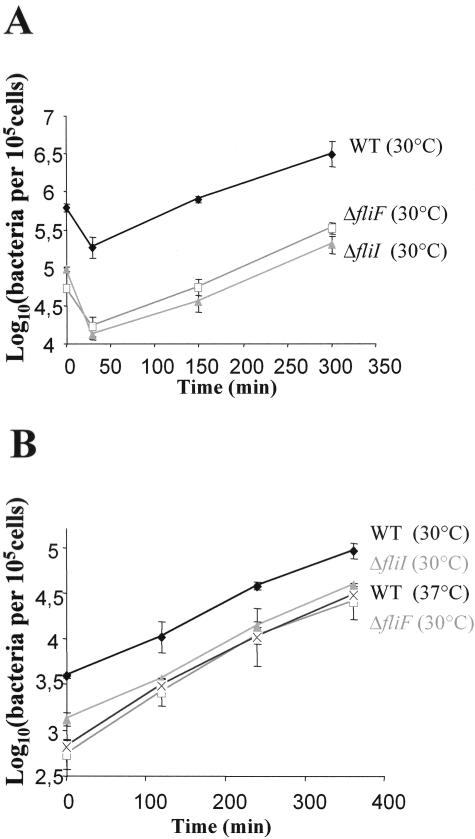
Invasion kinetics of L. monocytogenes EGD-e, ΔfliF, and ΔfliI strains in two different cell types: Caco-2 cells (A) and bone marrow-derived macrophages (B). Bacteria grown overnight at 30°C (or 37°C) were used to infect cell monolayers (100 bacteria per cell for Caco-2 cells; 0.1 bacteria per cell for macrophages). The temperatures given in the figure are the temperatures of bacterial growth before infection. All the infections were carried out at 37°C. After 30 min of infection, cells were washed and reincubated in fresh medium containing gentamicin in order to kill extracellular bacteria. After incubation (time given in abscissa) following washing, cells were lysed, and viable bacteria were counted on BHI agar plates. Values and error bars represent the means and standard deviations of the numbers of bacteria per well (three wells per assay and two different assays).
FIG. 6.
FIG. 6.
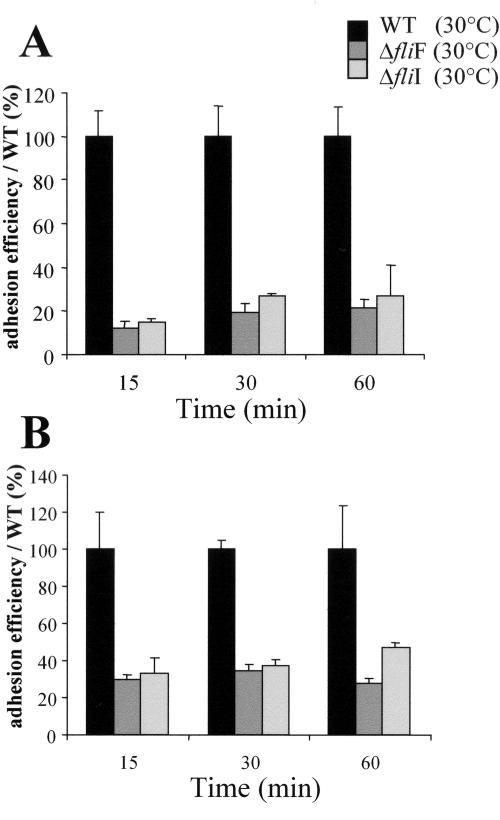
Adhesion assay on Caco-2 (A) or Hep-G2 (B) cell lines. Cell monolayers were infected with 100 bacteria (grown at 30°C) per cell. Adhesion efficiency is defined as the percentage of adherent bacteria (enumerated after 15, 30, or 60 min of incubation and three washes) compared to the initial inoculum. All adhesion efficiency rates are compared to that of the wild-type strain, which is set to 100%.
FIG. 7.
FIG. 7.
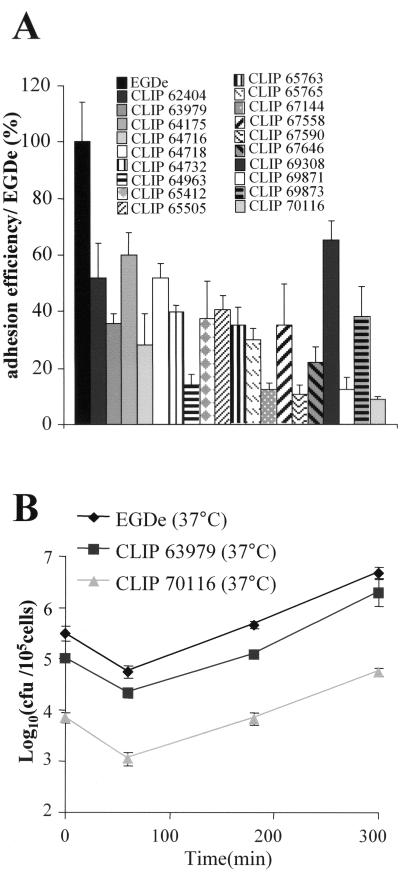
Analysis of the clinical isolates motile at 37°C. (A) Adhesion efficiency to Caco-2 cells of the 19 clinical isolates that were motile at 37°C. The laboratory EGD-e strain is set to 100%. All strains were grown at 37°C before infection. (B) Caco-2 invasion kinetics of two isolates (CLIP63979 and CLIP70116) compared to strain EGD-e.

References

    1. Arora, S. K., B. W. Ritchings, E. C. Almira, S. Lory, and R. Ramphal. 1998. The Pseudomonas aeruginosa flagellar cap protein, FliD, is responsible for mucin adhesion. Infect. Immun. 66:1000-1007. - PMC - PubMed
    1. Barilla, D., T. Caramori, and A. Galizzi. 1994. Coupling of flagellin gene transcription to flagellar assembly in Bacillus subtilis. J. Bacteriol. 176:4558-4564. - PMC - PubMed
    1. Bonnemain, C., C. Raynaud, H. Reglier-Poupet, I. Dubail, C. Frehel, M. A. Lety, P. Berche, and A. Charbit. 2004. Differential roles of multiple signal peptidases in the virulence of Listeria monocytogenes. Mol. Microbiol. 51:1251-1266. - PubMed
    1. Braun, L., B. Ghebrehiwet, and P. Cossart. 2000. gC1q-R/p32, a C1q-binding protein, is a receptor for the InlB invasion protein of Listeria monocytogenes. EMBO J. 3:1458-1466. - PMC - PubMed
    1. Chakraborty, T., M. Leimeister-Wachter, E. Domann, M. Hartl, W. Goebel, T. Nichterlein, and S. Notermans. 1992. Coordinate regulation of virulence genes in Listeria monocytogenes requires the product of the prfA gene. J. Bacteriol. 174:568-574. - PMC - PubMed

Publication types

MeSH terms

LinkOut - more resources