. 2005 Sep;73(9):5873-82.
doi: 10.1128/IAI.73.9.5873-5882.2005.

Cyclic diguanylate regulates Vibrio cholerae virulence gene expression

Affiliations

Cyclic diguanylate regulates Vibrio cholerae virulence gene expression

Anna D Tischler et al. Infect Immun. 2005 Sep.

Abstract

The cyclic dinucleotide second messenger cyclic diguanylate (c-diGMP) has been implicated in regulation of cell surface properties in several bacterial species, including Vibrio cholerae. Expression of genes required for V. cholerae biofilm formation is activated by an increased intracellular c-diGMP concentration. The response regulator VieA, which contains a domain responsible for degradation of c-diGMP, is required to maintain a low concentration of c-diGMP and repress biofilm formation. The VieSAB three-component signal transduction system was, however, originally identified as a regulator of ctxAB, the genes encoding cholera toxin (CT). Here we show that the c-diGMP phosphodiesterase activity of VieA is required to enhance CT production. This regulation occurred at the transcriptional level, and ectopically altering the c-diGMP concentration by expression of diguanylate cyclase or phosphodiesterase enzymes also affected ctxAB transcription. The c-diGMP phosphodiesterase activity of VieA was also required for maximal transcription toxT but did not influence the activity of ToxR or expression of TcpP. Finally, a single amino acid substitution in VieA that increases the intracellular c-diGMP concentration led to attenuation in the infant mouse model of cholera. Since virulence genes including toxT and ctxA are repressed by a high concentration of c-diGMP, while biofilm genes are activated, we suggest that c-diGMP signaling is important for the transition of V. cholerae from the environment to the host.


Figures
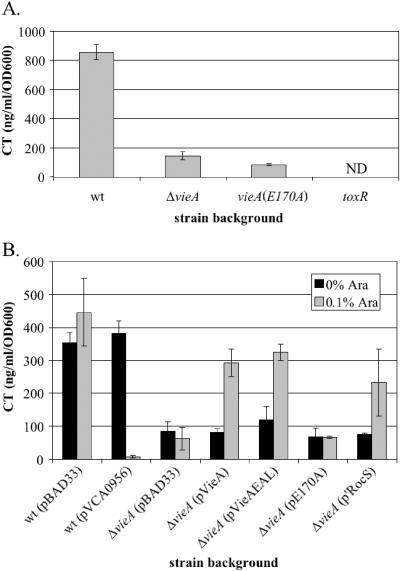
FIG. 1.
FIG. 1.
CT production is regulated by c-diGMP. GM1 ELISAs to quantify production of the CT B subunit were done with culture supernatants from the indicated strains grown overnight in M9 + NRES. Purified CT B subunit of known concentration was used to determine the concentration in the samples. ND, not detected. A. Strains AC-V61 (wild type), AC-V1386 (ΔvieA), AC-V1596 [vieA(E170A)], and AC-V744 (ΔtoxR). B. Strains were grown in the absence (black bars) or presence (gray bars) of 0.1% arabinose. The wild-type and ΔvieA mutant strain backgrounds carrying the indicated plasmids (strains AC-V1460, AC-V1726, AC-V1463, AC-V1464, AC-V1660, AC-V1661, and AC-V1843).
FIG. 2.
FIG. 2.
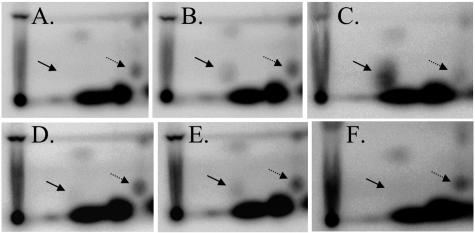
2D-TLC of 32P-labeled nucleotide extracts to detect c-diGMP. Strains were grown in MOPS plus NRES to an OD600 of 0.6 and labeled for 30 min with [32P]orthophosphate. Nucleotides were extracted with formic acid, spotted on TLC plates (origin at the bottom left corner), and developed in 0.2 M NH4HCO3, pH 7.8, in the first dimension (bottom to top) and 1.5 M KH2PO4, pH 3.65, in the second dimension (left to right). c-diGMP and GDP spots are indicated by the solid and dashed arrows, respectively. Only the relevant portion of the TLC plate is shown. A. AC-V61, wild type. B. AC-V1596, vieA(E170A). C-F. Strains were grown with 0.1% arabinose to induce expression from the pBAD promoter. C. AC-V1726, wild type (pVCA0956). D. AC-V1660, ΔvieA (pVieA-EAL). E. AC-V1661, ΔvieA (pE170A). F. AC-V1843, ΔvieA (p‵RocS).
FIG. 3.
FIG. 3.
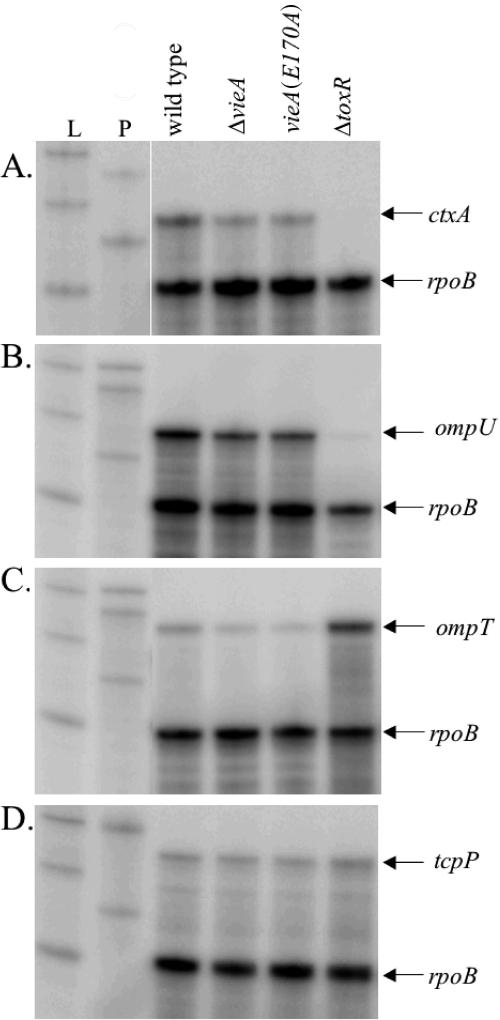
VieA regulates transcription of ctxA. The wild-type (AC-V61), ΔvieA (AC-V1386), vieA(E170A) (AC-V1596), and ΔtoxR (AC-V744) strains were grown to an OD600 of 0.6 in MOPS plus NRES, RNA was extracted, and indicated transcripts were detected by RNase protection assay. L indicates RNA ladder; P indicates undigested probes (only 0.1% of probe used in RPAs was loaded). All samples were normalized to the rpoB loading control and are the average for three independent experiments.
FIG. 4.
FIG. 4.
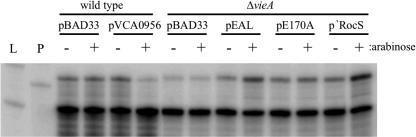
Ectopic expression of the GGDEF or EAL protein affects ctxA transcription. Strains with the indicated plasmids were grown in MOPS plus NRES with or without 0.1% arabinose to an OD600 of 0.6, RNA was isolated, and the ctxA and rpoB transcripts were detected by RPA. L indicates RNA ladder; P indicates undigested probes (only 0.1% of probe used in RPAs was loaded). All samples were normalized to the rpoB loading control and are the average for three independent experiments.
FIG. 5.
FIG. 5.
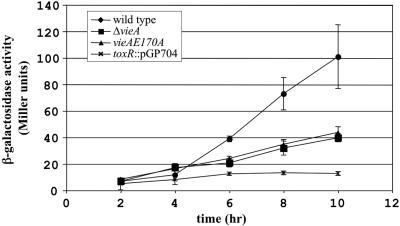
toxT-lacZ fusion activity is reduced in vieA mutants. Strains containing the toxT-lacZ fusion were grown in M9 + NRES at 30°C with shaking. β-Galactosidase activity was determined at 2-h intervals by the Miller method. Each result presented is the average ± standard error from three independent experiments.
FIG. 6.
FIG. 6.
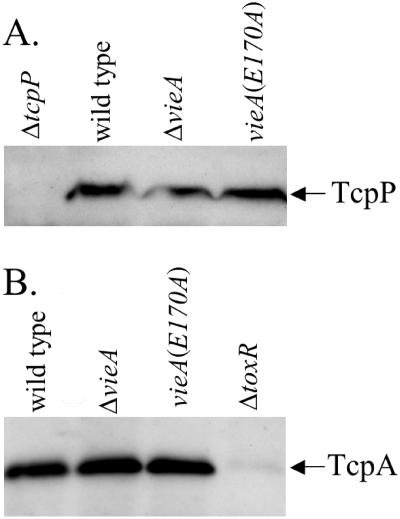
TcpP and TcpA protein levels are not affected by vieA mutations. A. TcpP was detected by immunoblotting for strains AC-V61 (wild type), AC-V1386 (ΔvieA), AC-V1596 [vieA(E170A)], and AC-V449 (ΔtcpP) grown to an OD600 of 0.6 in M9 + NRES at 30°C. B. TcpA was detected by immunoblotting for strains AC-V61 (wild type), AC-V1386 (ΔvieA), AC-V1596 [vieA(E170A)], and AC-V744 (ΔtoxR) grown to an OD600 of 0.6 in M9 + NRES at 30°C.
FIG. 7.
FIG. 7.
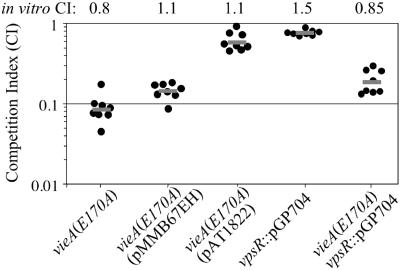
The vieA(E170A) mutant is attenuated for colonization of the infant mouse. Competition assays were performed with the infant mouse model of cholera. Strains AC-V1596 [vieA(E170A)], AC-V1869 (vpsR::pGP704), and AC-V1870 [vieA(E170A), vpsR::pGP704] were competed against strain O395. Strains AC-V1815 and AC-V1824 [vieA(E170A) containing the pMMB67EH or pAT1822 complementing plasmid, respectively] were competed against strain AC-V1109 (O395 carrying pMMB67EH). The competition index is the ratio of mutant to wild-type bacteria recovered from the small intestine, corrected for the ratio present in the inoculum. Each dot represents an individual mouse; the gray line represents the geometric mean of the data. The competition indices from in vitro competitions in LB are indicated above the graph.

References

    1. Beck, N. A., E. S. Krukonis, and V. J. DiRita. 2004. TcpH influences virulence gene expression in Vibrio cholerae by inhibiting degradation of the transcription activator TcpP. J. Bacteriol. 186:8309-8316. - PMC - PubMed
    1. Brown, R. C., and R. K. Taylor. 1995. Organization of tcp, acf, and toxT genes within a ToxT-dependent operon. Mol. Microbiol. 16:425-439. - PubMed
    1. Callahan, L. T., R. C. Ryder, and S. H. Richardson. 1971. Biochemistry of Vibrio cholerae virulence. II. Skin permeability factor/cholera enterotoxin production in a chemically defined medium. Infect. Immun. 4:611-618. - PMC - PubMed
    1. Camilli, A., and J. J. Mekalanos. 1995. Use of recombinase gene fusions to identify Vibrio cholerae genes induced during infection. Mol. Microbiol. 18:671-683. - PMC - PubMed
    1. Champion, G. A., M. N. Neely, M. A. Brennan, and V. J. DiRita. 1997. A branch in the ToxR regulatory cascade of Vibrio cholerae revealed by characterization of toxT mutant strains. Mol. Microbiol. 23:323-331. - PubMed

Publication types

MeSH terms

LinkOut - more resources