. 2005 Oct;68(1):36-42.
doi: 10.1016/j.antiviral.2005.07.002.

Anti-SARS coronavirus 3C-like protease effects of Isatis indigotica root and plant-derived phenolic compounds

Affiliations

Anti-SARS coronavirus 3C-like protease effects of Isatis indigotica root and plant-derived phenolic compounds

Cheng-Wen Lin et al. Antiviral Res. 2005 Oct.

Abstract

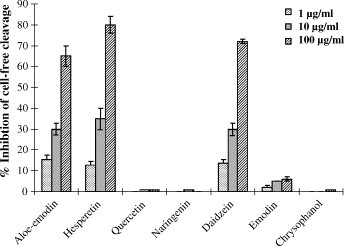
The 3C-like protease (3CLpro) of SARS-coronavirus mediates the proteolytic processing of replicase polypeptides 1a and 1ab into functional proteins, becoming an important target for the drug development. In this study, Isatis indigotica root extract, five major compounds of I. indigotica root, and seven plant-derived phenolic compounds were tested for anti-SARS-CoV 3CLpro effects using cell-free and cell-based cleavage assays. Cleavage assays with the 3CLpro demonstrated that IC50 values were in micromolar ranges for I. indigotica root extract, indigo, sinigrin, aloe emodin and hesperetin. Sinigrin (IC50: 217 microM) was more efficient in blocking the cleavage processing of the 3CLpro than indigo (IC50: 752 microM) and beta-sitosterol (IC50: 1210 microM) in the cell-based assay. Only two phenolic compounds aloe emodin and hesperetin dose-dependently inhibited cleavage activity of the 3CLpro, in which the IC50 was 366 microM for aloe emodin and 8.3 microM for hesperetin in the cell-based assay.


Figures
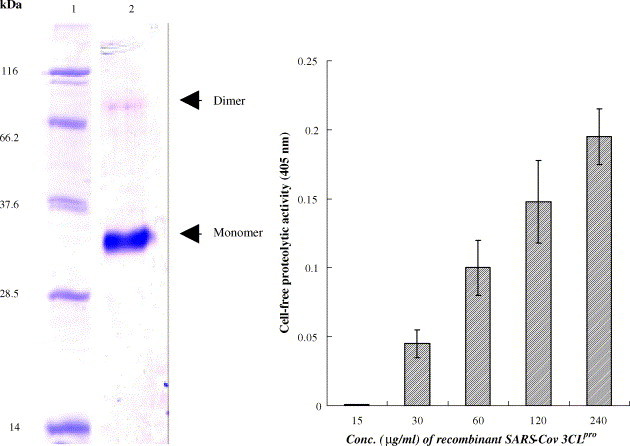
Fig. 1
Fig. 1
Cell-free cleavage activity of recombinant SARS-CoV 3CLpro. (A) The purified 3CLpro recombinant protein at the 1 mg/ml was analyzed by 10% SDS–PAGE with Coomassie blue staining (lane 2). (B) The trans-cleavage of the 3CLpro with a substrate fusion protein was determined using the ELISA. The substrate fusion protein was captured with anti-HSV mAb, followed by incubation with the serial dilution of the 3CLpro. The non-cleavage of the fusion protein was detected using the S protein-HRP conjugate and ABTS/H2O2 substrates. The ELISA product was measured at A405 nm. The relative cell-free cleavage activity was calculated as 1(A4053CLpro)/(A405no3CLpro).
Fig. 2
Fig. 2
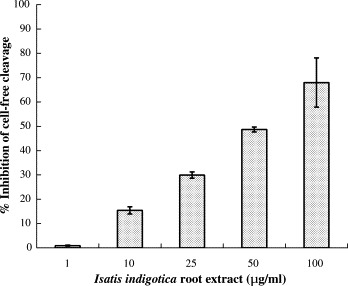
Inhibition of the cell-free cleavage of the 3CLpro by the Isatis indigotica root extract. The extract of the I. indigotica root was added into the mixture of the substrate fusion protein and the 3CLpro, and then incubated at room temperature for 3 h. The non-cleavage of substrate fusion protein was detected using the S protein-HRP conjugate and ABTS/H2O2 substrates. The ELISA product was measured at A405 nm. The relative inhibition of cell-free cleavage activity was calculated as 1(A405no3CLproA4053CLprowithinhibitor)/(A405no3CLproA4053CLpro).
Fig. 3
Fig. 3
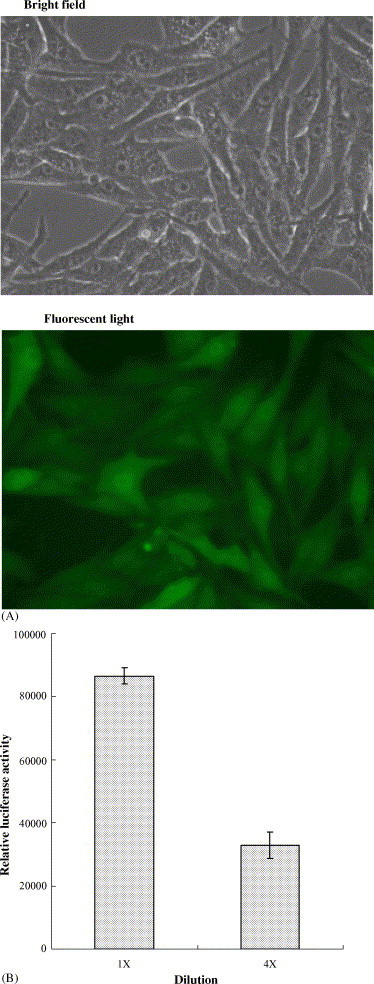
Cell-based cleavage assay of the 3CLpro in Vero cells. (A) Vero cells were transfected with the plasmid containing the 3CLpro–substrate–luciferase in-frame gene plus the indicated vector pEGFP-N1. (B) Relative Luc activity in the dilution of transfected cell lysates was determined using the dual Luciferase Reporter Assay System and the Luminometer TROPIX TR-717.
Fig. 4
Fig. 4
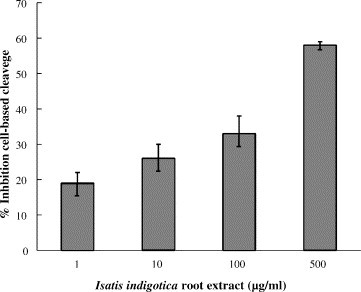
Inhibition of the cell-based cleavage of the 3CLpro by the Isatis indigotica root extract. Vero cells generating the 3CLpro–substrate–luciferase fusion protein were treated with the indicated concentration of the I. indigotica root extract. Equal amounts (100 μg) of cell lysates were used to determine the luciferase activity (LUC) using the dual Luciferase Reporter Assay System. The relative inhibition of cell-based cleavage activity was calculated as 1 − (LUCwith inhibitor)/(LUCwithout inhibitor).
Fig. 5
Fig. 5
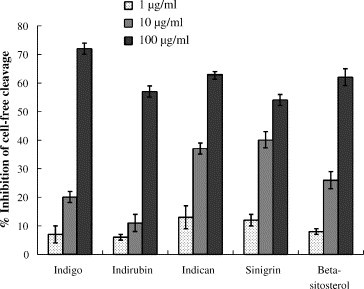
Inhibition of the cell-free cleavage of the 3CLpro by the compounds derived from Isatis indigotica root. The indicated compound was added into the mixture of the substrate fusion protein and the 3CLpro, and then the uncleaved substrate was detected using the S protein-HRP conjugate and ABTS/H2O2 substrates. The ELISA product was measured at A405 nm. The relative inhibition of cell-free cleavage activity was calculated as 1(A405no3CLproA4053CLprowithinhibitor)/(A405no3CLproA4053CLpro).
Fig. 6
Fig. 6
Inhibition of the cell-free cleavage of the 3CLpro by the phenolic compounds. The indicated compound was added into the mixture of the substrate fusion protein and the 3CLpro, and then the uncleaved substrate was detected. The relative inhibition of cell-free cleavage activity was calculated as 1(A405no3CLproA4053CLprowithinhibitor)/(A405no3CLproA4053CLpro).

References

    1. Andersen D.O., Weber N.D., Wood S.G., Hughes B.G., Murray B.K., North J.A. In vitro virucidal activity of selected anthraquinones and anthraquinone derivatives. Antiviral Res. 1991;16:185–196. - PubMed
    1. Brabban A.D., Edwards C. The effects of glucosinolates and their hydrolysis products on microbial growth. J. Appl. Bacteriol. 1995;79:171–177. - PubMed
    1. Cinatl J., Morgenstern B., Bauer G., Chandra P., Rabenau H., Doerr H.W. Glycyrrhizin, an active component of liquorice roots, and replication of SARS-associated coronavirus. Lancet. 2003;361:2045–2046. - PMC - PubMed
    1. Cinatl J., Morgenstern B., Bauer G., Chandra P., Rabenau H., Doerr H.W. Treatment of SARS with human interferons. Lancet. 2003;362:293–294. - PMC - PubMed
    1. Drosten C., Gunther S., Preiser W., van der Werf S., Brodt H.R., Becker S., Rabenau H., Panning M., Kolesnikova L., Fouchier R.A., Berger A., Burguiere A.M., Cinatl J., Eickmann M., Escriou N., Grywna K., Kramme S., Manuguerra J.C., Muller S., Rickerts V., Sturmer M., Vieth S., Klenk H.D., Osterhaus A.D., Schmitz H., Doerr H.W. Identification of a novel coronavirus in patients with severe acute respiratory syndrome. N. Engl. J. Med. 2003;348:1967–1976. - PubMed

Publication types

MeSH terms