


What can hospitalized patients tell us about adverse events? Learning from patient-reported incidents
- PMID: 16117751
- PMCID: PMC1490203
- DOI: 10.1111/j.1525-1497.2005.0180.x
What can hospitalized patients tell us about adverse events? Learning from patient-reported incidents
Abstract
Purpose: Little is known about how well hospitalized patients can identify errors or injuries in their care. Accordingly, the purpose of this study was to elicit incident reports from hospital inpatients in order to identify and characterize adverse events and near-miss errors.
Subjects: We conducted a prospective cohort study of 228 adult inpatients on a medicine unit of a Boston teaching hospital.
Methods: Investigators reviewed medical records and interviewed patients during the hospitalization and by telephone 10 days after discharge about "problems,""mistakes," and "injuries" that occurred. Physician investigators classified patients' reports. We calculated event rates and used multivariable Poisson regression models to examine the factors associated with patient-reported events.
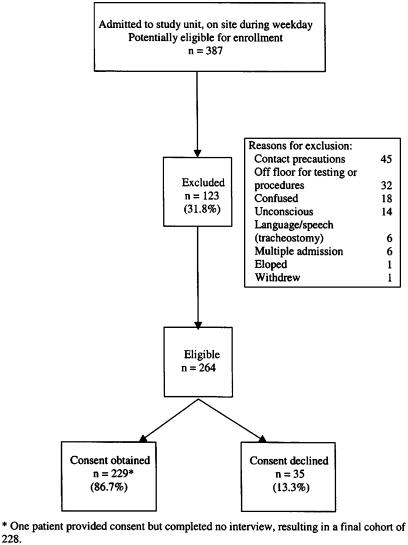
Results: Of 264 eligible patients, 228 (86%) agreed to participate and completed 528 interviews. Seventeen patients (8%) experienced 20 adverse events; 1 was serious. Eight patients (4%) experienced 13 near misses; 5 were serious or life threatening. Eleven (55%) of 20 adverse events and 4 (31%) of 13 near misses were documented in the medical record, but none were found in the hospital incident reporting system. Patients with 3 or more drug allergies were more likely to report errors compared with patients without drug allergies (incidence rate ratio 4.7, 95% CI 1.7, 13.4).
Conclusion: Inpatients can identify adverse events affecting their care. Many patient-identified events are not captured by the hospital incident reporting system or recorded in the medical record. Engaging hospitalized patients as partners in identifying medical errors and injuries is a potentially promising approach for enhancing patient safety.
References
-
- Institute for Family-Centered Care. Your Role in Safe Medication Use. Boston, Mass: Massachusetts Coalition for the Prevention of Medical Errors; 1999. Available at http://www.macoalition.org/documents/Best_Practice_Medication_Errors.pdf Accessed December 14, 2003.
-
- American Hospital Association. Successful practices for improving medication safety, 1999. Available at http://www.hospitalconnect.com/aha/key_issues/medication_safety/ahainiti... Accessed December 14, 2004.
-
- National Patient Safety Foundation. You can help improve patient safety. Available at http://www.npsf.org/html/patients.html Accessed January 20, 2003.
-
- National Patient Safety Foundation. National Agenda for Action: Patients and Families in Patient Safety, 2003. Available at http://www.npsf.org/download/AgendaFamilies.pdf Accessed December 14, 2003.
-
- Agency for Healthcare Research and Quality. 20 Tips to Help Prevent Medical Errors. Patient Fact Sheet. AHRQ Publication No. 00-PO38. Rockville, Md: Agency for Healthcare Research and Quality; 2000. Available at http://www.ahrq.gov/consumer/20tips.htm Accessed December 14, 2003.
Publication types
MeSH terms
Grants and funding
LinkOut - more resources
Full Text Sources