


Role of specific hemagglutinin amino acids in the immunogenicity and protection of H5N1 influenza virus vaccines
- PMID: 16118277
- PMCID: PMC1200312
- DOI: 10.1073/pnas.0506416102
Role of specific hemagglutinin amino acids in the immunogenicity and protection of H5N1 influenza virus vaccines
Abstract
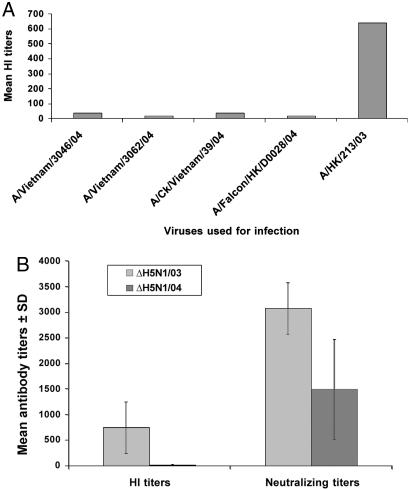
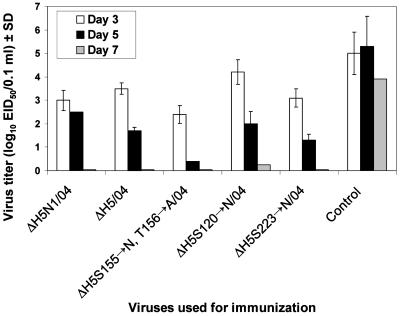
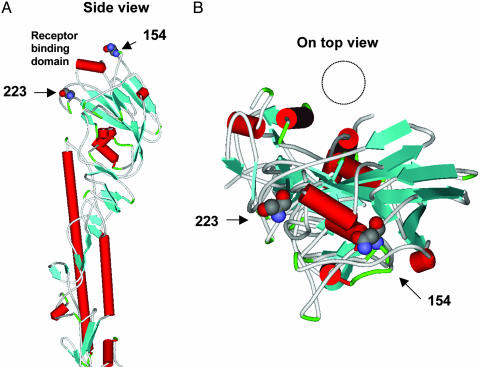
If H5N1 influenza viruses become transmissible among humans, vaccination will offer the most effective option to limit their spread. Two human vaccine candidates recently generated by reverse genetics are based on antigenically different hemagglutinin (HA) glycoproteins derived from the A/HK/213/03 (H5N1) and A/Vietnam/1203/04 (H5N1) viruses. Their HA1 amino acid sequences differ at 10 positions, one of which (N154) introduces a potential glycosylation site in A/Vietnam/1203/04 (H5N1). To assess the impact of five amino acids in the putative antigenic sites on immunogenicity and immune protection, we generated a series of whole-virus vaccines that differed only in one or two HA amino acids. Sera from ferrets vaccinated with these inactivated preparations had high virus neutralization titers, but their hemagglutination inhibition (HI) titers were usually low. Interestingly, a recombinant virus in which the HA amino acid S223 (characteristic of 2004 viruses) was converted to N223 (as in A/HK/213/03) resulted in higher HI titers. This observation indicates that specific HA residues, such as N223, increase the sensitivity of the HI assay by altering receptor specificity and/or antibody-antigen binding. Ferrets vaccinated with mutant vaccine viruses were protected against lethal challenge with wild-type A/Vietnam/1203/04 virus. Our results suggest that inclusion of the N223 residue in the HA glycoproteins of diagnostic reference viruses may facilitate the evaluation of vaccine efficacy in humans.
Figures
References
-
- Li, K. S., Guan, Y., Wang, J., Smith, G. J., Xu, K. M., Duan, L., Rahardjo, A. P., Puthavathana, P., Buranathai, C., Nguyen, T. D., et al. (2004) Nature 430, 209-213. - PubMed
-
- Kuiken, T., Rimmelzwaan, G., van Riel, D., van Amerongen, G., Baars, M., Fouchier, R. & Osterhaus, A. (2004) Science 306, 241. - PubMed
-
- Nicholson, K. G., Colegate, A. E., Podda, A., Stephenson, I., Wood, J., Ypma, E. & Zambon, M. C. (2001) Lancet 357, 1937-1943. - PubMed
-
- Stephenson, I., Bugarini, R., Nicholson, K. G., Podda, A., Wood, J. M., Zambon, M. C. & Katz, J. M. (2005) J. Infect. Dis. 191, 1210-1215. - PubMed
Publication types
MeSH terms
Substances
Grants and funding
LinkOut - more resources
Full Text Sources
Other Literature Sources
Medical
Research Materials
