


Patterns of HIV prevalence among injecting drug users in the cross-border area of Lang Son Province, Vietnam, and Ning Ming County, Guangxi Province, China
- PMID: 16120225
- PMCID: PMC1232855
- DOI: 10.1186/1471-2458-5-89
Patterns of HIV prevalence among injecting drug users in the cross-border area of Lang Son Province, Vietnam, and Ning Ming County, Guangxi Province, China
Abstract
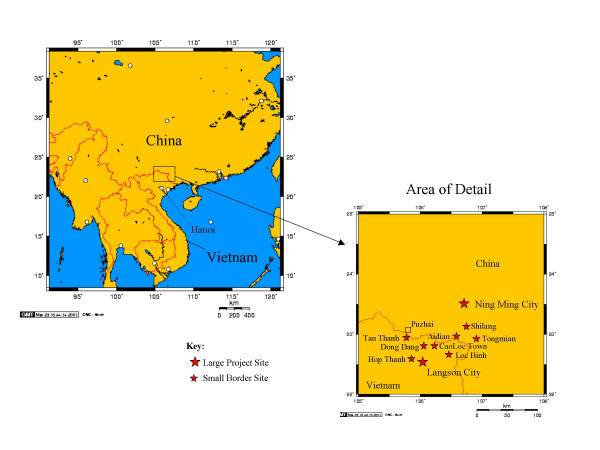
Background: To assess patterns of injecting drug use and HIV prevalence among injecting drug users (IDUs) in an international border area along a major heroin trans-shipment route.
Methods: Cross-sectional surveys of IDUs in 5 sites in Lang Son Province, Vietnam (n = 348) and 3 sites in Ning Ming County, Guangxi Province, China (n = 308). Respondents were recruited through peer referral ("snowball") methods in both countries, and also from officially recorded lists of IDUs in Vietnam. A risk behavior questionnaire was administered and HIV counseling and testing conducted.
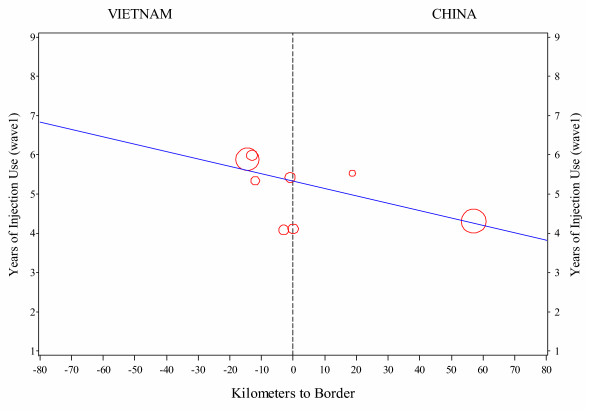
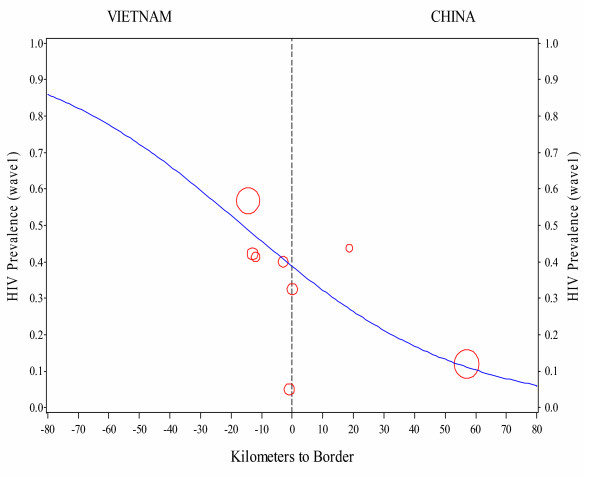
Results: Participants in both countries were largely male, in their 20s, and unmarried. A majority of subjects in both countries were members of ethnic minority groups. There were strong geographic gradients for length of drug injecting and for HIV seroprevalence. Both mean years injecting and HIV seroprevalence declined from the Vietnamese site farthest from the border to the Chinese site farthest from the border. 10.6% of participants in China and 24.5% of participants in Vietnam reported crossing the international border in the 6 months prior to interview. Crossing the border by IDUs was associated with (1) distance from the border, (2) being a member of an ethnic minority group, and (3) being HIV seropositive among Chinese participants.
Conclusion: Reducing the international spread of HIV among IDUs will require programs at the global, regional, national, and "local cross border" levels. At the local cross border level, the programs should be coordinated on both sides of the border and on a sufficient scale that IDUs will be able to readily obtain clean injection equipment on the other side of the border as well as in their country of residence.
Figures
References
-
- Stimson G, Aceijas C, Hickman M, Dehne K, Rhodes T. Global Estimate of Injecting Drug Use: April 20-24 200; Melbourne, Australia. 2004.
-
- D'Aquila RT, Williams AB, Petersen LR, Williams AE. HIV seroprevalence among Connecticut intravenous drug users in 1986-87: Race/ethnicity as a risk factor for HIV seropositivity: ; Washington, DC. 1987. p. 170.
-
- Weiss SH, Ginzburg HM, Goeddert JJ, Biggar RJ, Mohica BA, Blattner WA. Risk for HTLV-III exposure and AIDS among parenteral drug abusers in New Jersey.: ; Atlanta, GA. 1985.
-
- Stimson GV. Reconstruction of sub-regional diffusion of HIV infection among injecting drug users in South-East Asia: Implications for prevention. AIDS. 1994;8:1630–1632. - PubMed
Publication types
MeSH terms
Grants and funding
LinkOut - more resources
Full Text Sources
Medical
