. 2005 Aug 25;436(7054):1161-5.
doi: 10.1038/nature03867.

The neuronal representation of pitch in primate auditory cortex

Affiliations

The neuronal representation of pitch in primate auditory cortex

Daniel Bendor et al. Nature. .

Abstract

Pitch perception is critical for identifying and segregating auditory objects, especially in the context of music and speech. The perception of pitch is not unique to humans and has been experimentally demonstrated in several animal species. Pitch is the subjective attribute of a sound's fundamental frequency (f(0)) that is determined by both the temporal regularity and average repetition rate of its acoustic waveform. Spectrally dissimilar sounds can have the same pitch if they share a common f(0). Even when the acoustic energy at f(0) is removed ('missing fundamental') the same pitch is still perceived. Despite its importance for hearing, how pitch is represented in the cerebral cortex is unknown. Here we show the existence of neurons in the auditory cortex of marmoset monkeys that respond to both pure tones and missing fundamental harmonic complex sounds with the same f(0), providing a neural correlate for pitch constancy. These pitch-selective neurons are located in a restricted low-frequency cortical region near the anterolateral border of the primary auditory cortex, and is consistent with the location of a pitch-selective area identified in recent imaging studies in humans.


Figures
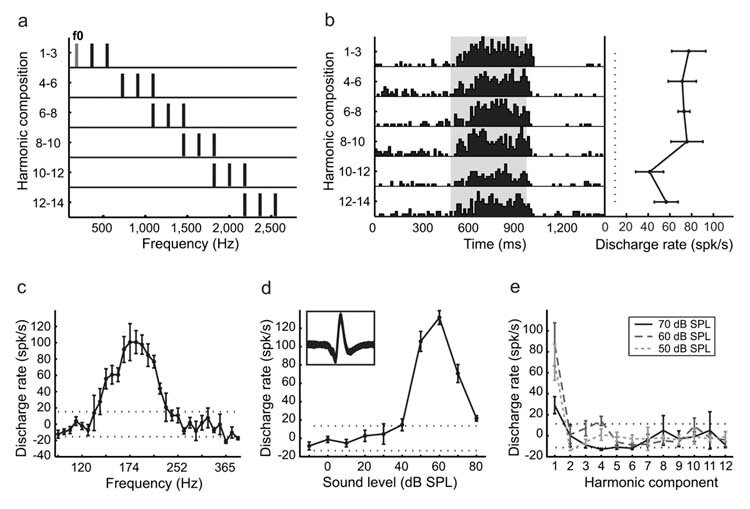
Figure 1
Figure 1
An example of a pitch-selective neuron (Unit M36n-532). Error bars represent standard error of the mean (SEM). The dotted black lines indicate the significance level for discharge rate (± 2 standard deviations away from the spontaneous discharge rate). a. Frequency spectra of a series of harmonic complex stimuli. The fundamental frequency component (f0) and its higher harmonics have an equal amplitude of 50 dB SPL. b. Peristimulus time histogram (left) and tuning curve (right) of the neuron’s response to the stimuli in a). c. Frequency tuning of the neuron derived from pure tones. d. Response of the neuron to a pure tone at CF (182 Hz) across sound levels (rate-level function). Inset plot shows an overlay of 2,434 digitized action potentials recorded from this neuron (displayed within a 2 ms window). e. The neuron’s responses to individual harmonics (number 1-12) at three sound levels, respectively. All the harmonics above the f0 component (1st harmonic) were outside the neuron’s excitatory frequency response area, and did not elicit significant responses.
Figure 2
Figure 2
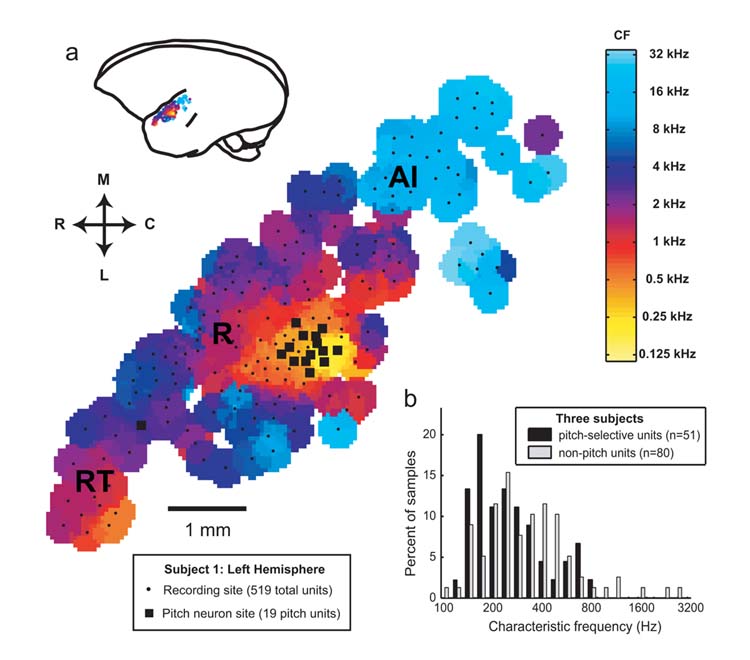
Location and characteristic frequency (CF) distribution of the pitch area in marmoset auditory cortex. a. CF topographical map from the left hemisphere of one marmoset (M2p). Pitch-selective neurons (black squares) were found clustered near the anterolateral border of AI. Frequency reversals indicate the borders between AI/R and R/RT (rostral temporal field). b. The CF distribution from pitch-selective and non-pitch neurons within the pitch area of three marmosets.
Figure 3
Figure 3
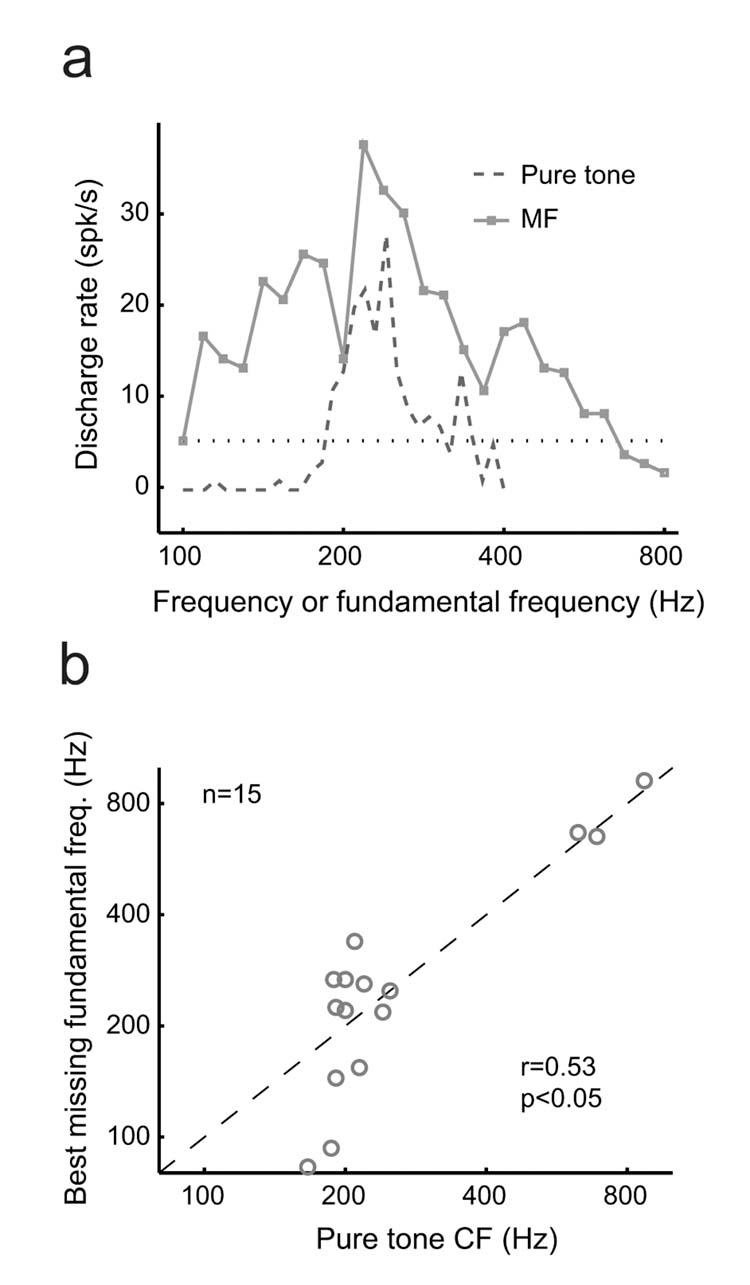
Pitch-selective neurons share a similar tuning for pure tones and MFs. a. An example of an individual pitch-selective neuron’s tuning to pure tone frequency and the fundamental frequency of MFs respectively. (Unit M2p-201) b. A comparison of the CF and best missing fundamental frequency responses from 15 pitch-selective neurons. The Spearman correlation coefficient (r) is displayed on the plot and is statistically significant (p<0.05).
Figure 4
Figure 4
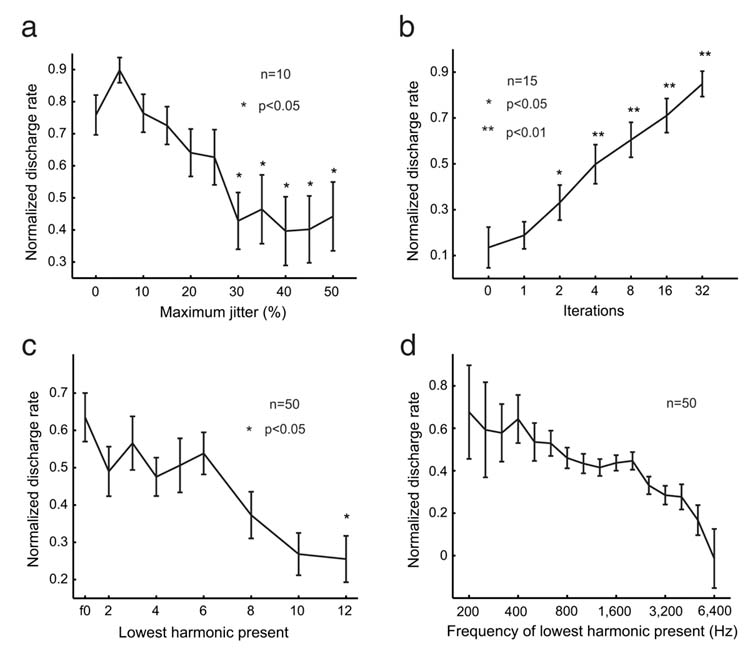
Pitch-selective neurons are sensitive to pitch salience. Error bars represent SEM. Statistical significance was determined using Wilcoxon rank sum test. Responses were normalized by the maximum response elicited within the stimulus set. a. Averaged population response of pitch-selective neurons to irregular click trains as a function of maximum jitter. The response to a regular click-train was used as a reference for statistical comparison at other jitter values. b. Averaged population response as a function of the iterations of IRN stimuli. The response to IRN stimuli with 0 iterations was used as a reference for statistical comparison at other iterations. c. Averaged population response as a function of the lowest harmonic presented in the MF stimuli. The reference for statistical comparsion was harmonic complex sounds with their fundamental frequency present. d. Averaged population response as a function of the frequency of the lowest harmonic presented in the MF stimuli.
Figure 5
Figure 5
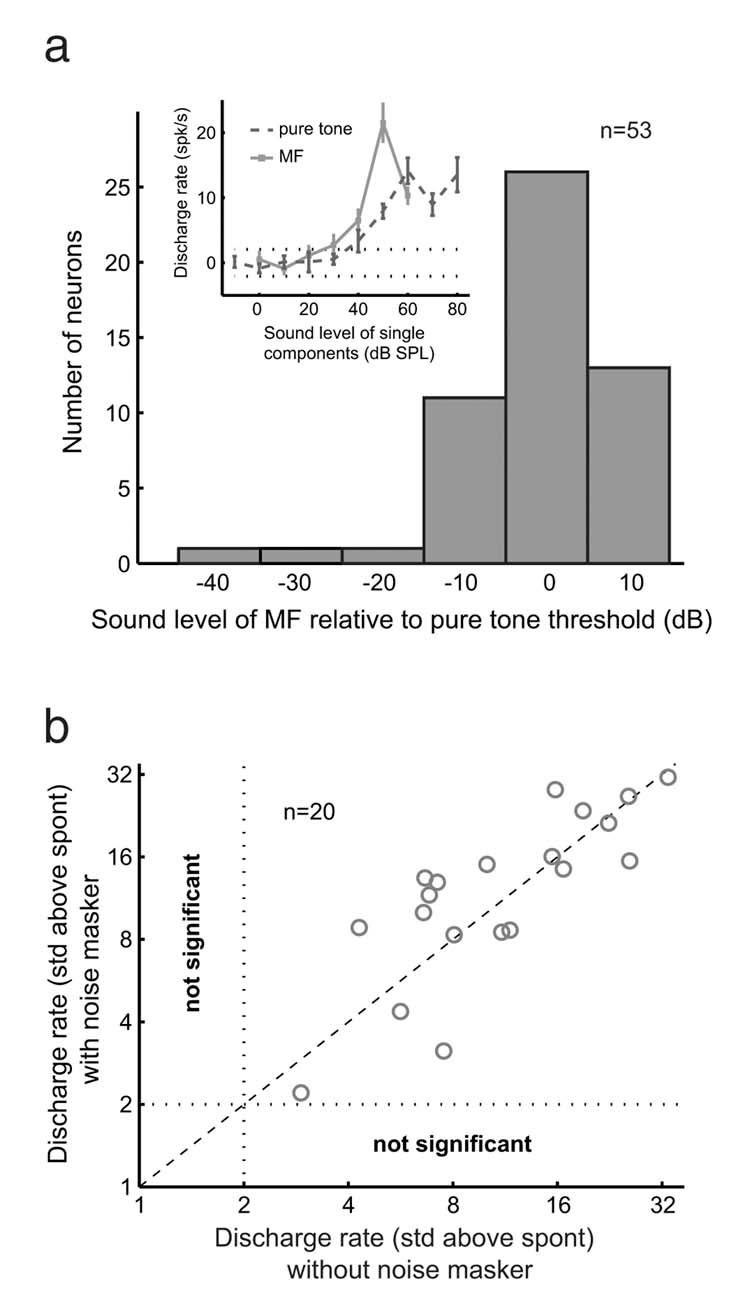
MF responses are not caused by combination tones. a. Distribution of sound level threshold for individual components of the MF response relative to the sound level threshold for a pure tone response at the neuron’s CF. Inset plot shows rate-level functions from a pitch-selective neuron (Unit M41o-294) for pure tones and MFs. The two dotted lines indicate two standard deviations from the spontaneous discharge rate. Error bars represent SEM. b. Scatter plot comparing responses to MFs with and without the presence of a noise masker for 20 pitch-selective neurons. All the neurons tested had significant discharge rates for both conditions. The two dotted lines parallel to the axes indicate two standard deviations from the spontaneous discharge rate. The diagonal line has a slope of 1.

Comment in

References

    1. Moore BCJ. An introduction to the psychology of hearing. Academic Press; London: 2003.
    1. Tomlinson RW, Schwarz DW. Perception of the missing fundamental in nonhuman primates. J Acoust Soc Am. 1988;84:560–5. - PubMed
    1. Heffner H, Whitfield IC. Perception of the missing fundamental by cats. J Acoust Soc Am. 1976;59:915–9. - PubMed
    1. Patterson RD, Uppenkamp S, Johnsrude IS, Griffiths TD. The processing of temporal pitch and melody information in auditory cortex. Neuron. 2002;36:767–76. - PubMed
    1. Penagos H, Melcher JR, Oxenham AJ. A neural representation of pitch salience in nonprimary human auditory cortex revealed with functional magnetic resonance imaging. J Neurosci. 2004;24:6810–5. - PMC - PubMed

Publication types