


A missense mutation in pstpip2 is associated with the murine autoinflammatory disorder chronic multifocal osteomyelitis
- PMID: 16122996
- PMCID: PMC3726202
- DOI: 10.1016/j.bone.2005.07.009
A missense mutation in pstpip2 is associated with the murine autoinflammatory disorder chronic multifocal osteomyelitis
Abstract
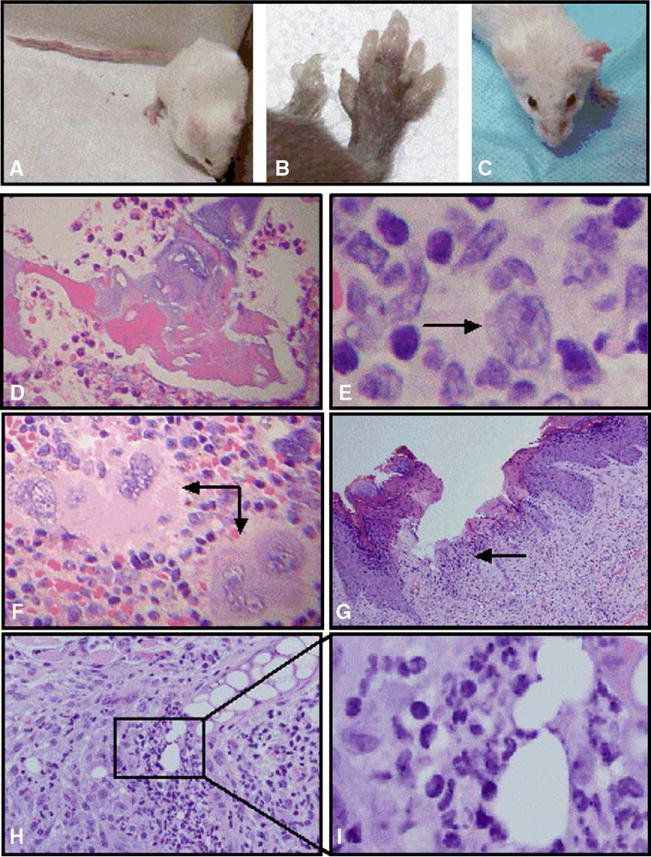
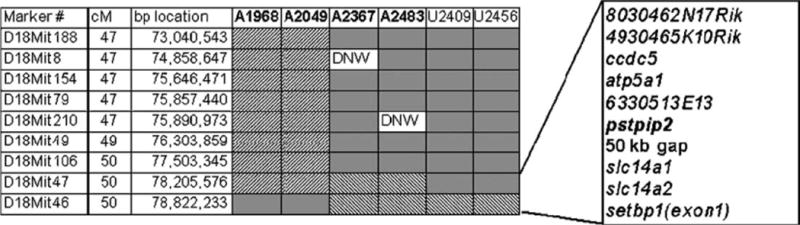
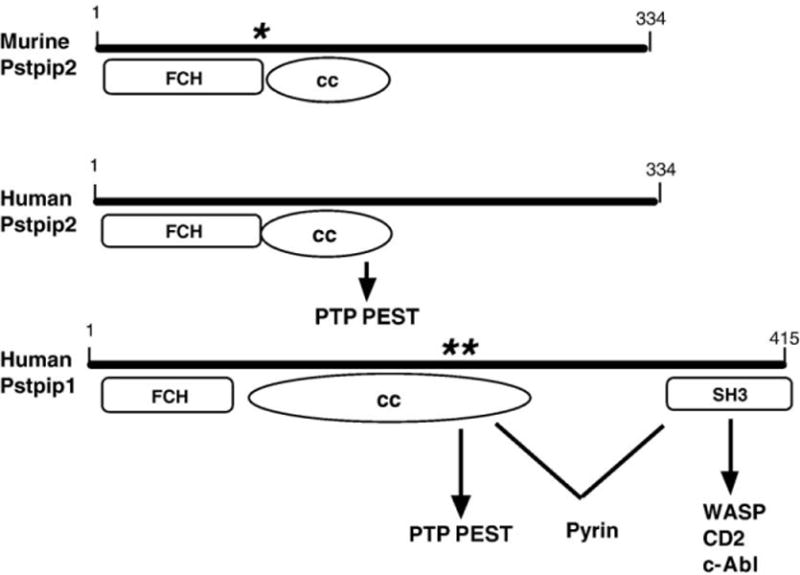
Chronic recurrent multifocal osteomyelitis (CRMO) is an autoinflammatory disorder that primarily affects bone but is often accompanied by inflammation of the skin and/or gastrointestinal tract. The etiology is unknown but evidence suggests a genetic component to disease susceptibility. Although most cases of CRMO are sporadic, there is an autosomal recessive syndromic form of the disease, called Majeed syndrome, which is due to homozygous mutations in LPIN2. In addition, there is a phenotypically similar mouse, called cmo (chronic multifocal osteomyelitis) in which the disease is inherited as an autosomal recessive disorder. The cmo locus has been mapped to murine chromosome 18. In this report, we describe phenotypic abnormalities in the cmo mouse that include bone, cartilage and skin inflammation. Utilizing a backcross breeding strategy, we refined the cmo locus to a 1.3 Mb region on murine chromosome 18. Within the refined region was the gene pstpip2, which shares significant sequence homology to the PSTPIP1. Mutations in PSTPIP1 have been shown to cause the autoinflammatory disorder PAPA syndrome (pyogenic arthritis, pyoderma gangrenosum and acne). Mutation analysis, utilizing direct sequencing, revealed a single base pair change c.293T --> C in the pstpip2 gene resulting in a highly conserved leucine at amino acid 98 being replaced by a proline (L98P). No other mutations were found in the coding sequence of the remaining genes in the refined interval, although a 50 kb gap remains unexplored. These data suggest that mutations in pstpip2 may be the genetic explanation for the autoinflammatory phenotype seen in the cmo mouse.
Figures

References
-
- Keipert JA, Campbell PE. Recurrent hyperostosis of the clavicles: an undiagnosed syndrome. Aust Paediatr J. 1970;6:97–104. - PubMed
-
- Giedion A, Holthusen W, Masel LF, Vischer D. Subacute and chronic “symmetrical” osteomyelitis. Ann Radiol (Paris) 1972;15:329–42. - PubMed
-
- Laxer RM, Shore AD, Manson D, King S, Silverman ED, Wilmot DM. Chronic recurrent multifocal osteomyelitis and psoriasis—A report of a new association and review of related disorders. Semin Arthritis Rheum. 1988;17:260–70. - PubMed
-
- Prose NS, Fahrner LJ, Miller CR, Layfield L. Pustular psoriasis with chronic recurrent multifocal osteomyelitis and spontaneous fractures. J Am Acad Dermatol. 1994;31:376–9. - PubMed
-
- Vittecoq O, Said LA, Michot C, Mejjad O, Thomine JM, Mitrofanoff P, et al. Evolution of chronic recurrent multifocal osteitis toward spondylar-thropathy over the long term. Arthritis Rheum. 2000;43:109–19. - PubMed
Publication types
MeSH terms
Substances
Grants and funding
LinkOut - more resources
Full Text Sources
Medical
Molecular Biology Databases
Miscellaneous
