Comparative Study
. 2005 Sep 6;102(36):12819-24.
doi: 10.1073/pnas.0503819102. Epub 2005 Aug 26.

Evolution of human-chimpanzee differences in malaria susceptibility: relationship to human genetic loss of N-glycolylneuraminic acid

Affiliations
Comparative Study

Evolution of human-chimpanzee differences in malaria susceptibility: relationship to human genetic loss of N-glycolylneuraminic acid

Maria J Martin et al. Proc Natl Acad Sci U S A. .

Erratum in

  • Proc Natl Acad Sci U S A. 2006 Jun 20;103(25):9745

Abstract

Chimpanzees are the closest evolutionary cousins of humans, sharing >99% identity in most protein sequences. Plasmodium falciparum is the major worldwide cause of malaria mortality. Plasmodium reichenowi, a morphologically identical and genetically very similar parasite, infects chimpanzees but not humans. Conversely, experimental P. falciparum infection causes brief moderate parasitization and no severe infection in chimpanzees. This surprising host specificity remains unexplained. We modified and enhanced traditional methods for measuring sialic acid (Sia)-dependent recognition of glycophorins by merozoite erythrocyte-binding proteins, eliminating interference caused by endogenous Sias on transfected cells, and by using erythroleukemia cells to allow experimental manipulation of Sia content. We present evidence that these remarkable differences among such closely related host-parasite pairs is caused by species-specific erythrocyte-recognition profiles, apparently related to the human-specific loss of the common primate Sia N-glycolylneuraminic acid. The major merozoite-binding protein erythrocyte-binding antigen-175 of P. falciparum apparently evolved to take selective advantage of the excess of the Sia N-acetylneuraminic acid (the precursor of N-glycolylneuraminic acid) on human erythrocytes. The contrasting preference of P. reichenowi erythrocyte-binding antigen-175 for N-glycolylneuraminic acid is likely the ancestral condition. The surprising ability of P. falciparum to cause disease in New World Aotus monkeys (geographically isolated from P. falciparum until arrival of peoples from the Old World) can be explained by parallel evolution of a human-like Sia expression pattern in these distantly related primates. These results also have implications for the prehistory of hominids and for the genetic origins and recent emergence of P. falciparum as a major human pathogen.


Figures
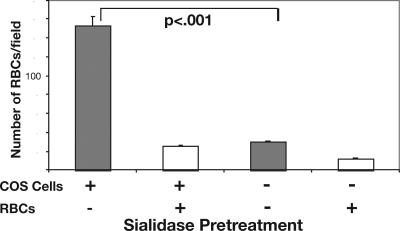
Fig. 1.
Fig. 1.
Sialidase pretreatment of transfected COS cells improves erythrocyte binding. COS7 cells were transfected with PfEBA-175-RII 2 days before the assay. Erythrocytes (RBCs), COS cells, or both were treated with sialidase or sham incubated in the same buffer without enzyme. Erythrocytes and COS cells then were allowed to interact for 30 min at 37°C, and total bound erythrocytes in 10 microscope fields were counted. Data are mean ± SEM.
Fig. 2.
Fig. 2.
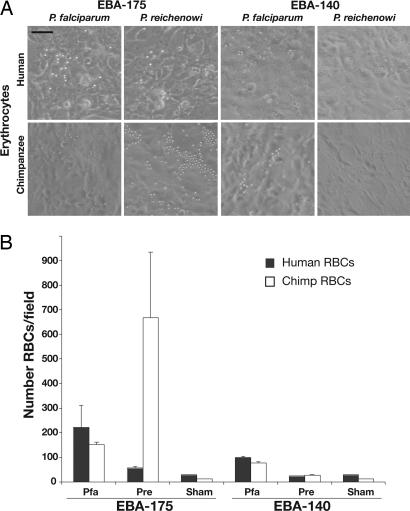
EBA-175-RII from Plasmodium species preferentially bind to their natural host erythrocytes. Binding assays (as in Fig. 1) were performed by using human and chimpanzee erythrocytes (RBCs) on COS cells transfected with EBA-175 or EBA-140 RIIs from P. falciparum and P. reichenowi.(A) Representative photos from 50 microscope fields are shown. (Scale bar, 1 μm.) (B) Mean erythrocyte numbers in 15 microscope fields, selected randomly. Sham, sham-transfected cells; Pfa, P. falciparum homolog; Pre, P. reichenowi homolog. Data are mean ± SE.
Fig. 3.
Fig. 3.
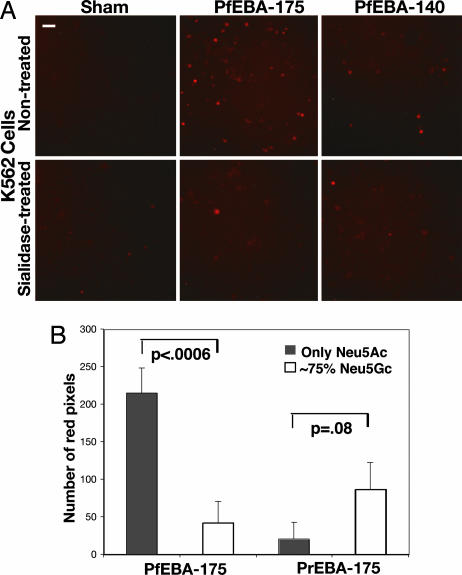
Neu5Gc expression on K562 cells reduces binding to PfEBA-175. (A) K562 cells were loaded with SNARF1-AM after treatment with or without sialidase as described for Fig. 1 and then incubated with desialylated COS cells expressing RII of PfEBA-175 or PfEBA-140 for 30 min at 37°C. After washing and fixation, bound K562 cells were analyzed by fluorescence microscopy. (Scale bar, 1 μm.) (B) Binding of desialylated COS cells expressed PfEBA-175 or PrEBA-175 to K562 cells expressing only cell-surface Neu5Ac (gray bars) or 75% Neu5Gc (open bars). Bound cells were quantitated by using Adobe photoshop to measure the number of red pixels from 15 microscope fields. (Scale bar, 1 μm.) Data are expressed as mean ± SE.
Fig. 4.
Fig. 4.
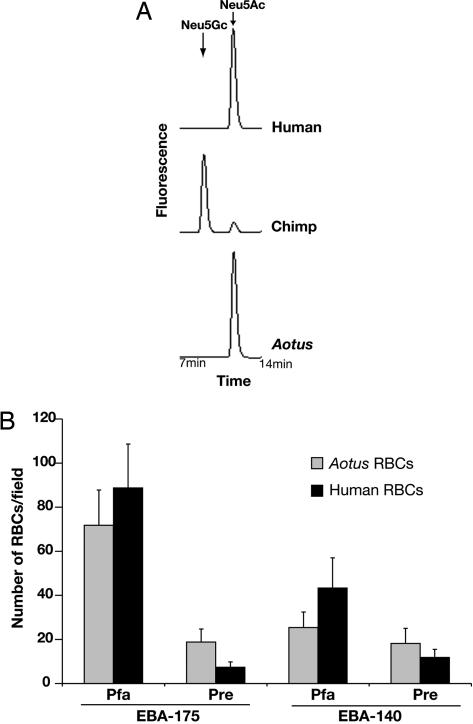
Aotus erythrocytes are more similar to human erythrocytes than to those of chimpanzees. (A) Sias released from human, chimpanzee, or Aotus erythrocytes (RBCs) were derivatized with 1,2-diamino-4,5-methylene dioxybenzene and profiled by HPLC. The elution position of Neu5Ac and Neu5Gc standards are indicated. (B) COS7 cells transfected with PfEBA-175, PrEBA-175, PfEBA-140, or PrEBA-140 were desialylated and used to test binding of Aotus or human erythrocytes as described for Fig. 2. Data are mean ± SE. Pfa, P. falciparum homolog; Pre, P. reichenowi homolog.

References

    1. Rasti, N., Wahlgren, M. & Chen, Q. (2004) FEMS Immunol. Med. Microbiol. 41, 9-26. - PubMed
    1. Miller, L. H., Baruch, D. I., Marsh, K. & Doumbo, O. K. (2002) Nature 415, 673-679. - PubMed
    1. Escalante, A. A. & Ayala, F. J. (1994) Proc. Natl. Acad. Sci. USA 91, 11373-11377. - PMC - PubMed
    1. Escalante, A. A., Barrio, E. & Ayala, F. J. (1995) Mol. Biol. Evol. 12, 616-626. - PubMed
    1. McCutchan, T. F., Kissinger, J. C., Touray, M. G., Rogers, M. J., Li, J., Sullivan, M., Braga, E. M., Krettli, A. U. & Miller, L. H. (1996) Proc. Natl. Acad. Sci. USA 93, 11889-11894. - PMC - PubMed

Publication types

MeSH terms