


Amygdalin inhibits genes related to cell cycle in SNU-C4 human colon cancer cells
- PMID: 16127745
- PMCID: PMC4320388
- DOI: 10.3748/wjg.v11.i33.5156
Amygdalin inhibits genes related to cell cycle in SNU-C4 human colon cancer cells
Abstract
Aim: The genes were divided into seven categories according to biological function; apoptosis-related, immune response-related, signal transduction-related, cell cycle-related, cell growth-related, stress response-related and transcription-related genes.
Methods: We compared the gene expression profiles of SNU-C4 cells between amygdalin-treated (5 mg/mL, 24 h) and non-treated groups using cDNA microarray analysis. We selected genes downregulated in cDNA microarray and investigated mRNA levels of the genes by RT-PCR.
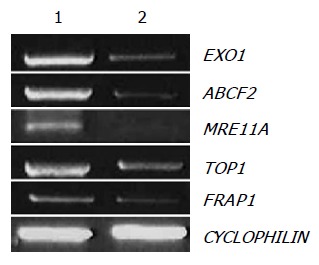
Results: Microarray showed that amygdalin downregulated especially genes belonging to cell cycle category: exonuclease 1 (EXO1), ATP-binding cassette, sub-family F, member 2 (ABCF2), MRE11 meiotic recombination 11 homolog A (MRE11A), topoisomerase (DNA) I (TOP1), and FK506 binding protein 12-rapamycin-associated protein 1 (FRAP1). RT-PCR analysis revealed that mRNA levels of these genes were also decreased by amygdalin treatment in SNU-C4 human colon cancer cells.
Conclusion: These results suggest that amygdalin have an anticancer effect via downregulation of cell cycle-related genes in SNU-C4 human colon cancer cells, and might be used for therapeutic anticancer drug.
Figures
References
-
- Singh P, Dai B, Dhruva B, Widen SG. Episomal expression of sense and antisense insulin-like growth factor (IGF)-binding protein-4 complementary DNA alters the mitogenic response of a human colon cancer cell line (HT-29) by mechanisms that are independent of and dependent upon IGF-I. Cancer Res. 1994;54:6563–6570. - PubMed
-
- Midgley R, Kerr D. Colorectal cancer. Lancet. 1999;353:391–399. - PubMed
-
- Kim EJ, Schaffer BS, Kang YH, MacDonald RG, Park JH. Decreased production of insulin-like growth factor-binding protein (IGFBP)-6 by transfection of colon cancer cells with an antisense IGFBP-6 cDNA construct leads to stimulation of cell proliferation. J Gastroenterol Hepatol. 2002;17:563–570. - PubMed
Publication types
MeSH terms
Substances
LinkOut - more resources
Full Text Sources
Molecular Biology Databases
Research Materials
Miscellaneous
