


Reduced sleep efficiency in cervical spinal cord injury; association with abolished night time melatonin secretion
- PMID: 16130027
- PMCID: PMC2882209
- DOI: 10.1038/sj.sc.3101784
Reduced sleep efficiency in cervical spinal cord injury; association with abolished night time melatonin secretion
Abstract
Study design: Case-controlled preliminary observational study.
Objective: Melatonin is usually secreted only at night and may influence sleep. We previously found that complete cervical spinal cord injury (SCI) interrupts the neural pathway required for melatonin secretion. Thus, we investigated whether the absence of night time melatonin in cervical SCI leads to sleep disturbances.
Setting: General Clinical Research Center, Brigham and Women's Hospital, Boston, USA.
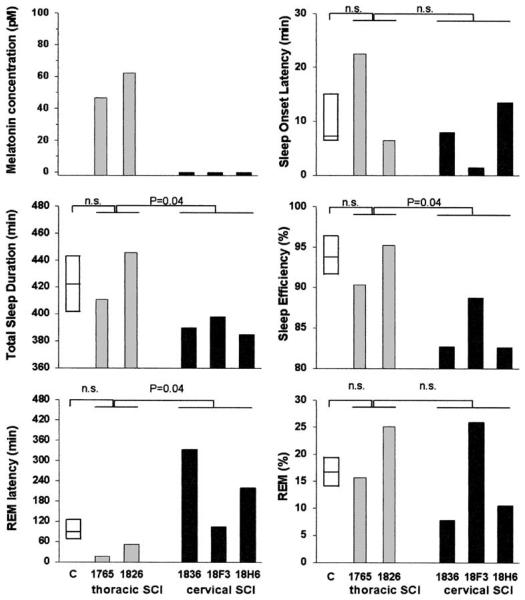
Methods: In an ancillary analysis of data collected in a prior study, we assessed the sleep patterns of three subjects with cervical SCI plus absence of nocturnal melatonin (SCI levels: C4A, C6A, C6/7A) and two control patients with thoracic SCI plus normal melatonin rhythms (SCI levels: T4A, T5A). We also compared those results to the sleep patterns of 10 healthy control subjects.
Results: The subjects with cervical SCI had significantly lower sleep efficiency (median 83%) than the control subjects with thoracic SCI (93%). The sleep efficiency of subjects with thoracic SCI was not different from that of healthy control subjects (94%). There was no difference in the proportion of the different sleep stages, although there was a significantly increased REM-onset latency in subjects with cervical SCI (220 min) as compared to subjects with thoracic SCI (34 min). The diminished sleep in cervical SCI was not associated with sleep apnea or medication use.
Conclusion: We found that cervical SCI is associated with decreased sleep quality. A larger study is required to confirm these findings. If confirmed, the absence of night time melatonin in cervical SCI may help explain their sleep disturbances, raising the possibility that melatonin replacement therapy could help normalize sleep in this group.
Figures
References
-
- Adey WR, Bors E, Porter RW. EEG sleep patterns after high cervical lesions in man. Arch Neurol. 1968;19:377–383. - PubMed
-
- Biering-Sorensen F, Biering-Sorensen M. Sleep disturances in the spinalcord injured: an epidemiological questionnaire investigation, including a normal population. Spinal Cord. 2001;39:505–513. - PubMed
-
- Zeitzer JM, Ayas NT, Shea SA, Brown R, Czeisler CA. Absence of detectable melatonin, preservation of cortisol, thyrotropin rhythms in tetraplegia. J Clin Endocrinol Metab. 2000;85:2189–2196. - PubMed
-
- VanDen Heuvel CJ, Reid KJ, Dawson D. Effect of atenolol on nocturnal sleep and temperature in young men: reversal by pharmacological doses of melatonin. Physiol Behav. 1997;61:795–802. - PubMed
Publication types
MeSH terms
Substances
Grants and funding
LinkOut - more resources
Full Text Sources
Medical
Miscellaneous
