


Alternative views of functional protein binding epitopes obtained by combinatorial shotgun scanning mutagenesis
- PMID: 16131663
- PMCID: PMC2253482
- DOI: 10.1110/ps.051519805
Alternative views of functional protein binding epitopes obtained by combinatorial shotgun scanning mutagenesis
Abstract
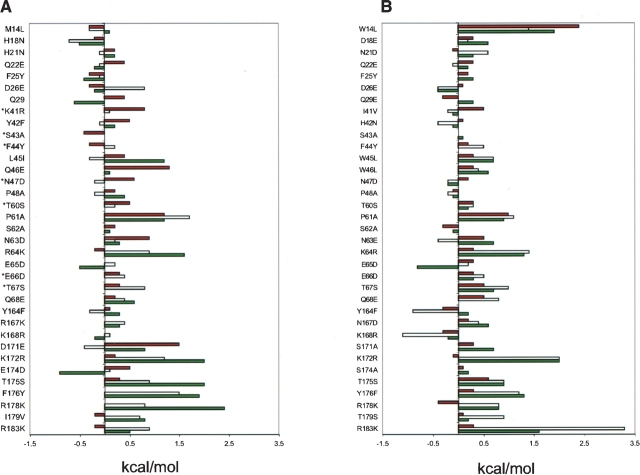
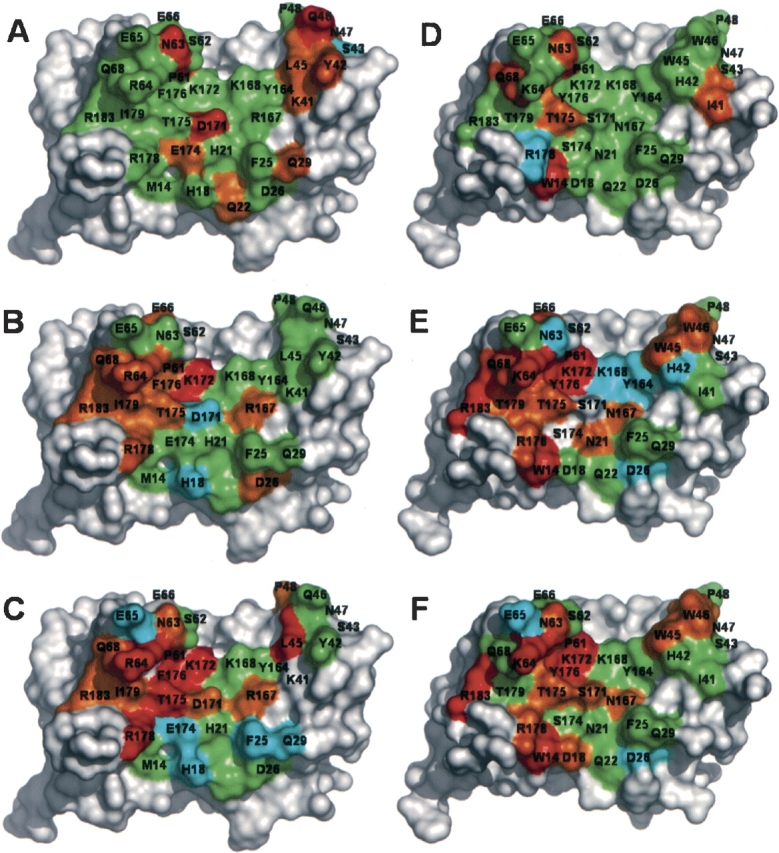
Combinatorial shotgun scanning mutagenesis was used to analyze two large, related protein binding sites to assess the specificity and importance of individual side chain contributions to binding affinity. The strategy allowed for cost-effective generation of a plethora of functional data. The ease of the technology promoted comprehensive investigations, in which the classic alanine-scanning approach was expanded with two additional strategies, serine- and homolog-scanning. Binding of human growth hormone (hGH) to the hGH receptor served as the model system. The entire high affinity receptor-binding sites (site 1) of wild-type hGH (hGHwt) and of an affinity-improved variant (hGHv) were investigated and the results were compared. The contributions that 35 residue positions make to binding were assessed on each hormone molecule by both serine- and homolog-scanning. The hormone molecules were displayed on the surfaces of bacteriophage, and the 35 positions were randomized simultaneously to allow equal starting frequencies of the wild-type residue and either serine or a homologous mutation in separate libraries. Functional selections for binding to the hGH receptor shifted the relative wild-type/mutant frequencies at each position to an extent characteristic of the functional importance of the side chain. Functional epitope maps were created and compared to previous maps obtained by alanine-scanning. Comparisons between the different scans provide insights into the affinity maturation process that produced hGHv. The serine and homolog-scanning results expand upon and complement the alanine-scanning results and provide additional data on the robustness of the high affinity receptor-binding site of hGH.
Figures
References
-
- Clackson, T. and Wells, J.A. 1995. A hot spot of binding energy in a hormone-receptor interface. Science 267 383–386. - PubMed
-
- Cunningham, B.C. and Wells, J.A. 1989. High-resolution epitope mapping of hGH-receptor interactions by alanine-scanning mutagenesis. Science 244 1081–1085. - PubMed
-
- Cunningham, B.C. and Wells, J.A. 1993. Comparison of a structural and a functional epitope. J. Mol. Biol. 234 554–563. - PubMed
-
- Cunningham, B.C., Jhurani, P., Ng, P., and Wells, J.A. 1989. Receptor and antibody epitopes in human growth hormone identified by homolog-scanning mutagenesis. Science 243 1330–1336. - PubMed
MeSH terms
Substances
LinkOut - more resources
Full Text Sources
Other Literature Sources
