


Assessing susceptibility from early-life exposure to carcinogens
- PMID: 16140616
- PMCID: PMC1280390
- DOI: 10.1289/ehp.7667
Assessing susceptibility from early-life exposure to carcinogens
Abstract
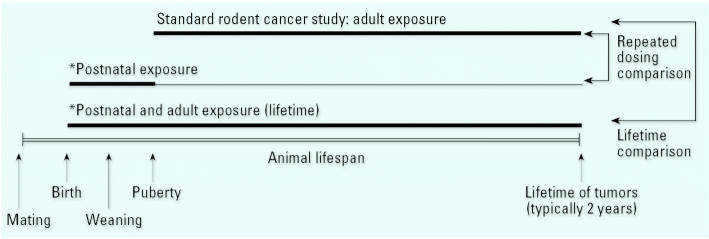
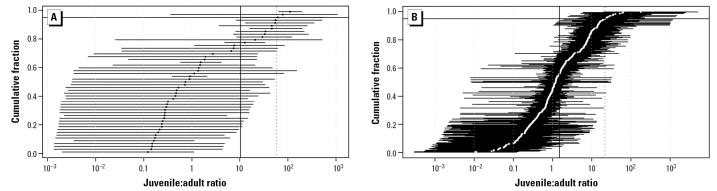
Cancer risk assessment methods currently assume that children and adults are equally susceptible to exposure to chemicals. We reviewed available scientific literature to determine whether this was scientifically supported. We identified more than 50 chemicals causing cancer after perinatal exposure. Human data are extremely limited, with radiation exposures showing increased early susceptibility at some tumor sites. Twenty-seven rodent studies for 18 chemicals had sufficient data after postnatal and adult exposures to quantitatively estimate potential increased susceptibility from early-life exposure, calculated as the ratio of juvenile to adult cancer potencies for three study types: acute dosing, repeated dosing, and lifetime dosing. Twelve of the chemicals act through a mutagenic mode of action. For these, the geometric mean ratio was 11 for lifetime exposures and 8.7 for repeat exposures, with a ratio of 10 for these studies combined. The geometric mean ratio for acute studies is 1.5, which was influenced by tissue-specific results [geometric mean ratios for kidney, leukemia, liver, lymph, mammary, nerve, reticular tissue, thymic lymphoma, and uterus/vagina > 1 (range, 1.6-8.1); forestomach, harderian gland, ovaries, and thyroid < 1 (range, 0.033-0.45)]. Chemicals causing cancer through other modes of action indicate some increased susceptibility from postnatal exposure (geometric mean ratio is 3.4 for lifetime exposure, 2.2 for repeat exposure). Early exposures to compounds with endocrine activity sometimes produce different tumors after exposures at different ages. These analyses suggest increased susceptibility to cancer from early-life exposure, particularly for chemicals acting through a mutagenic mode of action.
Figures
References
-
- Carlin BP, Louis TA. 2000. Bayes and Empirical Bayes Methods for Data Analysis. 2nd ed. Boca Raton, FL:Chapman & Hall/CRC.
-
- Carthew P, Edwards RE, Nolan BM, Martin EA, Heydon T, White INH, et al. Tamoxifen induces endometrial and vaginal cancer in rats in the absence of endometrial hyperplasia. Carcinogenesis. 2000;21:793–797. - PubMed
-
- Carthew P, Edwards RE, Nolan BM, Martin EA, Smith LL. Tamoxifen associated uterine pathology in rodents: relevance to women. Carcinogenesis. 1996;17:1577–1582. - PubMed