


Characterisation of parapoxviruses isolated from Norwegian semi-domesticated reindeer (Rangifer tarandus tarandus)
- PMID: 16143041
- PMCID: PMC1242257
- DOI: 10.1186/1743-422X-2-79
Characterisation of parapoxviruses isolated from Norwegian semi-domesticated reindeer (Rangifer tarandus tarandus)
Abstract
Background: Two outbreaks of the disease contagious ecthyma were reported in 1999 and 2000 in Norwegian semi-domesticated reindeer (Rangifer tarandus tarandus). Contagious ecthyma is an epidermal disease of sheep and goats worldwide, which is caused by the zoonotic parapoxvirus orf virus. Characterisation of clinical samples from the two outbreaks in semi-domesticated reindeer in Norway by electron microscopy and PCR (B2L) revealed typical parapoxvirus particles and partial gene sequences corresponding to parapoxvirus, respectively. If contagious ecthyma in reindeer is caused by orf virus, the virus may be transferred from sheep and goats, via people, equipment and common use of pastures and corrals, to reindeer. Another possibility is that contagious ecthyma in reindeer is caused by a hitherto unclassified member of the parapoxvirus genus that circulates among reindeer herds and remains endemic in Norway.
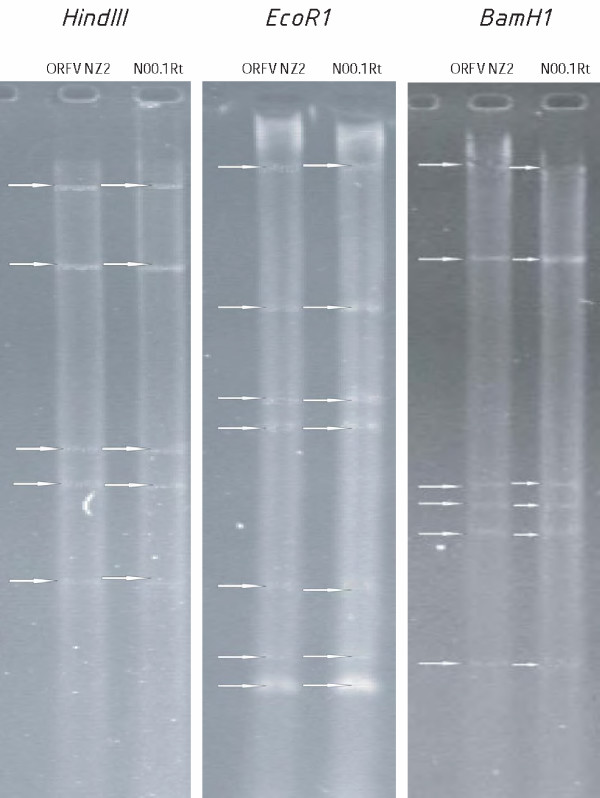
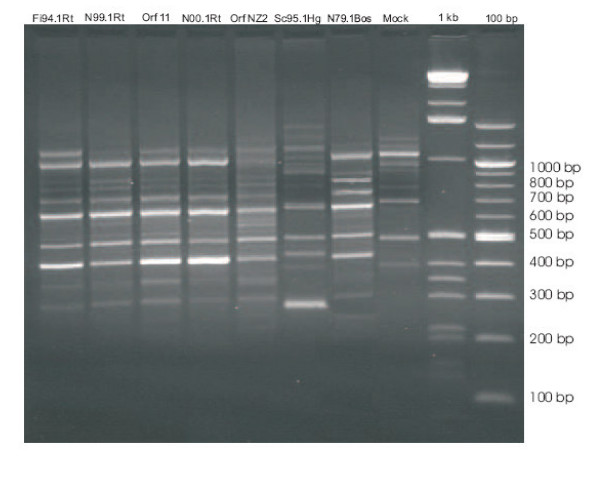
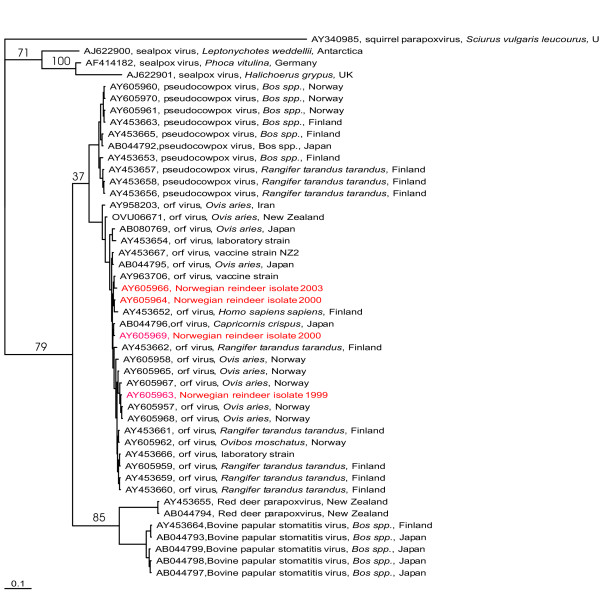
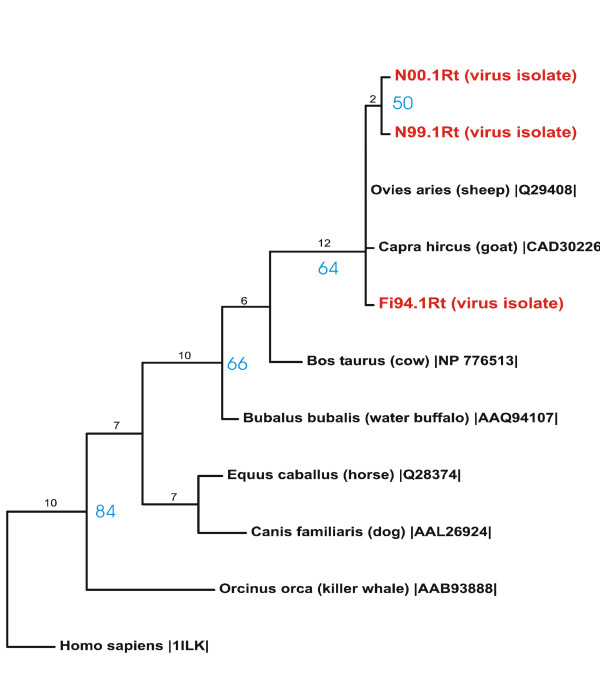
Results: Genomic comparisons of one standard orf strain (orf NZ2) and the reindeer isolates, employing restriction fragment length polymorphism (RFLP) and random amplified polymorphic DNA (RAPD) analysis, demonstrated high similarity between the reindeer viruses and known orf virus strains. Partial DNA sequences of two different viral genes were determined for the different isolates and compared with corresponding parapoxvirus genebank sequences. The comparison/alignment and construction of phylogenetic trees also point to an affiliation of the reindeer viruses to the species orf virus.
Conclusion: The results of this work imply that the parapoxvirus causing contagious ecthyma in Norwegian semi-domesticated reindeer belongs to the species orf virus and that the orf virus crosses the host species barrier from sheep and goat to semi-domesticated reindeer.
Figures
References
-
- Tryland M, Josefsen T, Oksanen A, Aschfalk A. Contagious ecthyma in Norwegian semi-domesticated reindeer (Rangifer tarandus tarandus) Vet Rec. 2001;149:394–395. - PubMed
-
- Kuhl JT, Huerter CJ, Hashish H. A case of human orf contracted from a deer. Cutis. 2003;71:288–290. - PubMed
-
- Oksanen A, Norberg H. Smittsom munnskurv. Reindriftsnytt. 1994;3–4:13–17.
Publication types
MeSH terms
Substances
Associated data
- Actions
- Actions
- Actions
- Actions
- Actions
- Actions
- Actions
- Actions
- Actions
- Actions
- Actions
- Actions
- Actions
- Actions
- Actions
- Actions
- Actions
- Actions
- Actions
- Actions
- Actions
- Actions
- Actions
- Actions
- Actions
- Actions
- Actions
- Actions
- Actions
- Actions
- Actions
- Actions
- Actions
- Actions
- Actions
- Actions
- Actions
- Actions
- Actions
- Actions
- Actions
- Actions
- Actions
- Actions
- Actions
- Actions
- Actions
- Actions
- Actions
- Actions
- Actions
- Actions
- Actions
- Actions
- Actions
- Actions
- Actions
- Actions
- Actions
- Actions
- Actions
- Actions
LinkOut - more resources
Full Text Sources
