


Endothelial targeting of a recombinant construct fusing a PECAM-1 single-chain variable antibody fragment (scFv) with prourokinase facilitates prophylactic thrombolysis in the pulmonary vasculature
- PMID: 16144802
- PMCID: PMC1895234
- DOI: 10.1182/blood-2005-05-2002
Endothelial targeting of a recombinant construct fusing a PECAM-1 single-chain variable antibody fragment (scFv) with prourokinase facilitates prophylactic thrombolysis in the pulmonary vasculature
Abstract
Means to prevent thrombus extension and local recurrence remain suboptimal, in part because of the limited effectiveness of existing thrombolytics. In theory, plasminogen activators could be used for this purpose if they could be anchored to the vascular lumen by targeting stably expressed, noninternalized determinants such as platelet-endothelial-cell adhesion molecule 1 (PECAM-1). We designed a recombinant molecule fusing low-molecular-weight single-chain prourokinase plasminogen activator (lmw-scuPA) with a single-chain variable fragment (scFv) of a PECAM-1 antibody to generate the prodrug scFv/lmw-scuPA. Cleavage by plasmin generated fibrinolytically active 2-chain lmw-uPA. This fusion protein (1) bound specifically to PECAM-1-expressing cells; (2) was rapidly cleared from blood after intravenous injection; (3) accumulated in the lungs of wild-type C57BL6/J, but not PECAM-1 null mice; and (4) lysed pulmonary emboli formed subsequently more effectively than lmw-scuPA, thereby providing support for the concept of thromboprophylaxis using recombinant scFv-fibrinolytic fusion proteins that target endothelium.
Figures
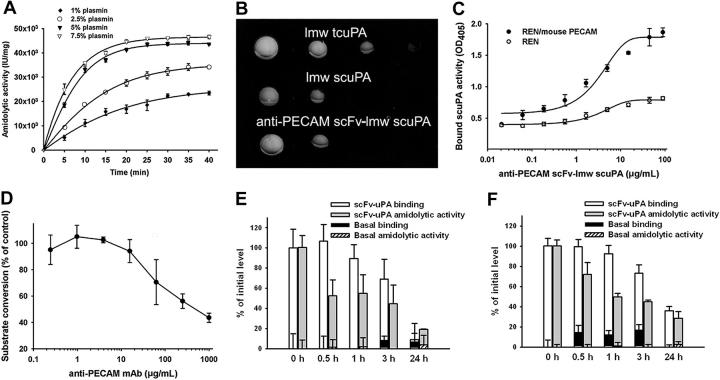
 ) was determined by using H5V mouse endothelioma cells (E) and human REN/PECAM-1 cells (F). Basal levels of uPA antigen (▪) and amidolytic activity (
 ) were determined by using intact cells. Amounts of fusion protein and amidolytic activity anchored to cell surface were significantly different from basal levels at 3 hours in mouse cells (P < .002) and 24 hours in human cells (P < .01). Error bars indicate SEM.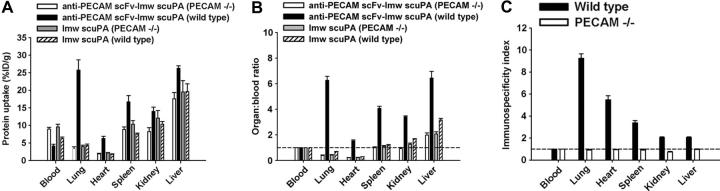
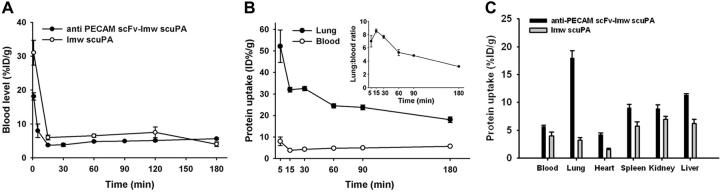 ) 3 hours after intravenous injection in wild-type mice. Error bars indicate SEM.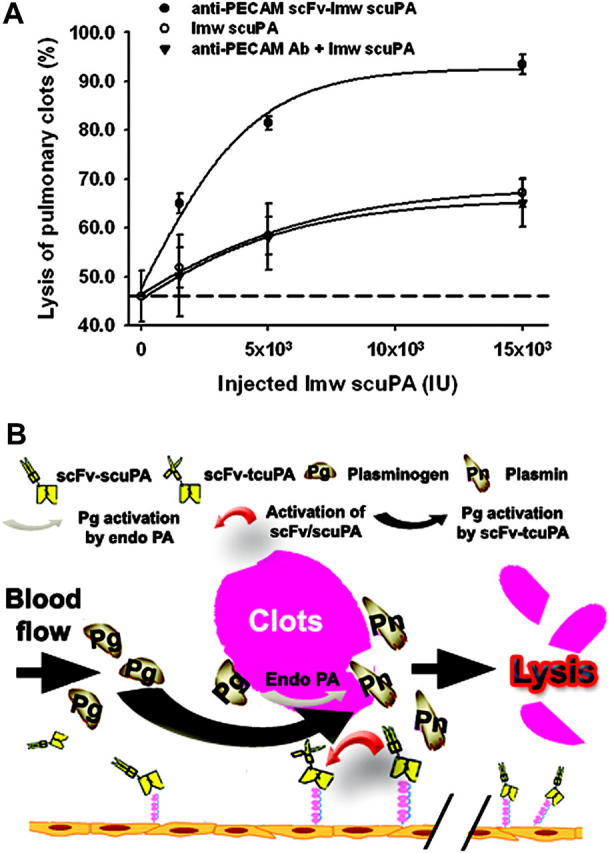
References
-
- Topol EJ, Morris D, Smalling R, et al. A multicenter, randomized, placebo-controlled trial of a new form of intravenous recombinant tissue-type plasminogen activator (Activase) in acute myocardial infarction. J Am Coll Cardiol. 1987;9: 1205-1213. - PubMed
-
- Marler JR, Goldstein LB. Stroke: tPA and the clinic. Science. 2003;301: 1677. - PubMed
-
- Collen D. Towards improved thrombolytic therapy. Lancet. 1993;342: 34-36. - PubMed
-
- Sakharov DV, Rijken DC. Superficial accumulation of plasminogen during plasma clot lysis. Circulation. 1995;92: 1883-1890. - PubMed
-
- Zhu Y, Carmeliet P, Fay WP. Plasminogen activator inhibitor-1 is a major determinant of arterial thrombolysis resistance. Circulation. 1999;99: 3050-3055. - PubMed
Publication types
MeSH terms
Substances
Grants and funding
LinkOut - more resources
Full Text Sources
Other Literature Sources
Medical
Molecular Biology Databases
Research Materials
Miscellaneous
