. 2005 Oct;23(9):1423-33.
doi: 10.1634/stemcells.2005-0390. Epub 2005 Sep 6.

Bypass of senescence, immortalization, and transformation of human hematopoietic progenitor cells

Affiliations

Bypass of senescence, immortalization, and transformation of human hematopoietic progenitor cells

Sergey S Akimov et al. Stem Cells. 2005 Oct.

Abstract

We attempted to extend the lifespan of CD34+ stem/progenitor cells in human cord blood (CB) by transduction with lentiviral vectors carrying the human telomerase catalytic subunit (hTERT) and/or the human papillomavirus type 16 (HPV16) E6 and E7 oncogenes. We found that hTERT was incapable of prolonging the replicative capacity of CB cells maintained under serum-free conditions in the presence of stem cell factor, Flt3 ligand, thrombopoietin, and interleukin-3 beyond 4 months (n=3). However, transduced CB cells cultured in the same cytokine cocktail constitutively expressing HPV16 E6/E7 alone (n=2) or in concert with hTERT (n=9) continued to proliferate, giving rise to permanent (>2 years) cell lines with a CD45+ CD34- CD133+/- CD44+ CD235a+ CD71+ CD203+ CD33+ CD13+ myeloerythroid/mast cell progenitor phenotype. Notably, CB cell cultures expressing only HPV16 E6/E7 went through a crisis period, and the resulting oligoclonal cell lines were highly aneuploid. By comparison, the CB cell lines obtained by coexpression of HPV16 E6/E7 plus hTERT exhibited near-diploid karyotypes with minimal chromosomal aberrations, concomitant with stabilization of telomere length, yet were clonally derived. The immortalized E6/E7 plus hTERT-expressing CB cells were not tumorigenic when injected intravenously or subcutaneously into sublethally irradiated immunodeficient nonobese diabetic/severe combined immunodeficient mice but could be converted to a malignant state by ectopic expression of a v-H-ras or BCR-ABL oncogene. These findings provide new insights into the mechanisms governing the senescence checkpoint of primitive human hematopoietic precursors and establish a paradigm for studies of the multistep process of human leukemogenesis.


Figures
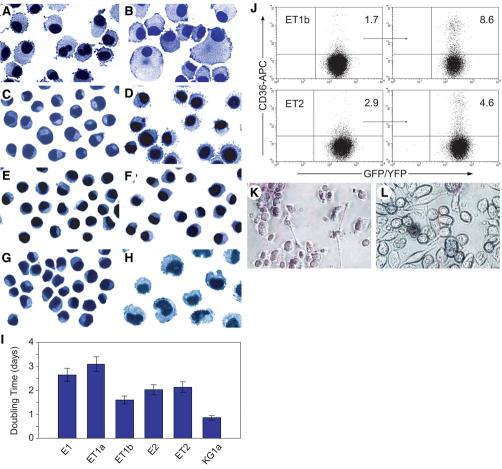
Figure 1.
Figure 1.
Immortalization of CB progenitors by HPV16 E6/E7 with or without hTERT. (A—H): Photomicrographs of cytospin preparations after Wright-Giemsa staining (magnification ×60). (A): Nontransduced CB cells at 4 months. (B): hTERT-transduced CB cells at 3 months. (C): E1 cells. (D): ET1a cells. (E): ET1b cells. (F): E2 cells. (G): ET2 cells. (H): KG1a-GFP myeloid leukemia cells. (I): Cell growth rates. The mean and SD of three experiments are shown. (J): Flow cytometric analysis of CD36 expression on ET1b and ET2 cells maintained in the absence (left panels) or presence (right panels) of erythropoietin-supplemented growth medium. The percentages of CD36+ cells are indicated in the upper right quadrants. (K, L): Monocytic differentiation of CB cells. Photomicrographs of (K) ET1a and (L) E1 cells adhering to fibronectin-coated plates after nitroblue tetrazolium staining. Note that most of the ET1a cells contain formazan, the product formed by the reduction of nitroblue tetrazolium by intracellular superoxide (magnification ×20). Abbreviations: APC, allophycocyanin; CB, cord blood; GFP, green fluorescent protein; HPV16, human papillomavirus type 16; hTERT, human telomerase catalytic subunit; KG1a, KG1a-GFP cells; YFP, yellow fluorescent protein.
Figure 2.
Figure 2.
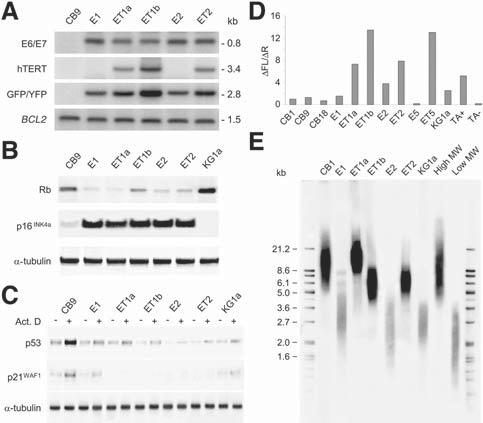
Analysis of CB cell lines expressing HPV16 E6/E7 with or without hTERT. (A): Southern blot analysis of genomic DNA (10 μg) with the indicated probes after digestion with EcoRI plus BglII. The sizes (kb) of unrearranged transgene sequences determined by comparison with HindIII-digested λ phage DNA are indicated on the right. Also shown is the 1.5-kb fragment corresponding to the endogenous BCL2 gene as restriction enzyme digestion and loading control. (B): Western blot analysis for Rb and p16INK4a. Proteins were immunoprecipitated from whole-cell lysates followed by immunoblotting. The blot was stripped and reprobed with anti—α-tubulin to demonstrate that equal amounts of the respective proteins were loaded. (C): Western blot analysis for p53 and p21WAF1/CIP1 in cells treated with (+) or without (-) actinomycin D for 24 hours. The blot was stripped and reprobed with anti—α-tubulin to demonstrate that equal amounts of the respective proteins were loaded. (D): Analysis of telomerase activity by polymerase chain reaction assay. Values represent the relative ratio of the net increase of fluorescein (△FL) and sulforhodamine (△R) emission determined using a fluorescence plate reader. (E): Expression of hTERT stabilizes telomere length. Mean telo-mere length was assessed by Southern blot analysis of HinfI/RsaI-digested genomic DNA with a telomere-specific probe. The positions of size standards (kb) are indicated on the left. Abbreviations: Act. D, actinomycin D; CB, cord blood; CB1, CB9, and CB18, 1-, 9-, and 18-day cultures of primary CD34+ CB cells, respectively; GFP, green fluorescent protein; high MW, high-molecular-weight control DNA; HPV16, human papillomavirus type 16; hTERT, human telomerase catalytic subunit; KG1a, KG1a-GFP cells; low MW, low-molecular-weight control DNA; Rb, retinoblastoma; TA+, telomerase extract positive control; TA-, telomerase extract negative (heat-inactivated) control; YFP, yellow fluorescent protein.
Figure 3.
Figure 3.
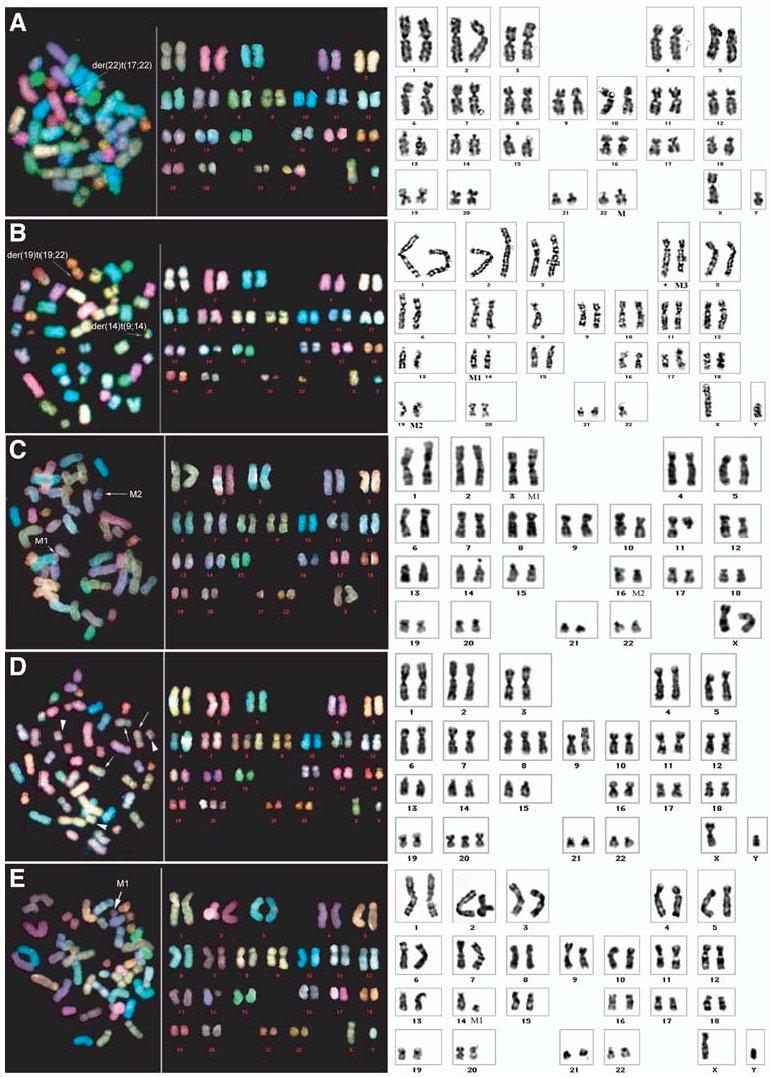
Spectral karyotyping (left panels) and G-banded (right panels) chromosome analysis of cord blood cell lines immortalized by HPV16E6/E7 and hTERT showing limited aneuploidy and rearrangements. (A): ET1a. (B): ET2. (C): ET3. (D): ET4. (E): ET5. Structural and numerical chromosomal abnormalities are indicated by arrows. See Table 2 for a detailed description of the karyotypes. Abbreviations: HPV16, human papillomavirus type 16; hTERT, human telomerase catalytic subunit.

References

    1. Thomson JA, Itskovitz-Eldor J, Shapiro SS, et al. Embryonic stem cell lines derived from human blastocysts. Science. 1998;282:1145–1147. - PubMed
    1. Smogorzewska A, de Lange T. Regulation of telomerase by telomeric proteins. Annu Rev Biochem. 2004;73:177–208. - PubMed
    1. Bodnar AG, Ouellette M, Frolkis M, et al. Extension of life-span by introduction of telomerase into normal human cells. Science. 1998;279:349–352. - PubMed
    1. Simonsen JL, Rosada C, Serakinci N, et al. Telomerase expression extends the proliferative life-span and maintains the osteogenic potential of human bone marrow stromal cells. Nat Biotechnol. 2002;20:592–596. - PubMed
    1. Roy NS, Nakano T, Keyoung HM, et al. Telomerase immortalization of neuronally restricted progenitor cells derived from the human fetal spinal cord. Nat Biotechnol. 2004;22:297–305. - PubMed

Publication types

MeSH terms