


Review
doi: 10.1038/sj.emboj.7600808.
Epub 2005 Sep 8.
Ubiquitylation and cell signaling
Affiliations
- PMID: 16148945
- PMCID: PMC1276169
- DOI: 10.1038/sj.emboj.7600808
Item in Clipboard
Review
Ubiquitylation and cell signaling
EMBO J.
.
Abstract
Ubiquitylation is an emerging mechanism implicated in a variety of nonproteolytic cellular functions. The attachment of a single ubiquitin (Ub) or poly-Ub (lysine 63) chains to proteins control gene transcription, DNA repair and replication, intracellular trafficking and virus budding. In these processes, protein ubiquitylation exhibits inducibility, reversibility and recognition by specialized domains, features similar to protein phosphorylation, which enable Ub to act as a signaling device. Here, we highlight several recent examples on how Ub regulates signaling and how signaling regulates ubiquitylation during physiological and pathological cellular processes.
Figures
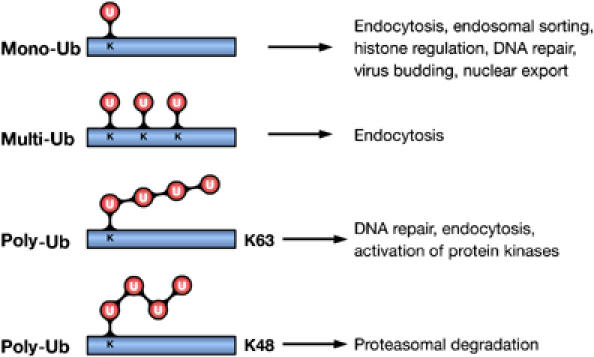
Ub modifications and their cellular functions. Attachment of a single Ub molecule to a single Lys (K) residue leads to protein monoubiquitylation (mono-Ub). Multiple monoubiquitylation (multi-Ub) results from the addition of several single Ub molecules to different Lys residues. These modifications are implicated in various nonproteolytic cellular functions, including endocytosis, endosomal sorting and DNA repair. Polyubiquitylation (poly-Ub) results from the attachment of a chain of Ub molecules to one or more Lys residues. Ub chains formed via Lys48 (K48) of Ub target-modified proteins for proteasomal degradation. Chains linked via Lys63 (K63) are implicated in DNA repair and activation of protein kinases.
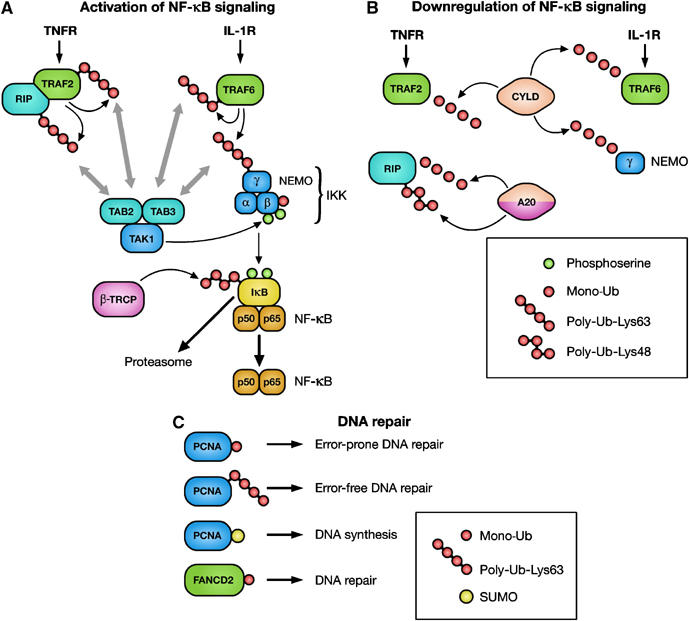
Ub in the regulation of NF-κB signaling and DNA repair. (A) Activation of the Ub ligases TRAF2 and TRAF6 leads to the modification of TRAF2, TRAF6, RIP and NEMO with UbLys63 chains. TAK1 is thought to be recruited to these proteins via TAB2/3, which harbor UBDs. Binding of TAB2/3 to Ub is required for the activation of TAK1, which in turn activates IKK. Serine phosphorylation of IKKβ triggers its monoubiquitylation. Once activated, IKK mediates serine phosphorylation of IκB, which triggers ubiquitylation by the Ub ligase β-TRCP, followed by proteasomal IκB degradation. When NF-κB is released, it translocates to the nucleus and activates transcription. IκB, inhibitor-κB; IKK, IκB kinase; IL-1R, interleukin-1 receptor; NEMO, NF-κB essential modulator; NF-κB, nuclear factor-κB; RIP, receptor-interacting protein; TAB, TAK1-binding protein; TAK1, TGF-β-activated kinase 1; TNFR, tumor necrosis factor receptor; TRAF, TNFR-associated factor; β-TRCP, transducin-repeat-containing protein. (B) Deubiquitylation of TRAF2, TRAF6 and NEMO by the DUB CYLD leads to inhibition of NF-κB activation. Moreover, deubiquitylation of RIP by A20 is followed by A20-mediated Lys48-linked polyubiquitylation of RIP. This modification targets RIP for proteasomal degradation. CYLD, cylindromatosis. (C) During DNA damage, monoubiquitylation and Lys63-linked polyubiquitylation regulates switching between translesion and high-fidelity polymerases, leading to error-prone or error-free DNA repair, respectively. Sumolyation of PCNA is involved in DNA synthesis. Monoubiquitylation of FANCD2 is associated with DNA repair.
References
-
- Adams J, Kauffman M (2004) Development of the proteasome inhibitor Velcade (Bortezomib). Cancer Invest 22: 304–311 - PubMed
-
- Blume-Jensen P, Hunter T (2001) Oncogenic kinase signalling. Nature 411: 355–365 - PubMed
-
- Brummelkamp TR, Nijman SM, Dirac AM, Bernards R (2003) Loss of the cylindromatosis tumour suppressor inhibits apoptosis by activating NF-kappaB. Nature 424: 797–801 - PubMed
Publication types
MeSH terms
Substances
LinkOut - more resources
Full Text Sources
Other Literature Sources
