


The "lipid accumulation product" performs better than the body mass index for recognizing cardiovascular risk: a population-based comparison
- PMID: 16150143
- PMCID: PMC1236917
- DOI: 10.1186/1471-2261-5-26
The "lipid accumulation product" performs better than the body mass index for recognizing cardiovascular risk: a population-based comparison
Erratum in
- BMC Cardiovasc Disord. 2006;6:5
Abstract
Background: Body mass index (BMI, kg/m2) may not be the best marker for estimating the risk of obesity-related disease. Consistent with physiologic observations, an alternative index uses waist circumference (WC) and fasting triglycerides (TG) concentration to describe lipid overaccumulation.
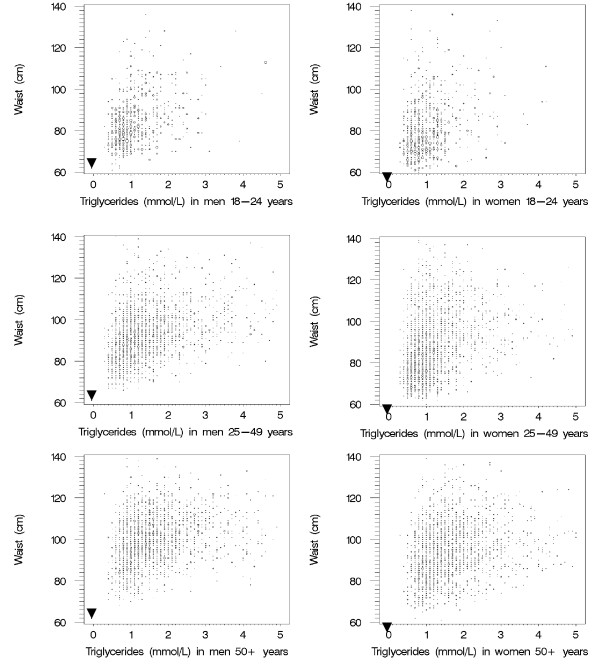
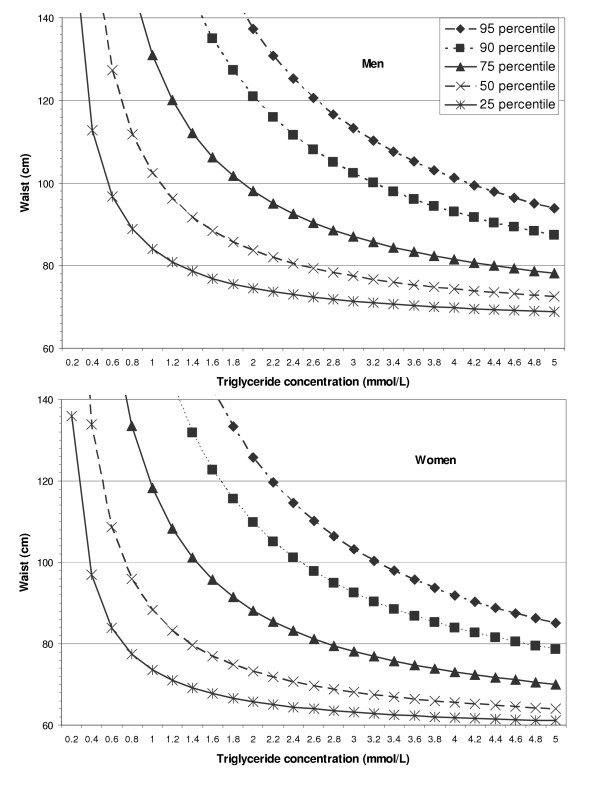
Methods: The WC (estimated population minimum 65 cm for men and 58 cm for women) and TG concentration from the third National Health and Nutrition Examination Survey (N = 9,180, statistically weighted to represent 100.05 million US adults) were used to compute a "lipid accumulation product" [LAP = (WC-65) x TG for men and (WC-58) x TG for women] and to describe the population distribution of LAP. LAP and BMI were compared as categorical variables and as log-transformed continuous variables for their ability to identify adverse levels of 11 cardiovascular risk factors.
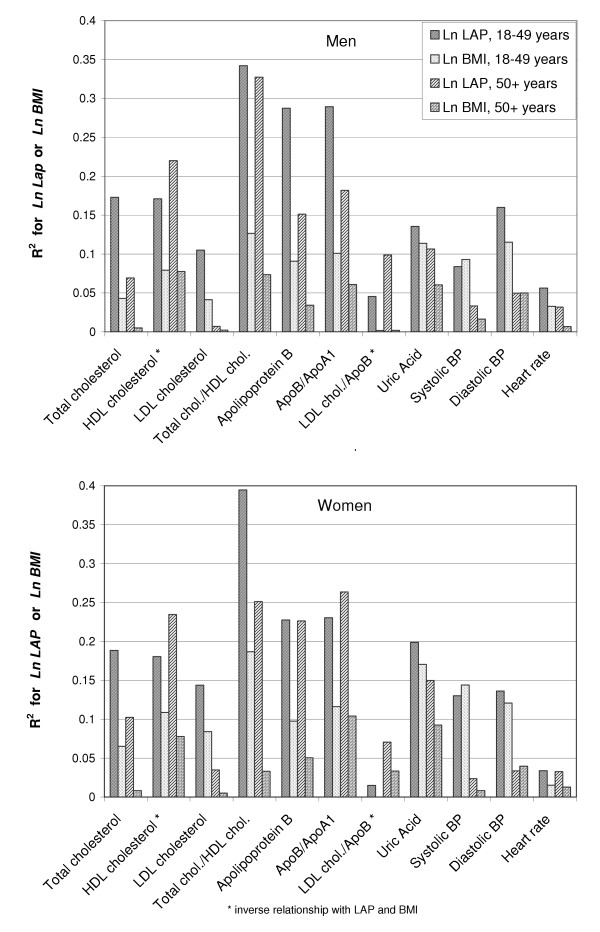
Results: Nearly half of the represented population was discordant for their quartile assignments to LAP and BMI. When 23.54 million with ordinal LAP quartile > BMI quartile were compared with 25.36 million with ordinal BMI quartile > LAP quartile (regression models adjusted for race-ethnicity and sex) the former had more adverse risk levels than the latter (p < 0.002) for seven lipid variables, uric acid concentration, heart rate, systolic and diastolic blood pressure. Further adjustment for age did not materially alter these comparisons except for blood pressures (p > 0.1). As continuous variables, LAP provided a consistently more adverse beta coefficient (slope) than BMI for nine cardiovascular risk variables (p < 0.01), but not for blood pressures (p > 0.2).
Conclusion: LAP (describing lipid overaccumulation) performed better than BMI (describing weight overaccumulation) for identifying US adults at cardiovascular risk. Compared to BMI, LAP might better predict the incidence of cardiovascular disease, but this hypothesis needs prospective testing.
Figures
References
-
- Havel PJ. Update on adipocyte hormones: Regulation of energy balance and carbohydrate/lipid metabolism. Diabetes. 2004;53:S143–S151. - PubMed
-
- Lamarche B. Abdominal obesity and its metabolic complications: implications for the risk of ischaemic heart disease. Coron Artery Dis. 1998;9:473–481. - PubMed
-
- Van Pelt RE, Evans EM, Schechtman KB, Ehsani AA, Kohrt WM. Contributions of total and regional fat mass to risk for cardiovascular disease in older women. Am J Physiol Endocrinol Metab. 2002;282:E1023–E1028. - PubMed
Publication types
MeSH terms
Substances
LinkOut - more resources
Full Text Sources
Research Materials
Miscellaneous
